


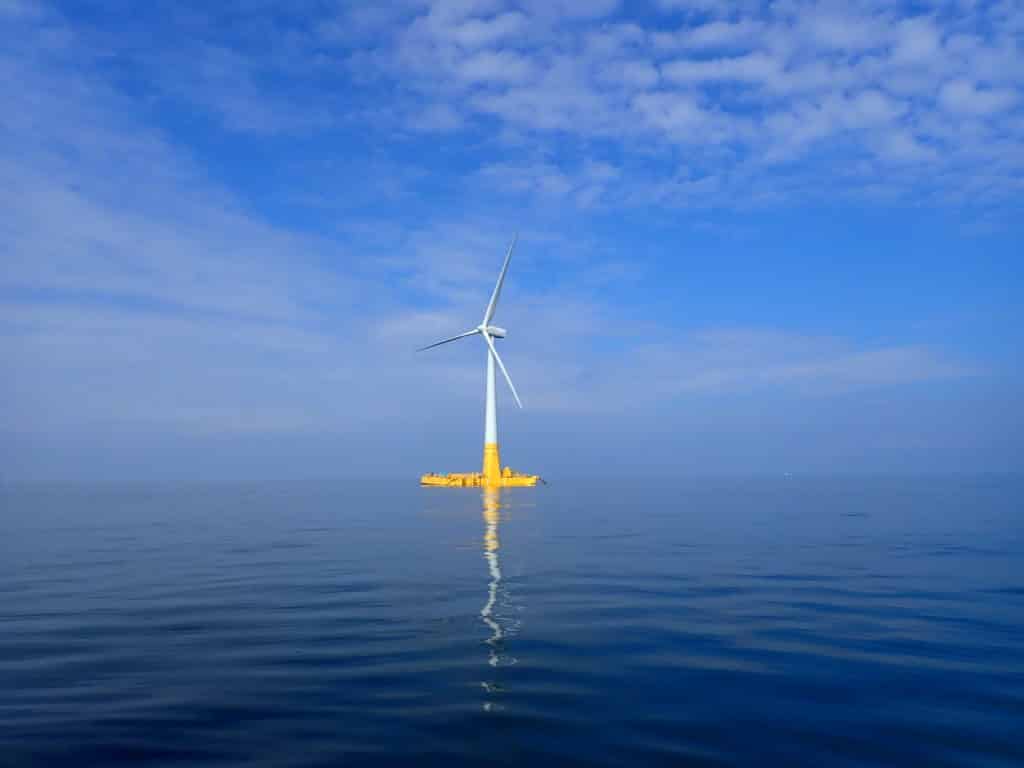
Floating wind turbines show much promise for energy production worldwide: 330,000 TWh per year, or 79% of the total theoretical potential of offshore wind power1. Floating devices are used beyond a depth of 50 metres, the limit at which it becomes too expensive to deploy land-based turbines. The first semi-commercial sites have started production. Part of the Floatgen project, the SEM-REV2 offshore test site, supported by École Centrale de Nantes, is the first to produce electricity in France using an offshore wind turbine. The wind turbine deployed by the company Ideol has been generating over 6 GWh of electricity a year since 2018. Hydrodynamics research engineer Yves Perignon is responsible for the test site.
While many land-based wind farms have been in operation since the 1990s, offshore wind power is only just beginning to emerge. How do you explain this?
Offshore wind turbine technology is indeed less mature. The first prototype was deployed in Norway by the oil company Equinor in 2009. Portugal followed with another prototype from the floater Principle Power in 2011. Further developments then ensued, and there are now around ten prototypes worldwide. Several countries are starting the commercial phase: for example, in Scotland, two wind farms with installed capacities of 30 and 50 MW are in operation. In France, four pilot farms will be built over the next few years.
There are a number of reasons for this delay. Northern European countries – Germany, the United Kingdom, the Netherlands, Denmark, Norway, and Belgium – have been pioneers in wind power. After testing onshore turbines on islands, many of them have invested in offshore wind power. The knowledge gained thus far has allowed them to resolve many issues, such as cost reduction, production capacity, connection to electricity grids, etc. Land-based wind power has shown that offshore wind power could also be of interest for a country’s energy balance. Offshore wind power technology, which is less technologically mature, is the next logical step. The projects and developments are being carried out by international consortia, often including players from the offshore oil industry, who already have many of the skills required to develop floating wind power.
What are the technological barriers to the commercialisation of offshore wind?
The main issue concerns the structure – comprising a float and an anchoring system – that supports the wind turbine. A variety of advanced technologies exist, but various obstacles still need to be overcome. For example, regarding their reliability, material fatigue and resistance to extreme conditions during storms must be tested throughout the life of a wind farm. Another challenge is up-scaling from the prototype stage to a wind farm, which will also involve replacing deteriorated anchor lines.
Other challenges involve the electrical connection: manufacturers are working to improve the strength and reliability of connecting cables. What is more, today, individual wind farms are connected to each other in a series, which means that several wind turbines have to be shut down in the event of a failure. Alternative solutions could help limit downtime.
Does scaling up pose other challenges?
Yes, and more generally, it means that we need to think about the upkeep of these farms, which are located far out at sea. The obstacle is not only technical, but also economic: these farms will require more underwater inspection around cables, anchors or the float. Maintenance must be made more routine and adaptable to cope with this. Optimising the means of inspection, for example, may have important economic implications. Finally, port infrastructures, and the suitability of the construction or storage areas for floats and other components, will be crucial.
Manufacturers are now capable of building floating wind turbines, but the challenge is to scale up to low-cost, low-carbon power generation.
Why is the economic equation a problem? How might it be solved?
To date, only one tender has been launched in France for the creation of a floating wind farm – in Southern Brittany by 2029. The costs of floating wind power are 1.5 to 4 times higher than those of land-based wind power3. This can be explained by the fact the offshore sector is not as mature. Prospective studies4 show, however, that the cost of floating wind technology will decrease and align with market price in less than 15 years.
The economic model of floating wind energy is based on innovative technical and operational choices, but also on a better exploitation of turbine capability. As with land-based wind energy, increasing the unit power of wind turbines will improve the yield of wind farms.
Why develop offshore wind turbines?
Floating wind power represents a very important source of energy production that land-based wind power cannot cover. But it also offers other advantages: floating wind turbines have higher load factors, for example, than those of land-based wind ones, and thus suffer less from intermittent energy production. Deployed further from the coast, floating wind turbines are exposed to stronger winds and therefore have a higher production capacity. The visual impact of these structures is also reduced – because they are built far out at sea. More broadly, we are beginning to better understand the socio-economic and biodiversity impact of offshore installations. We can therefore evaluate the advantages and limitations of floating wind turbines in the context of energy policies and when planning future wind power installations.