Using algorithms to imagine a future world for Uber’s air taxis


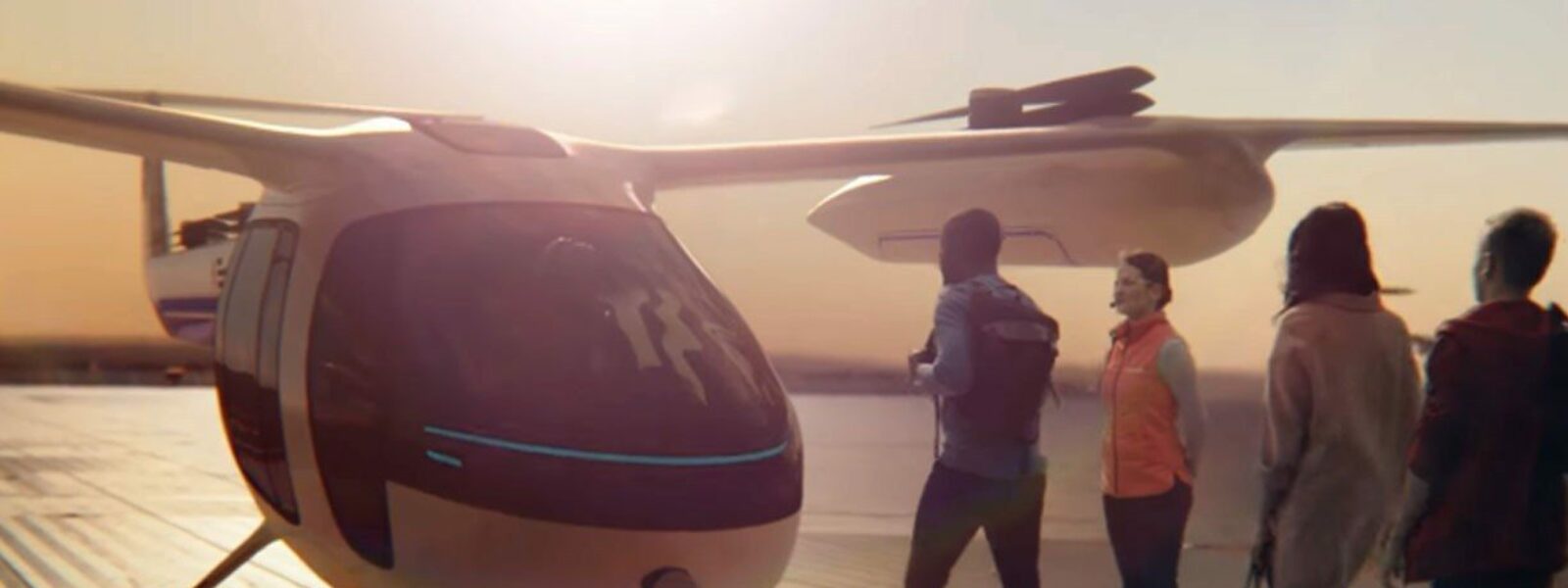
Uber’s fleets of electrical aircraft are set to take to the skies in Dallas, Los Angeles and Melbourne within the next three years. Dubbed UberAir and based on eVTOL (electronic vertical take-off and landing) vehicles, the service promises to see us into the next decade with urban ‘on-demand aviation’ solutions being released by 2023. Instead of taking a long-distance taxi, Uber will be offering passengers transport via bitesize zero-emissions, electronic aircraft. Even though the vehicles themselves are set to cost 20 times as much as normal cars, Uber says that the eVTOLs will be cheaper for commuters over the long-term. What’s more, they are set to provide an effective way for commuters to share journeys.
Whilst there may be reason to believe that the idea is a far-fetched pipe dream, in reality the technology is just around the corner. Some of the challenges still to overcome include finding batteries that are both powerful and lightweight enough, pilot training and obtaining the necessary certification and authorisations. But these are technological and reglementary barriers Uber hope to iron out soon enough. A big question, though, is how to anticipate the infrastructure requirements and develop urban air traffic management tools to support such a system. For that, Uber teamed up with Institut Polytechnique de Paris in 2019 to create an international academic research chair on “Integrated urban mobility”, which I hold. Our aim is to anticipate the needs of the urban infrastructures around eVTOL, helping Uber to better understand how the system can fit into urban landscapes.
Tomorrow’s needs imagined
In downtown Los Angeles, for example, there are already at least 40 pre-existing helipads. However, most are privately controlled. Could they offer a solution? If so, what are the power requirements? In my research we design algorithms that could help Uber scout out the different options, so that the company can make concerted, strategic decisions. This is what operations research algorithms do: help people make ‘optimal decisions’.
To provide an analogy, think about the example of Google Maps; the software uses an algorithm to calculate the fastest route between two points whilst taking into account real-time information like traffic or roadworks. The decision problem the program solves is referred to as ‘shortest path’. Put simply, it breaks the journey down into smaller segments and calculates the quickest route per segment by asking “which is fastest?”. In my work as the research chair, I design similar algorithms based on the different possible scenarios that will be accounted for. A fleet of eVTOL aircraft will bring with it a whole new set of constraints that we have never seen before. The world is likely to look different in 2023!
While there are reasons to believe that the project is a pipe dream, its realisation is actually much closer than one might think.
Future choices anticipated
Such algorithms provide a way of studying effects of decisions made in this future world. What factors should be taken into account? What components will need to be installed? What will the energy requirements be for eVTOLs are electric and how will infrastructures need to be adapted to supply it?
In the early stages, eVTOLs will be pilot driven and monitored via control towers. But eventually the goal is to make them driverless. In my research, I seek to understand how the airborne vehicles will be able to respond to unexpected events. If an emergency vehicle needs to take flight, the trajectory of the eVTOLs will have to be altered rapidly as a consequence.
We also need to be supple enough to change in response to shifting needs. The pandemic is just one example of a challenge the project will face. If we consider ground transportation, for example, currently UberPool – the service which allows passengers to share vehicles – is not an available option. With the current risk of infection, travellers cannot share taxis. But then again, this will probably change by 2023. What may stay with us though is the change in habits. In Paris, bike users went up by around 60 % after the confinement. We can factor this into our simulations. Changes in lifestyles are an interesting avenue to explore.
Contributors
Claudia D'Ambrosio
Claudia D'Ambrosio works on theoretical and practical problems in operations research. At the Computer Science Laboratory of the École Polytechnique (*LIX: a joint research unit of the CNRS, École Polytechnique - Institut Polytechnique de Paris), she studies mathematical and algorithmic tools for decision making. She is a research director at the CNRS, responsible for the chair with Uber "Integrated urban mobility" and a lecturer at the École polytechnique.