

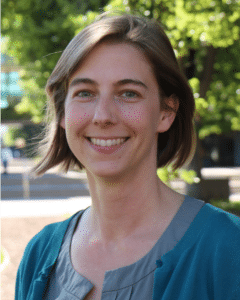
“So much of the value provided to us by nature is taken for granted,” explains Lisa Mandle, lead scientist for the Natural Capital Project at Stanford University. “Our mission is to provide information on where and how nature matters to people – and the economy.”
The Natural Capital Project is an interdisciplinary organisation that has been working on the question of ecosystem services – or ‘nature’s contributions to people’ – for 15 years. Using InVEST, a software they have developed, the team say that they use the best available science to help decision-making. “And the business side is a piece of that,” she explains.
InVEST is an open-source software suite; a tool for exploring different scenarios of land and ocean use and management. “We wanted to make a tool that was easy to use in a variety of contexts,” Lisa Mandle states. InVEST provides a suite of models to compare ecosystem services in different instances. It enables users to map and quantify services such as carbon sequestration, flood protection and water quality, based on commonly available data like topographic maps.
Global impacts on ecosystems
“To date, we have found over 400 peer-reviewed (and other) publications using InVEST. Of them, 82% are authored by people who are not part of the Natural Capital Project, which is a good sign that our software is being widely used.” According to the Natural Capital Project, InVEST can be applied anywhere in the world, and can be especially valuable in contexts with low access to data. And, as such, the team recently ran models on a global scale for the first time. Their results, published in the journal Science1, indicate regions of the world where investment in natural resources would have the biggest impact on local communities, including the Ganges Basin, Eastern China and regions of sub-Saharan Africa.
“Our approach and tools are a way of showing what’s at stake by bringing the value of nature into decision-making and increasing transparency of the consequences of choices made by governments and businesses on people.”

Working with big companies
“In addition to governments, NGOs, and research institutions, we have worked with a number of different companies in the private sector,” she explains. One of those is the multi-national, Unilever, which has made some very ambitious commitments to reducing the impacts of their operations on the environment. They are looking at the impacts of sourcing products from different places2.
There are many ways businesses can make use of the Natural Capital Project’s science and tools. “Some companies like Unilever have people who have been running our models by themselves,” she outlines. In other cases, information is taken up by the business via consultants and researchers. “Even though we didn’t work directly with them, insurance company Swiss Re recently published a report3 based on our modelling, too.”
In 2015, the Natural Capital Project published a study describing a collaboration with Dow chemical4. The analysis was a case study using one of their facilities in the Gulf of Texas, which is susceptible to flooding from coastal storms. They wanted to know whether they should invest in a sea wall to protect it. In this instance, they were faced with the options of (1) building an artificial sea wall or (2) restoring marshlands as a natural protection barrier.
Based on the analyses, it was found that an artificial sea wall would provide a value of $217 million to the company, significantly higher than natural protections. However, upon using InVEST to model different scenarios, the balance shifted. They proposed another solution: a moderate sea wall combined with some restoration efforts. In that configuration they saw added costal protection from natural systems, benefits to locals in terms of recreational activities and carbon sequestration – all of which are considered as ecosystem services – providing a ‘hybrid’ outcome that was worth $229 million to the company.
Moreover, there were added advantages for biodiversity, supporting fisheries and wildlife. Thus, providing an argument for a partial restoration of the land, offering a ‘grey-green’ approach as a compromise that was both economically and environmentally favourable.
Contributing to wider projects
In some cases, the Natural Capital Project is involved in more complex, multi-industry collaborations. One of their projects in Mongolia, led by Natural Capital Project lead scientist Becky Chaplin-Kramer, involves the production of cashmere for luxury fashion house, Kering5.
During a period of less than 10 years, the demand for cashmere had quadrupled, resulting in a drastic increase in goat farming in the Gobi Desert. Over-grazing drove a huge drop in vegetation, with negative impacts on the environment including dust from the desert being easier to whip into clouds that reached as far away as California.
The team were involved in finding a solution. To do so, they helped a local mine by offering them a solution for biodiversity offsetting in the region to restore the vegetation. For that, the Natural Capital Project have been using their ecosystem modelling services in the form of InVEST, combined with NASA satellite imagery to monitor the restoration project.
As such, the team are seeing ways to interact with businesses to make plans, help decision-making and monitor the outcomes. Nevertheless, working with industries in this way requires substantial research efforts and time. “We get more requests than we can handle,” says Lisa Mandle. “There is a lot of demand for this kind of information and the challenge has been providing solutions quickly and comprehensively enough for the people who want to use it. It’s great to see these ideas really taking hold around the world.”