


What are the challenges of military land robotics today?
David Filliat. Whether military or civilian, robotics covers different technical domains. There are sensory technologies or mobility technologies, from a mechanical or artificial intelligence point of view, etc. Impressive progress has been made in recent years: Boston Dynamics’ robots, for example, are very successful in terms of physical mobility and are fully operational. But a lot remains to be done if we consider the constraints of the battlefield or military operations in a broader sense – both in terms of discretion and robustness, we are only at the beginning of this story.
The greatest challenges today relate to autonomous movement. Unknown and complex terrain has little in common with a road where, broadly speaking, there are only pedestrians and cars. In a military context the terrain is more rugged and varied. The need to be able to navigate using GPS coordinates remains the same, but when it comes to the details of planning the route the slightest branch can be an obstacle that must be detected, evaluated, and managed – either by software or mechanically. So, there are additional, higher-level challenges.
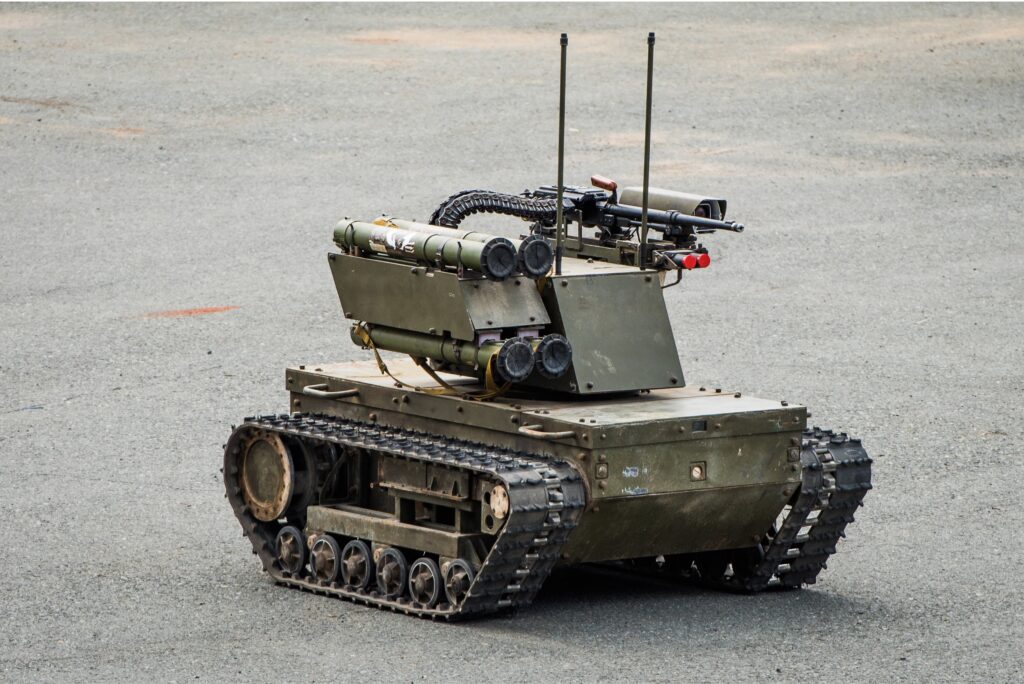
Rather than humanoid (or dog-like) robots, we should imagine wheeled or tracked robots and the robotisation of equipment.
However, designers imagine complete systems, with each method providing solutions to circumvent certain problems. In robotics, for example, aerial systems can be simpler than terrestrial systems. However also brings a form of vulnerability, unless one can fly very high, far from operations control, which involves technical choices. If we consider the on-board capacity, ground vehicles (versus walking or flying) allow us to carry more energy and include more sensors. Each system has its own advantages and disadvantages; at the moment, there is no single ‘best’ solution. We think more in terms of the different applications.
Is full autonomy out of reach today?
On the battlefield, certainly. It is not in the coming years that we will see fully autonomous robots carrying out complex missions. Robots will probably appear alongside humans. Rather than humanoid (or dog-like) robots, we should imagine wheeled or tracked robots and the robotisation of equipment.
For example, we will see driving aids in the form of convoys, as is already being experimented with in the civil sector with convoys of semi-trailers, or in the form of self-driving vehicles that take over from humans on open terrain. This latter could allow the driver to leave controls and rest for an hour.
The main objective in all these technical efforts is to save human lives. But this goes hand in hand with the search for other, different, more efficient ways of acting on the enemy. Robotics also comes into play in a context where new threats are appearing, which are themselves dehumanised, such as swarms of drones. This is therefore a question of protecting oneself, protecting drivers and ground soldiers, by mechanising and automating certain tasks.
Robotics is only a new stage in what is already a long history. During the Second World War, the Germans designed the V1 to limit the loss of pilots, which are rare and highly qualified personnel. Today’s armies reason in the same way with all troops, because in distant conflicts that are not fully legitimate in the eyes of public opinion, a single human life lost has a great impact.
However, we must not pretend that we are not witnessing changes. Fifteen years ago, the applications of robotics were still logistics, observation, and support. Today there is a switch towards to lethality. This effort is due in part to the perception that the threats faced have evolved: in the short term, the perceived danger comes from swarms of small drones. But large countries can develop larger, stealthier drones: the development of autonomous weapons systems is a response to this threat, in an inevitable technological race.
What are the determinants of this technological race?
An essential and new element, for me, is that we are talking about dual technologies, which are not being developed solely for the military. This is very different from what happened in the nuclear or aeronautical sectors, not to mention the many technologies developed within the framework of the American DARPA that were then disseminated to the civilian world (think of the Internet, GPS, etc.). Today, it can even be considered that the civilian world (industrialists, major software players) is a melting pot for technologies that could revolutionise this type of equipment. The military have understood this and are looking for synergies with the civilian world.
The military are looking for synergies with the civilian world.
This is the case when it comes to the ability to analyse surroundings, where algorithms must be capable of processing huge volumes of data. This is where the civilian world may have an advantage as the number of systems deployed that can acquire data is much greater. Autonomous vehicles that car manufacturers and equipment suppliers are currently working on must deal with decision-making, trajectory planning and perception problems, which are all functionalities that are also essential for military use. Even if, as we have seen, the challenges are greater in a military context, and the data more difficult to collect, the same technological building blocks are being developed.