



The installation of 5G in France started in 2020. This fifth generation of mobile technology follows on from the previous generations. Each generation follows the previous one at the same rate of approximately once every ten years and each marks a technological evolution: after voice (2G), text and SMS (3G), and then mobile internet (4G), 5G now makes it possible to offer higher speeds, lower latency and to connect many more objects. Its scope is therefore much wider than just consumer use.
[Videos produced in partnership with Ecole Polytechnique Executive Education].
First and foremost, an industrial tool
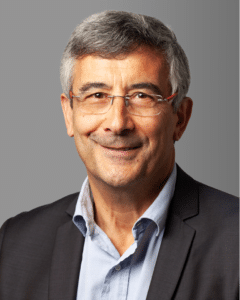
5G will have applications “both in companies and in large public spaces such as stations, airports and stadium. It will make it possible to ensure the simultaneous connection of thousands or even millions of devices,” explains Pierre-Jean Benghozi, CNRS research director and professor at École Polytechnique (IP Paris), a specialist in digital economy. Some people even imagine that it will be possible, for example, to zoom in on the screen of one’s mobile phone from the stands at the Stade de France to see a specific player approaching the goal…
While 5G will help to relieve congestion on the public 4G network (which is close to saturation in densely populated areas), it was not designed for entertainment applications, nor was it designed so that fans of Netflix can download their episode in a thousandth of a second instead of one. “5G primarily meets the digitisation needs of Factory 4.0,” says Pierre-Jean Benghozi. “Most of 5G applications are for industry.”
Presented as the new industrial revolution (after mechanisation, mass production in the 19th Century and automation of production in the 20th Century), Factory 4.0 is characterised by integration of digital technologies at all levels, right down to the manufacturing process, allowing us to think differently about uses. “In this factory, the Internet of Things is a network of networks that allows […] digital entities and physical objects to be identified directly so that the data relating to them can be recovered, stored, transferred and then processed, without any discontinuity between the physical and virtual worlds,” continues Professor Benghozi1. And all this is possible thanks to electronic identification systems and wireless mobile devices, to increasingly interconnected fixed and mobile ultra-high-speed connection methods, and finally to algorithmic and data processing capacities that can be designed in a decentralised manner.
This continuous and instantaneous communication between the various tools and workstations integrated into the manufacturing and supply chains implies investments and a rethinking of organisational modes, but it makes it possible to optimise manufacturing processes as well as service management. In addition, it provides the means to improve flexibility in order to adapt to real-time demand and to better satisfy individual customer needs.
France’s first 5G factory
ArcelorMittal’s “5G Steel” project, launched with the support of the stimulus plan, is a good illustration of the new production methods made possible by 5G. The global steel giant has installed its own private network on its huge site in Dunkirk, on bands made available by ARCEP (Autorité de Régulation des Communications Électroniques et des Postes). Marking its desire to remain European, ArcelorMittal has chosen to work on this network with the operator Orange and the equipment manufacturer Ericsson.
The Dunkirk site can be thought of as a small town with 3,300 employees, which produces 10% of the steel produced by the steel group, i.e. 6–7 million tonnes per year. Here, automatic bridges and gigantic cranes line the production lines, which are about 2 km long and have more than 200 data sensors to monitor production.
“This site is open in some places, closed in others, and has many areas not covered by mobile networks,” explains David Glijer, technical director at ArcelorMittal and responsible for the project’s deployment. “It is absolutely impossible to cover the whole site with fibre. Until now, staff spent a lot of time going back and forth between the production lines and the central office to reload data.” With 5G, the network is available throughout the site. “In addition, we plan to have our large trucks (with the capacity to transport 120 tonnes of steel coils) move around the site (200 km of internal rail tracks and several kilometres of private roads) autonomously, without a driver, because these shipments are complex and sometimes dangerous.”
Eight outdoor antennas have been installed on this site, which is classified as a Seveso site and has strict safety standards. “Safety is one of our obsessions, and we have to operate 24 hours a day: by controlling our own network, we are protected from a technical problem that might occur with an external operator.”
Industrial risk is very high if we do not make the shift to 5G.
The 5G Steel project is already operational, but still experimental. “Here we are really testing 5G in a ‘severe’ industrial environment, because there is a lot of dust on this site, a lot of metal, areas of high heat… We have to check that the metal does not interfere with the antennas and eliminate any uncertainties and risks regarding robustness and safety.”
Other industries are stalling
In Dunkirk, 5G is part of a collaborative, multi-site project and will be deployed in 2023 on the Florange and Mardyck sites. But in France, ArcelorMittal’s network is singularly isolated. In March 2022, Philippe Herbert’s report on the Industrial 5G Mission2 noted several obstacles to the development of industrial uses of this type of network in France, in particular the problem of access to frequencies, the weakness of the ecosystem around industrial 5G and the insufficient availability of suitable equipment and services.
“Until now, in order to access 5G, a manufacturer has had to pay a minimum of €70,000 to obtain the right to transmit over an area of 100 km2,” Philippe Herbert points out in his report. The entry ticket is far too high to test a new technology and the transmission area far too large if it is a matter of equipping an industrial site of a few square kilometres. Other countries have chosen to reserve frequencies for their companies from the outset. This is the case in Germany, where more than 70 universities and companies working in the industrial, transport, health and media sectors have embarked on industrial 5G projects.
“We have to make French and European companies, including SMEs, understand that the industrial risk is very high if we do not make the shift to 5G,” says David Glijer. “Our competitors are in Asia, China, and Korea, where 5G is already working. But it is not enough to have the network, you need the applications. It is therefore essential to attract French and European start-ups working on such applications in our wake. That’s why our network, although private, is accessible to our partners in the Dunkirk Urban Community, which will allow certain companies to benefit from it.”