


[This article is a summary of a note published by La Jaune et La Rouge. To read the original text (in French only), click here].
Road transport – including both roads and thermal vehicles – accounts for approximately 30% of greenhouse gas emissions (GHG) worldwide. Therefore, it is a sector that requires major efforts to achieve carbon neutrality. Although the automobile is in the midst of transition in terms of energy (towards electricity) and use (driverless vehicles), roads themselves will also need to be adapted because a large proportion of the materials used to make them, such as cement and bitumen, are non-renewable and require high energy consumption.
Some countries, including France, are trying to encourage a modal shift towards rail and waterways through public policies, but the share of road transport remains dominant, particularly for goods, and is even continuing to increase. Consequently, over the last ten years or so, governments have changed their policies and sought to decarbonise roads and vehicles, while encouraging the complementarity of modes of transport, each being used where it is efficient and economically viable. As such, the road of the future (or fifth generation1) is being conceived to meet these demands, opening new perspectives for the 21st century.
Electric roads
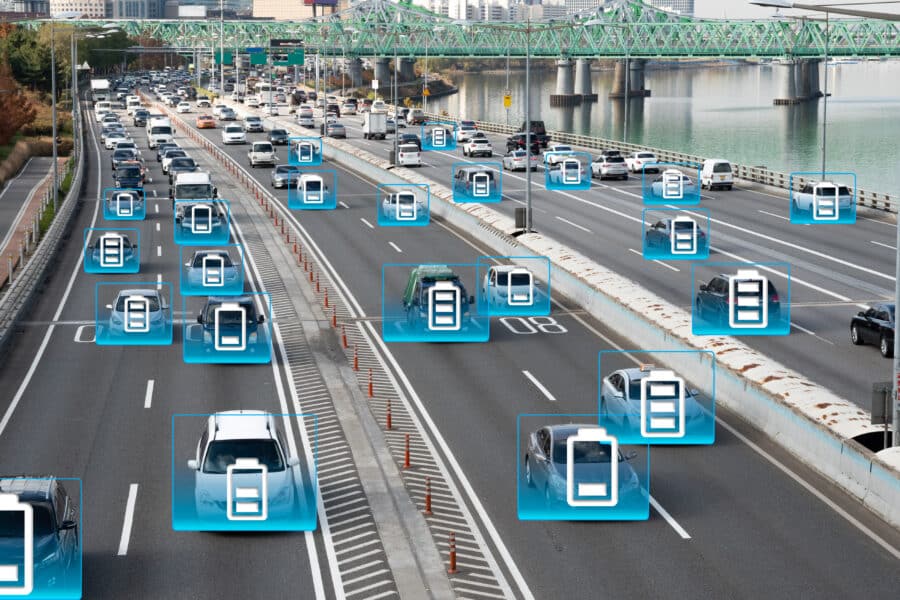
Batteries are reaching their physical and economic limits, especially for heavy vehicles (trucks, coaches), and cannot provide the necessary power needed to travel of several hundred kilometres for the largest vehicles under full load. Or at unacceptable costs, volumes, and masses. Hence, one solution is to power the vehicles while they are running, through the infrastructure. Power supply systems developed for railways (trains, metros, trams) can be adapted to the road. Siemens is proposing a power supply via catenaries and pantographs (double catenary because there is no current return via the ground), Alstom is developing a power supply via the ground with rails electrified in sections (transposition of the Bordeaux tramway system) and Elways is proposing a hollow profiled rail, both of which have pads or a pick-up pin installed under the vehicles. Contactless induction systems already exist for buses and are being developed or tested in Europe and Asia. Sweden and Germany are experimenting with these so-called “electric road systems” (ERS) and a state-of-the-art report was published on the subject in 2018 by the World Road Association2.
ERS would be relevant on high-traffic motorway corridors, especially for heavy goods vehicles, which account for nearly 30% of road transport emissions. It would not only ensure the propulsion of vehicles on the equipped network, but also recharge their batteries to give them sufficient autonomy outside the electrified network. The investment costs of ERS solutions are estimated (before industrialisation) at 2–5M€/km, and for France it is accepted that 3–4,000km of motorways would be eligible for ERS initially, extendable to 8–10,000km, i.e. an investment of 10–15€bn (it would suffice to equip 50% of the length of the slow lanes, given the presence of buffer batteries in the vehicles). With a repayment period of 20–30yr and a concession system, this does not seem out of reach. However, questions of safety, system resilience and the economic model (distribution of costs and benefits) remain to be clarified, but no major obstacles have been identified.
Intelligent, energy-positive roads
Roads consume energy, both for their construction, maintenance, and operation (lighting and signalling) and for the vehicles that use them. But it can also produce energy: its surface, which receives the sun’s rays, could in fact be a source of energy. With conservative assumptions of 25% sunshine (i.e. half the day), 0.5% of the road surface used and 300 W/m² of energy received, the average power received would be of the order of 2.25 GW, i.e. 3.5% of the electrical power installed in France, or a little more than half that consumed by road transport. Of course, the really recoverable part of this energy is probably small, but it could nevertheless contribute to the decarbonisation of the road sector, or even meet limited energy needs in the vicinity of an equipped road.
Solar energy recovery via roads could be thermal, with stored heat, or photovoltaic, with cells inserted in the surface course made transparent to allow incident light to pass. The first solution is successfully marketed in France by Eurovia for the thermal rehabilitation of buildings. The second solution, proposed by Colas (Wattway), can be used to power sensors or contribute to lighting. The two solutions can be combined on the same site. Nevertheless, the yield of these technologies remains limited and the investments quite heavy, especially for the photovoltaic solution.Finally, the road of the 21st Century is no longer a simple strip of bitumen supporting vehicles and equipped with safety and signalling devices. In addition to its physical functions, roads will increasingly be equipped with sensors, information and communication systems, and connected to the vehicles that use it and to the operators who manage it. This so-called ‘intelligent’ road will have to be self-diagnostic, even self-repairing, communicating information with regards to its condition and evolution. Its function will be collaborative, insofar as it will participate in the management or control of traffic, in the energy supply of certain vehicles and in the guidance or monitoring of autonomous vehicles. Furthermore, it will be integrated into a true global system of mobility services. Nevertheless, each solution and the associated business model must be studied to avoid technological myths.