


Fifty years ago, many of the technologies used in the civilian sector came from the defence sector. Today we are witnessing the opposite movement, with the emergence of innovations in defence coming from the civil sector. Why is this so?
There are several reasons for this phenomenon. Firstly, technological cycles in the civilian sector are much faster than the long cycles of armament programmes, which can last from ten to forty years. Secondly, R&D investments in the civilian sector sometimes greatly exceed the defence budgets of most Western nations. For example, Huawei’s R&D budget (€21 billion) exceeds Israel’s military budget by one billion, even though Israel is a major player in terms of defence innovation. But we should also be sure what we mean by innovation here.
The Ministry of the Armed Forces has been investing for a long time in so-called “planned innovation”, in the sense of long-term R&D, which aims to anticipate technological breakthroughs and ensure management of emerging technologies of a strategic nature. But there are also innovations in their use, too. For example, the diversion of technologies from the civilian sector (e.g. drones), not foreseen in the technological roadmaps, can respond to operational challenges and be developed more rapidly by companies targeting civilian markets. The Defence Innovation Agency (DIA), created in 2018, has the ambition, among others, to detect, monitor and capture opportunities from the civilian world.
The arrival of these civilian players in the world of defence (for example Parrot, to take the case of drones) raises new questions. The issue of confidentiality is not the most difficult to manage. The real issues, which we encounter in the context of open innovation with large defence groups, are how to organise the co-innovation process, by correctly regulating the intellectual property rights. Collaboration between start-ups and large groups can sometimes lead to a phenomenon of predation, whether voluntary or not. Yet, contractual solutions do exist.
Furthermore, the DIA, through its open innovation approach, has the mission of detecting and capturing the “right project at the right time”: that is to say, a project that responds to the challenges expressed by the armed forces, capable of reaching levels of maturity not only technological but also market and user. And often the business model of these start-ups cannot be based solely on the defence market, which is both too small and marked by excessively long acquisition cycles.
Do defence SMEs have a strategy to management this duality?
The problem of duality must be observed on several levels of analysis: strategy, projects, and business model. The potential for duality often decreases as technology develops, but also as uses, processes and organisational choices change. The development costs for defensive specifications are usually so large for the scale of a start-up’s resources that it can rarely focus on several markets at the same time, at least in the beginning. The linear model of technology development that has been used as a reference to define duality is somewhat outdated, as we notice today that some (rare) defence start-ups have demonstrated the ability to absorb artificial intelligence developments in the civilian world and adapt them to the defence context.
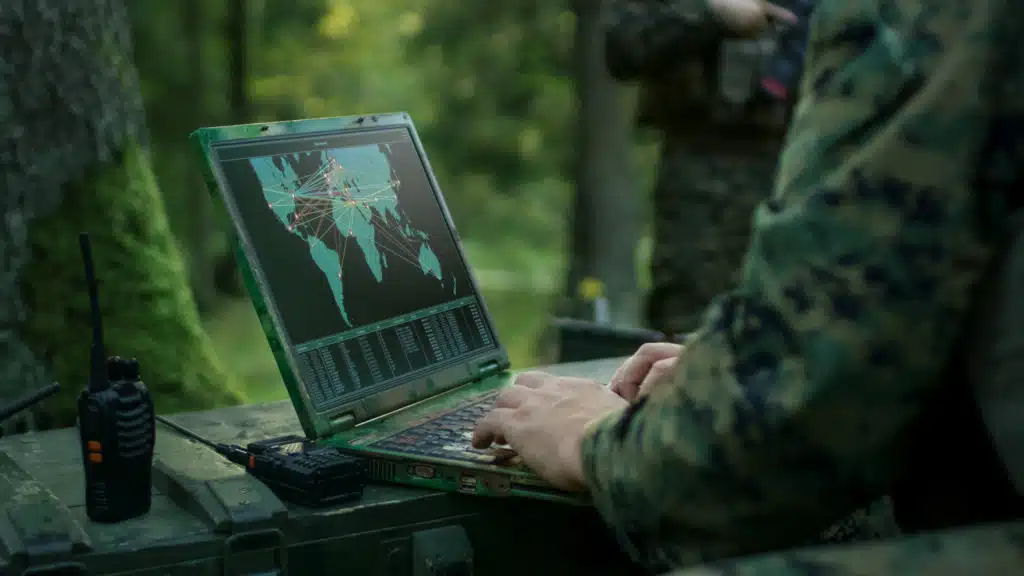
This is the case of Preligens: a start-up which develops software using AI to automatically analyse mass data from multiple sources, notably satellite optical imagery, and alerts intelligence agents when an abnormal situation is detected on a site of strategic interest.
In practice, the duality is very difficult to manage, especially from a strategic point of view and on the question of resource allocation. There are dual technologies, but real dual SMEs are rare (we can nevertheless cite the case of MC2 Technologies, on anti-drone combat).
Can we still speak of a defence ecosystem, or does the civilian component anchor these start-ups in other innovation ecosystems?
Talking about a defence ecosystem contrasts somewhat with a concept that is still very regularly used by the players in the defence market: that of the defence industrial and technological base (DITB), made up of about ten industrial prime contractors (some of which were State services before being privatised) and about 4,000 SMEs.
Open innovation represents less than a quarter of the DIA’s budget. There is no revolution. Nevertheless, open innovation is redefining the roles of players in the defence world and their relationships, especially in cross-cutting areas such as artificial intelligence, where there is no historical player that imposes itself on this vertical.
The major defence groups are increasingly systems integrators: they integrate all the systems and components, a skill that only the very large players possess. But they no longer have full technological control. SMEs are not just subcontractors; they provide complete technological building blocks. Open innovation also encourages the emergence of intermediaries to align players in an innovation situation, for example the DIA’s Innovation Defense Lab, the innovation labs of the Armed Forces such as the Battle Lab Terre, or even capital investors.
An ecosystem is driven by a form of cooperation, but also by the spur of competition. What is the situation in defence?
The shift towards strategies of hyper-competition and intensive innovation has been described for more than thirty years by researchers in management sciences, and the defence sector is no exception. This context of strong competition has had a significant impact, pushing companies to rationalise the organisation of development projects. In the early 2000s, major technological disruptions made the systematic design and standardisation of development processes obsolete.
This is perhaps where the defence market can shed some interesting light. Indeed, faced with the increasing complexity of systems, the conduct of armament operations through major programmes is finding it increasingly difficult to cohabit with exploratory approaches. These exploratory projects, characterised by their uncertainty, must allow learning loops to be carried out and several concurrent developments to be carried out in order to avoid being “killed” by the quality-cost-delay logic of operations. The challenge of the defence innovation ecosystem today is to allow real breakthroughs to emerge from these exploratory projects.
Between large and small players, what about the competition for talent?
The human factor is of course crucial for the armed forces as well as for the actors of the defence world. If the question of manpower is always important, especially in the current geostrategic context, the question of a qualitative rise in profiles is central. Acculturation to new technologies is essential to face the evolution of professions, equipment, and organisations. In the fields of artificial intelligence, cybersecurity, or nanotechnologies, many professions are in permanent tension. Cyber defence is one of the priorities of the armed forces in terms of recruitment. And it is here again that the power of an open ecosystem can be illustrated, as is the case in Bruz near Rennes, where public actors (the Directorate General of Armaments, the ComCyber) and private actors (industrialists and start-ups) work closely together, including to attract talent.