


Virtual realities are a way of extending and improving the real world, and this is also the role of a digital twin. In tangible terms, they provide a frame of reference upon which different disciplines can collaborate on a common project. By combining their knowledge and expertise, they will be able to share, on the basis of the same representation, several possible scenarios.
Nobody expects a digital twin to be perfect. To draw a parallel with the automotive industry, 95% of crash tests on cars on the market are carried out on computers. Thanks to the digital twin of a vehicle, even if it is incomplete, we can test its resistance to a crash, for example – hence, these are models that can be trusted. The human body is obviously more complex than a car, but our objective is similar: we want to improve life expectancy and keep people healthy at a cost that is sustainable for the health care system.
A multidisciplinary project
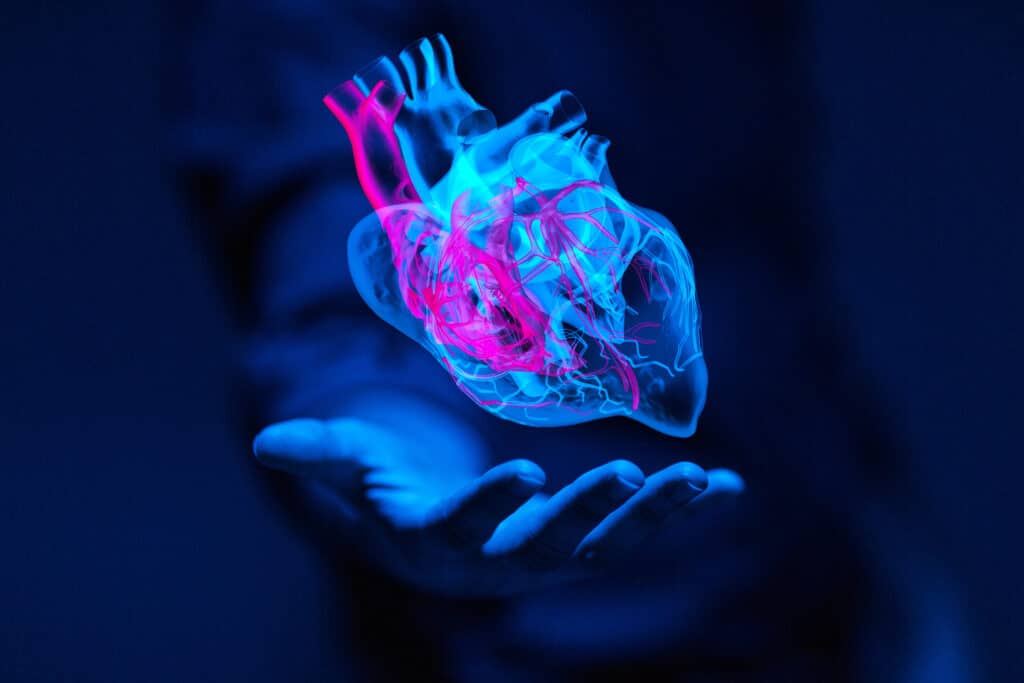
To do this, at Dassault Systèmes we have implemented a real flexibility between the different scales and disciplines that are used by these virtual tools. Our digital twin of the heart is defined as multi-physical. The heart is a pump, and therefore has mechanical behaviour that make it contract when stimulated by an electrical signal. We can digitally replicate this phenomenon and the way the pump is controlled. As such, this twin is also capable of reproducing the geometry of the heart from an imaging system, but also the behaviour of the muscle fibres: this is the first type of physics that we have used.
Although a model is can only make use of the data you put into it, it can still be used to make predictions.
This model heart contracts, circulating the blood. From there, we went on to call upon other types of physics to reproduce other actions like fluid mechanics to best characterise the haemodynamic behaviour. The challenge is to customise this heart model to each individual so that we can, for example, test different ways of treating a patient when he or she has an illness. Based on this configurable model, it is possible to create a precise reproduction of the patient’s heart and its behaviour, both in terms of geometry but also in terms of the electrophysiological ellipse or physics. Although a model is only comprised of the data you put into it, it can nevertheless be used to make predictions.
We are also capable of a multi-scale approach. For the heart, it is possible to change the tool to reproduce cardiotoxic behaviour. Some drugs will be able to enter heart cells and control the opening/closing of ion channels. Here we enter the field of chemistry and molecular biology. We can thus generate arrhythmias of the heart that go as far as torsades de pointe [a specific type of abnormal heart rhythm], which our software is able to reproduce according to the drug dosage. In this instance we are working on a molecular scale, not just in the field of physics.
Different types of digital twin
We therefore need to run several digital twins of the patient to understand their condition, identify their pathology and be able to test different intervention scenarios. While longevity has been increasing in recent years – according to WHO figures – healthy life expectancy has stagnated. To overcome this plateau, this multiplicity will be necessary. For example, an intervention scenario may use a drug or a medical device, or even both. Another digital twin to test the molecule or medical device will then be required. This care will be administered in a particular environment: if it is an operation, it will take place in a hospital, but it may be a remote consultation or a face-to-face consultation in a doctor’s surgery. We will then need a digital twin of the site.
Finally, making a digital twin of the care system will also require testing to understand cashflows and seek the best ways to manage it. It can even be in 2D – a digital twin does not necessarily need to be in 3D! Even if it is the most informative model to illustrate the technology and, in fact, we don’t need to wait until we have a complete digital twin of the human body to see solid results.
A vital tool for doctors
These advances will allow us to move into personalised medicine and find the right treatment for the right patient at the right time. There will also be several secondary benefits. Firstly, the patient will have a better understanding of what is going to happen during the operation. This will enable them to become active in their own healthcare, thus promoting more effective prevention. In addition, this progress would free up doctors’ time. If a digital twin is used to test different configurations that used to be done by hand, this will free up medical staff time without undermining the relationship with the patient. It also promises better collaboration between doctors.
There is already a high demand from doctors for these digital twins.
There is already a high demand from doctors for these digital twins, especially as they complain that they spend too much time on administration and not enough time with patients. But this is only the beginning, and while some are convinced of the merits of this approach, they are still pioneers in this field. The need is all the more pressing now that medical knowledge doubles every 70 days. And these doctors see the advantage of being able to pool their knowledge to train the younger generations or to discuss a complex case with several practitioners.
One example is the Boston Children’s Hospital, where the head of paediatric surgery, Dr Hogan, uses a model of the heart before operating on infants with congenital malformations. This digital twin of the heart helps him to better understand the child’s illness and allows him to visually explain their child’s condition to parents to build confidence.
This is proof that the technology can be used in advanced medical practice, but we are still far from widespread adoption. While the medical world is keen on innovations, it also wants them to be proven. However, these technologies are quite reasonable in terms of cost and time. In two- or three-years’ time, they will have greatly evolved in terms of speed, rendering, results and consumption of technological resources, which will encourage their use throughout the medical profession.