Understanding collective emotions to optimise sports performance



- The social sciences, and more specifically social psychology, are disciplines that should be considered when it comes to optimising sporting performance.
- Emotions are subjective experiences at the root of biological and cognitive processes.
- Understanding them enables us to measure the influence of individual and collective emotions on game situations in team sports.
- Technology offers the tools to measure and obtain valid indicators of emotions.
- Interdisciplinary research is developing these scientific performance support tools, but integrating them into training programmes remains a challenge.
Sport is an emotional arena like no other, capable of mobilising entire populations. To perform, athletes must learn to master the high emotional intensity to which they are subjected. Traditionally viewed from an intra-individual perspective, social psychology overcomes this shortcoming by focusing on the collective dimension of emotional experience. As a result, it is opening up important avenues of innovation when it comes to performance in team sports.
Disciplines where individual and collective emotions collide
Team sports are inherently social. Performance, both individual and collective, is influenced by emotions, which in turn are affected by group phenomena and psychosocial mechanisms. So in a team, emotional contagion and the influence of relationships are both a risk and a potential means of optimising performance.
What happens when a penalty is taken in a football match? Is it exclusively a matter of the player’s emotional experience before taking the shot? A thesis by Guillaume Perreau-Niel from the Psy-DREPI laboratory at the University of Burgundy is currently exploring the emotional state of the athlete at this crucial moment. In particular, he is seeking to understand the factors that influence a player’s emotional state. Initial results show that, in addition to the stakes (both individual and collective), the body language of partners and opponents influences the player’s emotions just before taking the shot.
An emotion is a subjective experience that stems from biological and cognitive processes. The latter depend on how the individual assesses the importance of what is at stake, their ability to cope with it and their degree of responsibility in the situation. This subjective cognitive assessment of the situation (or “appraisal”) explains why the same situation arouses different emotions in different people. In sport, the perception of what is at stake varies enormously. For example, an athlete’s perception changes according to their experience or degree of identification with the team: a senior player in the French national team will experience a match differently from a team-mate selected for the first time.
Social psychology as a means of optimising performance
Alongside these individual feelings, so-called “collective” emotion depends largely on the identity process, because we are all part of different social identities. These may be social categories linked to gender, age, political class, skin colour, etc. They are also task groups, of which sports teams are a prototype. An athlete will activate different identities depending on the context. A female rugby player may wear the hats of sportswoman, mother, wife, team member and so on. The one she activates will influence her vision of the world, and therefore of the situation, generating different emotions. Social identities therefore condition what are known as intergroup emotions, as described by Diane Mackie in the 2000s1. These are the emotions that thrill us when our national team wins a match, or that underpin the mechanics of opposition in derbies.
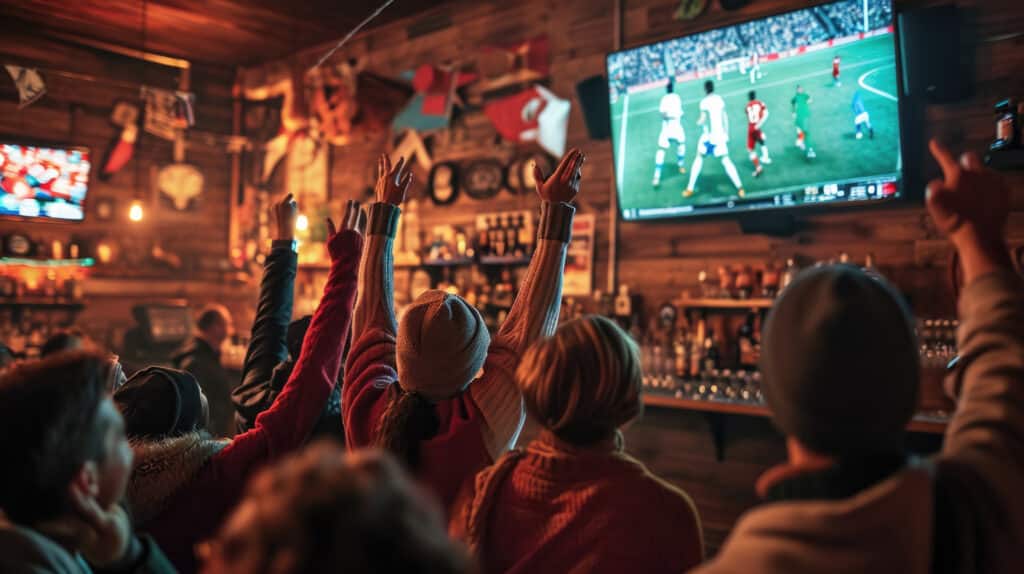
So when players identify with their team, they experience shared and common emotions. This emotional group experience makes the group a psychosocial entity in its own right. This paradigm is far from neutral when it comes to optimising performance. In fact, a 2018 study shows that the player’s perception of this shared emotion has a greater influence on his performance than his own individual emotions2. Top-level athletes therefore need to work not only on their emotional skills – identifying the emotions of others and learning to regulate and express them – but also on a certain “identity intelligence”.
These systems lead us to work on the relationship between emotions and performance in team sports through the mechanisms of emotional contagion. The way in which emotions are expressed can be more or less contaminating. Indeed, studies show that leading players have a considerable influence on group emotion. All it takes is for them to break down to have a psycho-affective impact on the rest of the group.
Integrating technology into training programmes
Social psychology in sport is beginning to study these parameters and how they influence performance. This requires the use of technology to obtain reliable indicators of emotions. Researchers generally use psychophysiological measurements (cardiac activity, electrodermal conductance, electromyograms of facial muscles, etc.). However, these are not adapted for use in sports. As for psychometric tools, such as self-report measurement scales3, they only allow for a posteriori measurement and are sometimes too influenced by the subjectivity of the subject. There is a lack of tools for in situ measurement, particularly of collective emotions. Sport science research is therefore developing new tools. They will exploit body language, for example, using automatic learning algorithms.
This is the case of the TEAM-SPORTS project, funded by the France 2030 initiative through the priority research programme “Very High Performance Sport”, launched with the Paris Olympic Games. The project brings together the French rugby (FFR), basketball (FFBB), handball (FFHB), volleyball (FFVolley) and football (FFF) federations. One of its aims is to develop technologies to capture the emotional states of teams. For example, a video tracking technology using artificial intelligence is being developed by the CEA in collaboration with the Psy-DREPI laboratory. It automatically tracks the individual and collective body language of rugby players during matches.
As part of the same project, the French national team has benefited from another pilot programme to capture the influence of game events – such as scoring a try – on the emotional state of the team. The aim is to study emotional dynamics during matches in order to provide innovative information to coaches and help them make strategic choices. This tool was put to the test in international competition during the World Cup in the summer of 2023 and has recently been adapted for rugby 7s so that the French team can benefit from it during the Paris Games.
Having these metrics at our disposal will help us to measure their effects on individual and collective performance, in a psychological balance of power – which is the very essence of competition in team sport. Ultimately, this research is intended to be transferred to sports teams as a scientific tool to support performance. However, the timing of the research differs from that of sporting competition. Integrating this scientific support into team management is one of the major challenges of high performance. This means reducing the delays inherent in research, so as to stay ahead of other nations through innovation. We also need to systematically prioritise the acceleration of knowledge transfer within sports ecosystems. The future of high performance is inexorably linked to this type of approach, which will integrate sports scientists specialising in human sciences into staff, clubs and federations.