What effect do screens have on our sleep?



- There are a number of preconceived ideas about the relationship between screens and sleep; studies need to be qualified, as they are often carried out in laboratories and not outdoors.
- Experiments show that our exposure to light during the day can, for example, have a major impact on our sensitivity to it in the evening.
- Among the data we have on screens, the problem is not so much the light emitted by electronic devices as their stimulating effects.
- While blue light is denounced, its effects on eye fatigue are thought to be due to a problem of visual accommodation (fixing a point of light in a darker environment).
- A real problem caused by screens is myopia: one study found that between 70% and 90% of city-dwellers under the age of 18 in South-East Asia suffer from it.
We all notice it—our eyes have never spent so much time staring at screens. Whether at work, at home, in public transport, or in waiting rooms, looking at them has become almost instinctive. According to the 2022 Digital Barometer1, 89% of French people over the age of 12 own at least one computer, whether desktop or laptop, personal or professional. That number rises to 92% when considering mobile phones alone.
A growing field of research has emerged to investigate their potential impact on human health, particularly in relation to sleep quality. While it is widely believed that blue light disrupts our biological rhythms and affects sleep, some researchers suggest a more nuanced perspective. Among them is Russell Foster, professor of circadian neuroscience and Director of the Sleep and Circadian Neuroscience Institute at the University of Oxford, who warns against drawing conclusions solely from laboratory studies: “Many recommendations we hear today are largely, if not exclusively, based on laboratory studies. However, studying the impact of light on human behaviour in an artificial environment may lead to misleading conclusions.”
Foster, who has written extensively on sleep and circadian rhythms 2, dedicates much of his work to clarifying what science actually knows about sleep. However, he acknowledges that even if we know that sleep quality is strongly linked to overall health, many aspects remain unclear: “We do not really have a good mechanistic understanding of the connections between poor health and sleep quality.”
Do Screens Disrupt Our Internal Clock?
“One striking example is a study conducted at Harvard a few years ago, explains the professor. This study examined the effects of prolonged exposure to an e‑reader screen (similar to a Kindle) set at its maximum brightness (about 30 lux) for four hours before bedtime, over five consecutive nights. However, before their exposure to the e‑reader, the participants had already spent several hours in a laboratory environment illuminated at around 90 lux. After five days of exposure, participants’ sleep onset was delayed by nine minutes. And that result was just statistically significant.”
Foster draws an additional conclusion from this study: “Melatonin levels rise in anticipation of nightfall, peaking around 4 AM, which has led to the belief that melatonin is a sleep hormone. However, the e‑reader experiment clearly showed both a suppression of melatonin and a marked delay in the circadian rhythm of melatonin. But this did not directly impact upon sleep/wake behaviour. Even though biologically significant changes were observed in melatonin, the behavioural impact was far less pronounced.” Another key point was that the subjects were exposed to dim light, around 90 lux, in the laboratory prior to the e‑reader. A few years later another group repeated the experiments but exposed the participants to around 550 lux for 6.5hr during the day. The effect of this was to completely abolish the effects of e‑reader use both on sleep and melatonin. It seems that “light history” can have a big impact upon how sensitive we are to light in the evening.
This study focused on a specific type of screen. E‑readers are designed to minimize screen brightness and facilitate reading, and most models (except the one used in this experiment) only display grayscale text. This raises broader questions about the spectrum of emitted light and its intensity across different wavelengths.
“What science has determined is the significant link between our exposure to natural light and the regulation of our circadian rhythm,” the professor asserts. “And if specifying that the light source is natural matters, it is primarily a question of intensity. In the evening at home, ambient light is estimated to be around 100 – 300 lux. The brightest artificial light, typically found in offices, reaches approximately 400 lux. By comparison, natural light is far more intense—a cloudy day outdoors provides at least 10,000 lux, while a sunny day can exceed 100,000 lux – even in England! It is estimated that 30 minutes of exposure to 10,000 lux is enough to regulate our internal clock.”
“In contrast to our vision, the circadian system is incredibly insensitive to light, and we still don’t fully understand how light intensity, length of exposure, light history, how old we are and the colour (wavelength) of the light all interact to regulate our circadian rhythms. What we do know is that bright white light or around 10,000 lux for 30minutes seems to be effect for most people.”
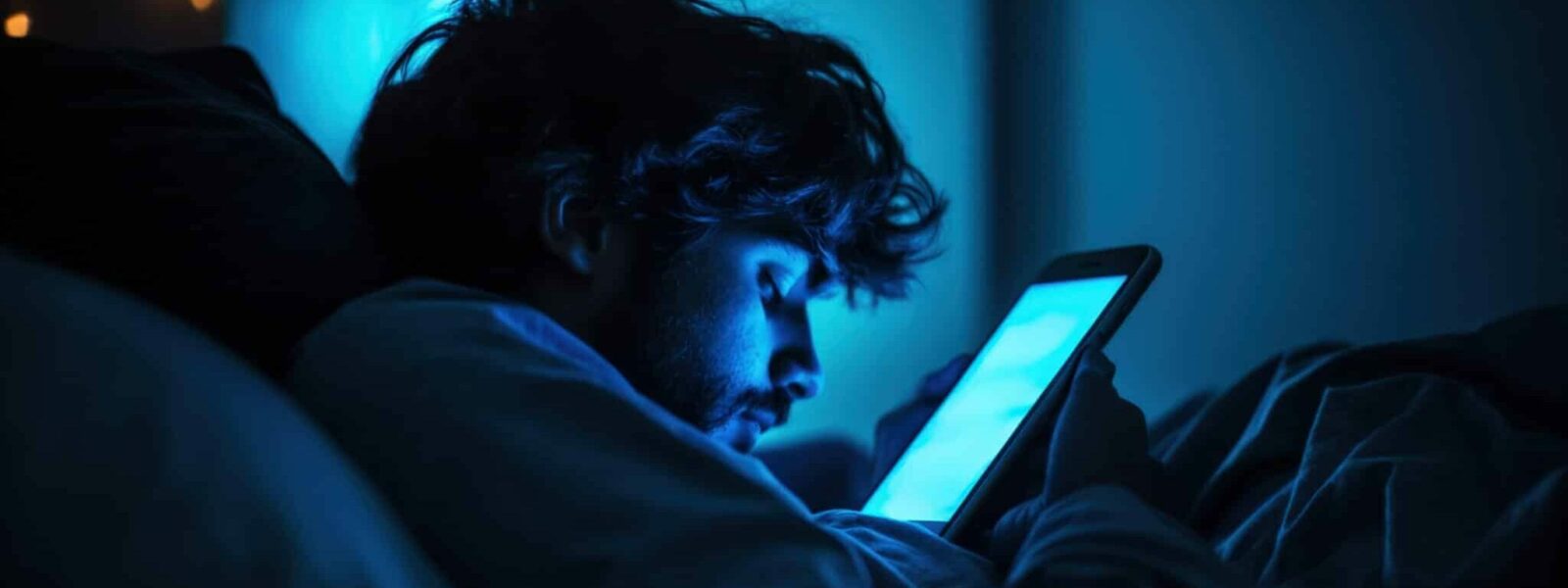
On the basis of the data we have so far, it is not so much the light from electronic devices such as e‑readers, smart phones or computer screens that is the problem but rather the stimulating effects these devices induce. Social media, gaming, watching a film and emails will act to make us more alert and this will delay sleep. The key point is that these mentally engaging activities delay sleep, with little impact from the emitted light.
The Blue Light Problem
“The wavelength of light has also been widely debated. In one study3, we demonstrated that novel photoreceptors in the eye, different from the visual photoreceptors, the rods and cones, and called photosensitive retinal ganglion cells (pRGCs) are most sensitive to 480-nanometer wavelengths, in the blue portion of the spectrum,” explains Russel Foster. “But this finding applies only to an isolated response from these cells—observed in laboratory mice that lacked rods and cones. If those were present, the spectral responses were different.” At the time of their discovery, researchers tended to distinguish between visual and non-visual responses to light. Cones and rods were believed to be responsible for visual responses, while pRGCs were thought to regulate non-visual processes. “The truth is that they communicate with each other,” clarifies the professor. “What we concluded is that rods likely contribute to the dim light sensitivity of the internal clock, cones probably integrate flickering stimuli, and photosensitive retinal ganglion cells essentially function as brightness detectors. However, how exactly they interact remains unclear, and this is an active area of study.”
Although the rods, cones, and pRGCs interact, studying these interactions is complicated and some of the published studies have got it wrong. If you want to compare the effect of different wavelengths of light you need to deliver the same number of photons at different wavelengths. Blue light has more energy than red light, and in many cases, researchers have compared the same energy levels and not the same number of photons. As a result, there would be fewer photons of high energy blue light compared to low energy red light, altering the apparent sensitivity of the response. These studies have further confused the picture of what is going on.
Interestingly, there are programmes that shift the colour of screens from “blue-enriched” during the day to “red enriched” during the evening. These were developed to prevent screens delaying the sleep/wake cycle in the evening. However, there are no data that show this actually works. Of course, screen-induced eye fatigue is a real issue, and while blue light is often blamed, its impact is primarily due to its higher perceived intensity. Screen brightness ranges from 30 to 300 lux, which is very little compared to sunlight. So why doesn’t the sun cause the same eye strain? The answer seems to be that screen usage requires constant visual accommodation—our eyes must adjust to a bright focal point against a significantly darker surrounding environment. This contrast is what leads to eye strain.
And that brings us to a more concerning issue associated with lack of natural light: Myopia. “Foster mentioned a 2019 study4 which showed an alarming trend: between 70 to 90% of young urban people under 18 in Southeast Asia are affected by myopia. It seems that these individuals are spending very little time outside in bright natural sunlight, and too much time inside looking at their computers. Bright sunlight seems to stop the eye elongating during development. A elongated eye causes an image to be formed in front of the retina which then has to be corrected by glasses. The light from screens is simply not bright enough to prevent eye elongation. So young people need to spend time outside for healthy eye development.”