

There are few experiences more unifying than sleep. Scientists have never found a human who does not sleep. And for that matter, no one has ever, deliberately or accidentally, made a mouse model that can eschew sleep entirely. Sleep puts animals in an intensely vulnerable state — while sleeping they could be attacked, injured, or eaten — but evolution has not done away with it, suggesting it is essential to survival. Still, despite intense academic scrutiny, researchers are still asking themselves: what does sleep actually do?
#1 Our brains get cleaned during sleep.
TRUE – Sleep helps the brain to rid itself of toxins.
There is no clear consensus about why we need to sleep, but one influential hypothesis, supported by a paper published in Science in 2013, is that sleep helps the brain flush out its toxins.
The lymph system cleans organs like the heart and liver, but researchers have never found an equivalent process in the brain. In 2013, the University of Rochester’s Maiken Nedergaard and colleagues proposed the existence of the glymphatic system, a process by which cerebrospinal fluid (CSF) pulses into the brain to wash out harmful toxins. Notably, they found this process increased during non-REM sleep.
This hypothesis was based on a sophisticated experimental setup. A fluorescent dye injected in the cisterna magna of a mouse, an area outside of the brain where CSF is found, allowed them to track the dye molecules as they entered the brain. Their observations suggested that CSF flowed like a river in a convective flow driven by the pulsations of the arteries. This important work became a citation classic. But it was never really challenged, in part because the experimental approach was difficult.
FALSE – The brain doesn’t clean itself as effectively at night as it does during the day.
Our recent experimental study, published in Nature Neuroscience1 suggests that the brain isn’t cleaning itself as effectively at night as it is during the day. Like Nedergaard and colleagues, we injected a dye into a mouse’s brain. But this time, the fluorescent molecule (AF488 (~570 Da)) was delivered to the middle of the brain, the caudate-putamen, and tracked as it spread through the brain.
By comparing our observations to a mathematical model established by paper co-author Prof. Nick Franks, we found that the dye moved towards the frontal cortex at a rate that is consistent with simple diffusion. Importantly, we saw no evidence of a convective flow in the brain, and this did not change with the mouse’s vigilance state (we studied mice that were awake, sleeping, or anaesthetized with 200 μg per kg of dexmedetomidine, a molecule that induces an artificial non-REM-like sleep).
Does this mean the Nedergaard paper was wrong? We think their observations were correct, but we disagree with their interpretation. There are black box mechanisms that clear metabolites from the brain—we don’t know how they work, but we know they are there. Our observations suggest these clearance mechanisms work more intensely during the day, suggesting that the brain is actually cleaning itself less during sleep and anaesthesia. That would explain why Nedergaard saw brighter waves of dye in the sleeping mice — the brain wasn’t flushing the dye out.
To some extent, this is logical. During waking hours, the brain is working harder, so it wouldn’t make sense for clearance to be delayed till sleep. But that means you can’t explain sleep with brain cleaning.
INTERESTING – Other mechanisms could be at play during sleep.
There’s good evidence, for instance, that acute sleep deprivation elevates amyloid and tau, proteins linked with Alzheimer’s disease and dementia. Poor sleep may mean less clearance of these bigger proteins or more plaque buildup. We have to investigate.
#2 We know our brains keep track of sleep.
TRUE – The brain tracks how long you’ve been awake and how much sleep you need to recover.
This process, called sleep homeostasis, is quite well documented. Mice are usually constantly napping, but if you put a new object in their enclosure, like a colourful Lego brick, they will be so interested that they will postpone sleep until, like us, they crash. They’ll then enter a longer, deeper, recovery sleep.
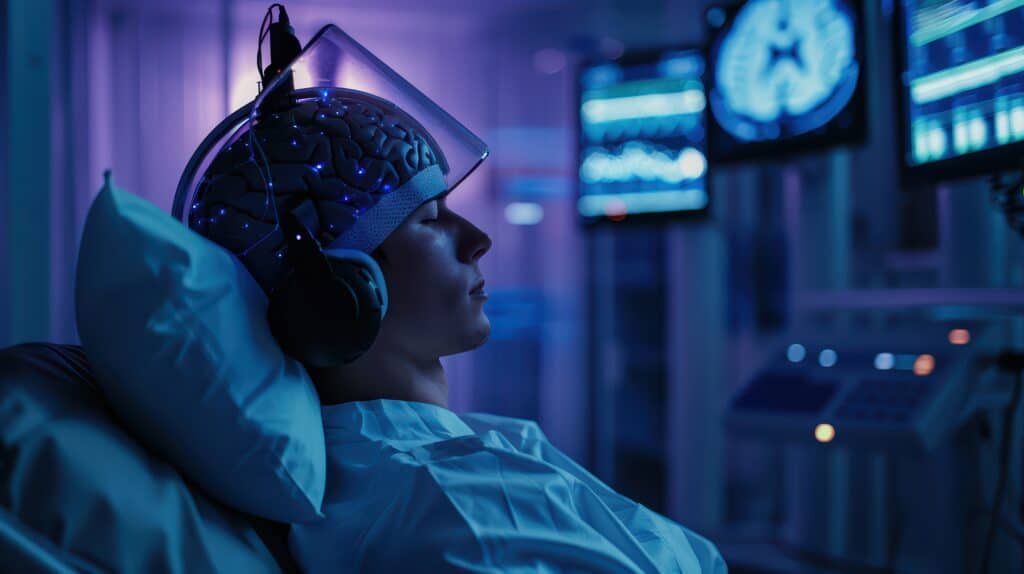
We know how this is happening to some extent. This activates certain neurons in the base of the brain and in the cortex, which help track that deficit. We showed2 that eliminating those neurons means the mice no longer catch up on the sleep lost after deprivation.
FALSE – We still don’t know exactly how this works.
But of course, it’s not that simple. The neurons are not acting on their own. We’re dealing with a soup of organic molecules that interact with sleep deprivation.
One such molecule is interleukin 6 (IL‑6), an inflammatory protein and a known somnogen. You’ll feel its effect if you’ve been doing a long walk or a whole day or cycling — large muscles release IL‑6 during sustained exercise. When it reaches the brain, it induces sleep. We know, for instance, that IL‑6 increases in response to sleep loss3.
Another such molecule is the famous adenosine, which is left over after the energy molecule adenosine triphosphate is used up. Researchers have found that adenosine accumulates during the day and builds up sleep pressure4. Levels also increase in some brain regions after sleep deprivation, so it may partially track sleep need. Still, it’s likely that other molecules are playing into this mix. We don’t have a unified picture
INTERESTING – The role of circuits that track sleep requirements.
The hope is that by understanding the circuits that track sleep needs, we can work out what it replenishes and, by extension, what it does for the body. One of the most interesting questions is whether sleep is for the brain, the body, or both. My personal hypothesis is that sleep may help protect the heart, but that’s far from a consensus view.
#3 Drugs can help us get over tiredness.
TRUE – Some seem to induce a biomimetic state of deep sleep.
There’s interesting research going on in the sleep field about a class of drugs called alpha‑2 adrenergic agonists. One of these, dexmedetomidine, is now being used in the US — and increasingly in Europe — to induce a state of arousable sedation for patients in intensive care services.
Most general anaesthetics, like propofol or isoflurane, stop neurons from talking to each other all over the brain, to induce a state, general anesthesia, that does not resemble sleep. But dexmedetomidine, seems to induce a biomimetic state of deep sleep.
Intriguingly, recent work5 in humans found that sleep-deprived volunteers treated with dexmedetomidine can partially replace their lost sleep. This is consistent with other results — scientists in St. Louis and Boston have shown6 that the brainwaves of volunteers on dexmedetomidine with resemble non-REM sleep. Our work has also shown7 that dexmedetomidine interacts with the neurons involved in this sleep homeostasis system.
FALSE – Some sleeping pills can put you to sleep, but it’s not clear how restorative that sleep is.
Ambien (Zolpidem) for instance is a very good sleep drug that induces a non-REM-like sleep and reduces the time it takes to get to sleep. But it’s not clear whether sleeping with Ambien can restore you.
INTERESTING – Dexmedetomidine can not be used as a home medication.
The drug binds receptors found in the heart and on blood vessels, so an important complication is that the heart rate shoots down, and you get very cold. It can only be used under the surveillance of an anesthesiologist.
However, our work and that of others, suggests we could tweak the drug to develop a better sleeping pill in the future. This could also help us better understand what mechanisms play into restorative sleep.