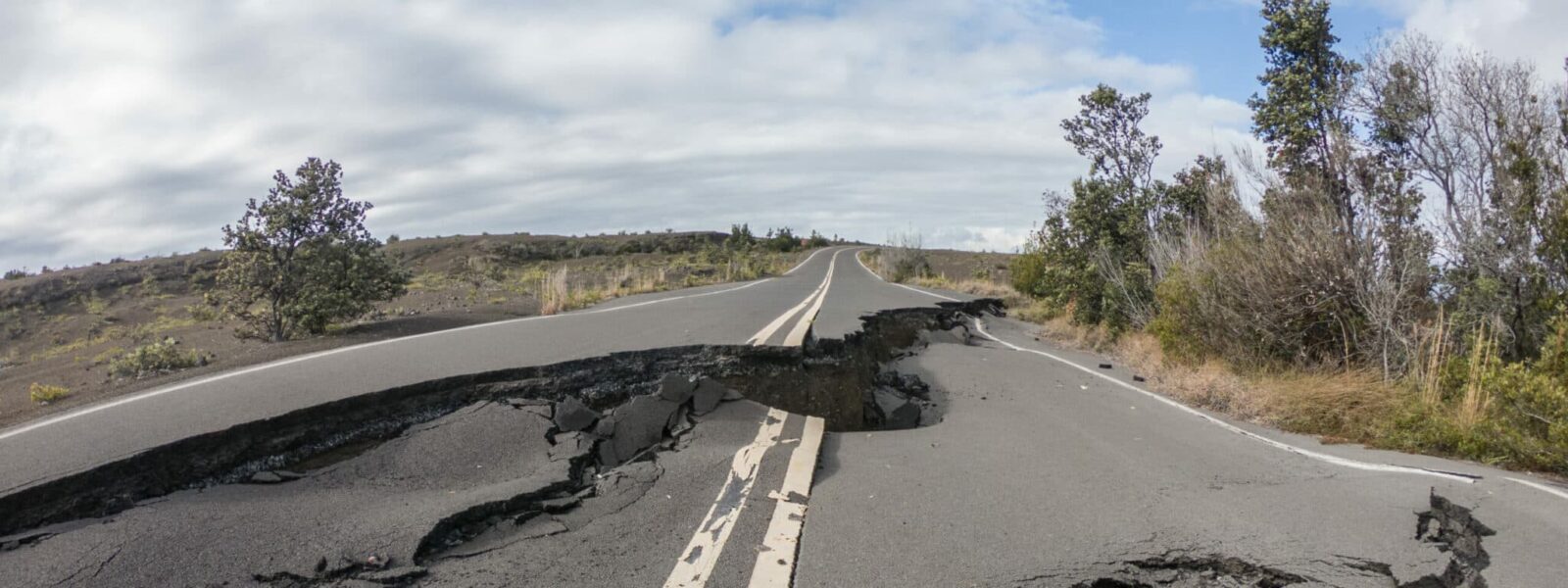
Earthquakes: a force of nature that can be tamed?



Earthquakes are natural catastrophes that happen due to a sudden rupture in the geological layers of the Earth’s crust. Each year, there is at least one earthquake, which produces a magnitude over 8 [Richter scale, the energy level] somewhere in the world, and a further 130 of a magnitude between 6 and 7. On average, every minute there are two “mini” earthquakes of a magnitude of 2 or more.
Seismic events like these happen due to movement of the tectonic plates; these outer layers of our planet gradually move, sometimes pushing against one another. Even though this movement is relatively slow, the increasing force of the plates pushing against one another results in a huge amount of energy being stored where they meet. Energy that progressively builds up over the course of months or years.
Eventually the force becomes too great, and the two plates skid past one another releasing an immense burst of energy. That generates seismic waves, the force of can be felt in the shaking we experience during an earthquake, resulting in heavy damage to buildings, bridges and lifelines (e.g. water, gas). As such, subsequent damage can be colossal. The large 2011 Tohoku earthquake in Japan, for example, cost the World bank ~$235bn.
Artificial earthquakes
Natural earthquakes aside, today there are a number of man-made earthquakes, too. Occurring due to various human activities, these seismic events take the form of weak shaking generated by transport systems such as heavy trucks, or industrial facilities using turbines. Whilst these weak shakes tend not to be too troublesome, there are other stronger artificial quakes. Strong shaking, for example, can be felt in neighbourhoods that surround geothermal plants (such as those in Strasbourg or Basel), mining operations or areas where hydraulic fracturing is performed. Such effects are called “anthropic seismicity” since they are due to human activities.
Taking the example of hydraulic fracturing. It is a process which is used to obtain oil and gas trapped inside solid bedrock, by pumping pressurised liquid underground. The result is a series of cracks being created underground, releasing the hydrocarbons from pockets that would otherwise have remain trapped for millennia. As such, this technique can induce significant shaking or even activate pre-existing natural fault lines between the geological layers. Even though hydraulic fracturing is an important method of extracting oil, industrial activities are often delayed or even forbidden because of the risks of quakes.
Lubricating fluids could be injected into the bedrock so that the geological structures ‘slide’ smoothly over each other.
Controlling artificial quakes
Since the annoyances or damages due to artificial quakes can prove to be significant, it is mandatory to balance the risk with the economic issues. Hence, several avenues are under study to find an appropriate method of prevention. To reduce artificial quakes, research has shown that it may be possible to inject lubricanting fluids into the bedrock so that the geological structures gently “slide” against one another; releasing the energy in a gradual rather than brutal way.
The CoQuake project, funded by the European commission, aims at controlling artificial quakes in such a way1. As such, ongoing research is being conducted in the framework of this project between Ecole Centrale de Nantes (Prof. Stefanou) and Institut Polytechnique de Paris (POEMS, Dr Chaillat, and IMSIA Labs at ENSTA Paris). They combine lab experiments, complex mechanical and seismological models as well as advanced simulation methods.
We have a PhD student (L. Bagur) who is studying the complex mechanical processes that occur in man-made quakes using computer models. Using a software known as COFFEE2, the team can model the effectiveness of controlling quakes by injecting different fluids, all the while taking into account the extremely complex 3D layout of the geological layers. The challenge is to understand the different sliding effects of fluid pressures – similar to what happens with windscreen wipers slipping or squeaking depending on how much rain there is!
Of course, beyond the scientific interest in the topic, there are huge economic and environmental benefits if we are able to reduce seismic problems associated with hydraulic fracturing.
Ultimate dream: control natural quakes
For natural quakes, we already know the crucial role of fluids in the triggering of fault slips. It has been extensively studied in the Corinth gulf – one of the most seismic areas in Europe. We could thus imagine being able to adjust the fluid pressure at strategic positions to control stability of fault lines.
This possibility remains a very complex problem on such a large scale. So, the idea is exciting but it will probably need huge facilities to reach an efficient process. Such ideas are linked to on-going research conducted in the USA by Prof Avouac at Caltech3. He studied the so-called slip deficit along active fault lines in order to predict the triggering of large quakes. The idea is to quantify the number of earthquakes that should have occurred over a given period of time in order to assess the probability of a large earthquake occurring in the future in relation to the build-up of forces in the tectonic plates.
In fact, the energy storage process around large faults may be slow. It may take decades, so no news may often be bad news in the case of earthquakes. But, one day, we may eventually be able to master and control large earthquakes!
Contributors
Jean-François Semblat
Jean-François Semblat’s research focuses on the propagation of seismic waves in geological layers during major earthquakes. Using numerical simulation methods, he studies their amplification, attenuation, liquefaction, and dynamic soil-structure interaction. He is a member of the scientific council of the French association for earthquake engineering, a professor at ENSTA-Paris, and the head of the Mechanics and Energy department at the Institut Polytechnique in Paris.