


Since when have drones been used on a massive scale?
It was the United States, in the early 2000s, that started using drones to eliminate terrorist targets in the tribal areas of Pakistan and Afghanistan. At the time, they were big machines. They looked like fighter jets, flew high and could not be operated by civilians or terrorists. But those days are gone for good.
These days, drones aren’t just for the armed forces. Who else can use them?
Yes, they are now being used more and more for civilian applications, which is very interesting. For example, farmers can use small, inexpensive drones (costing from €600) to spread fertiliser equally over fields. The problem? These are the same drones that will be bought by drug traffickers or terrorist groups, diverted from their intended use. Mexican cartels, for example, buy agricultural drones and replace weedkiller sprayers with the same weight of grenades weighing around 10–20 kg. These days, it’s almost as easy to make your own drone kit as it is to assemble a piece of Ikea furniture! You can also adapt it to your particular needs, with a battery that lasts longer or shorter, a camera of varying resolution, and a variable control distance. In short, there’s something for every purpose and every price…
Are drones more or less suited to certain conflicts?
They are now used in all conflicts, but they are particularly useful in certain configurations. In the war against Hamas, the Israelis can use them to get inside tunnels. If they were only to send men to these locations, the loss of life would be much higher.
Is it very difficult to defend against a drone attack, and if so, why?
Yes. The problem with drones is that they are very easy and inexpensive. Also, it’s very complicated, if not impossible in some configurations, to defend against them. For “simple” attacks involving a limited number of drones, there are, of course, systems for detecting the intrusion of a drone into a protected area (airport, stadium, etc.), then jamming its navigation system, or destroying the aircraft. However, certain so-called “swarm” attacks, which involve sending several dozen – or even several hundred – drones in multiple directions, are virtually unstoppable. Beyond thirty drones, it becomes complicated to defend oneself.
Are you working on improving defence?
Yes, I’m in charge of the scientific committee of the first European federation of security drones, DRONES4SEC, launched in 2021.We are working on anti-drone modelling. For example, in a swarm attack configuration, we are trying to calculate how many drones need to be launched at the same time, at what speed, along what trajectories and to neutralise as many hostile vectors as possible. A technological platform will be developed for this purpose.
In addition, at European level, we are working with PARROT (Europe’s leading drone manufacturer) on a ‘trusted drone’ label, which would guarantee drone buyers that their flight data and personal data will not be exfiltrated each time they use a drone. Some drone manufacturers, particularly Chinese ones, have major problems with respect for personal data. In fact, the main Chinese drone manufacturer, the world leader in the sector, is now banned from selling to security forces in North America for this very reason.
Superpowers are no longer the only ones making drones?
Turkey, India, Iran, and Israel are all very active in the production of civilian and military drones. While nuclear weapons are still reserved for a very select club of major powers, drones are on the way to becoming “the poor man’s weapon”. Fixed-wing drones carrying 2–3 kg of explosives are used as kamikaze drones against all kinds of high-value targets: armoured vehicles, tanks, artillery, supply trucks, radar, and communications systems. These prowling munitions represent a minor revolution in the “art of war”. With very low production costs and almost infinite multiplication possibilities, these munitions can be used to destroy highly tactical targets on the enemy’s side, which are often very costly. The destruction ratio (i.e. the cost of the prowling munition versus the cost of the target) clearly favours the attacker and forces the attacked to deploy sophisticated and costly means of protection.
Is there a huge variety of drones?
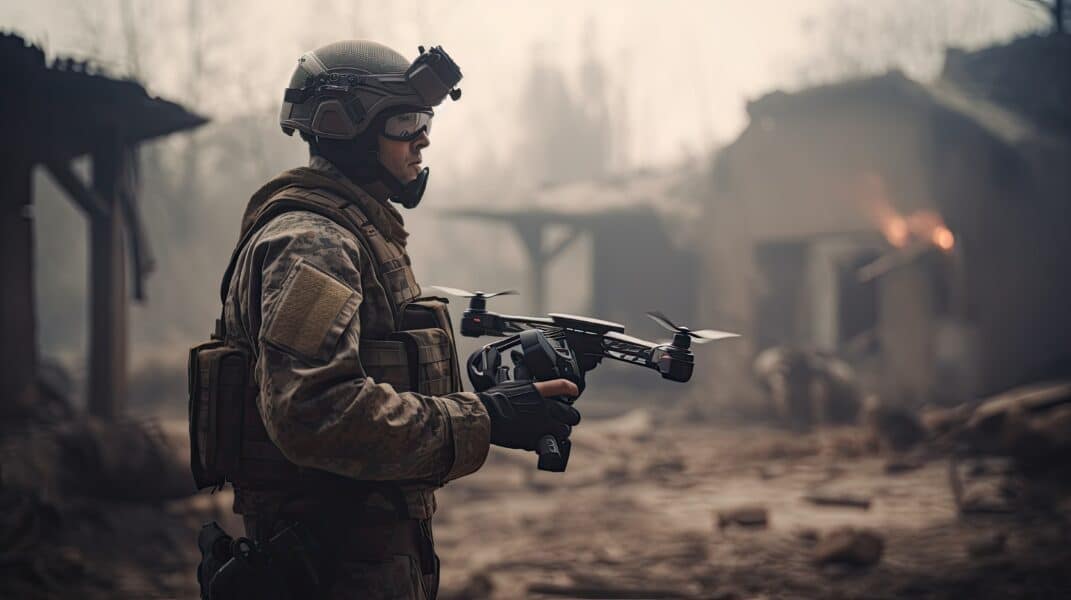
Yes. An aerial drone dedicated to intelligence can remain in the air for 24 hours, without a pilot on board, while carrying out its data-gathering mission. Others are designed for combat or artillery guidance. Quadcopter micro-UAVs (with four propellers) are used by the Russian and Ukrainian armies to “clear” a trench by dropping grenades vertically on the targeted fighters, with centimetre accuracy. These drones are often commercial industrial drones transformed into grenade launchers, using a rudimentary charge-carrying system.
Some can operate in fully automatic mode, carrying out a mission on a target on their own and returning. Other machines must always be under the control of a remote pilot, from a greater or lesser distance. Above all, there are drones for every environment: the air, but also land, sea, and even underwater robots! The Turks recently demonstrated three drone launches on the surface of the water, painted blue so they couldn’t be spotted. They managed to cut the hull of a cargo ship in half at sea! It was only a test, but it gives you an idea of the power of these machines…
What’s the smallest drone?
The “Black Hornet” is a micro reconnaissance drone that looks like a helicopter, but measures just 10 cm and weighs 30 g. The Americans sell it for €40,000 but the Chinese have just put an inspired version on the market for 130 dollars! For this price, it weighs just 20g more than the original, is barely any bigger, and offers almost the same performance… The fall in the price of civilian drones and robots will lead to their widespread use in all areas of activity.
What about civil uses?
There are more and more of them. During the last earthquake in Morocco, drones were sent inside buildings that were still standing to spot cracks and identify which could be saved and which could not. After the storms in France, some roofers used drones to spot missing tiles on roofs and intervene directly where necessary.