
Origami and kirigami in the service of science



- Origami, the art of folding, and kirigami, the art of cutting, have techniques for making things that can be useful in certain scientific fields.
- Examples of these techniques can be found in nature, such as the leaf of a tree or the wings of an insect.
- These techniques can be used to make an object more flexible or to change its structure.
- In this way, objects lose strength but are more easily adapted to different environments.
- The question remains as to how to control the deformation of the flexible object so that it is fully effective.
Have you ever tried to make an A4 sheet of paper stand up? Flexible as it is, no matter how hard you try, it will keep collapsing in on itself. But if you fold the same sheet lengthwise, it gains a new property: more rigid, this time it stands on the table! However, the material of the sheet does not change, only a different aspect of its structure has been added. How can this change in properties be explained?
This phenomenon can be observed in nature, in various forms – such as the leaf of a tree, which has a specific folding for its unfolding out of the bud and which reinforces, at the same time, its structure. Origami, the art of folding, and kirigami, the art of cutting, work in a similar way. Sophie Ramananarivo, a researcher at the Hydrodynamics Laboratory (LadHyX*1), is currently working on these arts and their contribution to science.
From life to robotics
One of the main advantages of origami and kirigami is it’s the flexibility they bring to the modified object. What is more, this flexibility becomes controllable. A flexible object can, through this characteristic, acquire new properties. “One of my previous projects consisted of observing and understanding the usefulness of the flexibility of the wings of certain insects,” explains Sophie Ramananarivo. “In fact, this characteristic was a passive way of limiting the effort of flapping these wings for better performance2.” Another study looked at the folds that made up the wings of certain insects3. Instead of having muscles that would allow a stronger flapping action, the folds structuring their wings give a greater amplitude to the flapping action, while facilitating their deployment. “It would be interesting to observe the role of these folds in flight performance,” admits the researcher. “This is something I would like to study in the future.”
In this phenomenon, it is not the material of the wing that gives it this property, but the folds that it is composed of. This structure can be reproduced on a sheet of paper, using origami. “Origami and kirigami are used as metamaterials,” she explains. “The properties of the object do not come from its material, but from the structure we give it.”
These techniques soon became of interest to the field of ‘soft robotics’45. “Previously, in robotics, we tended to favour rigid components,” explains the researcher, “so that each of the robot’s parts that had to move in relation to each other was robust. But there is a real benefit in making components that are more flexible: this field of research makes it possible.” Like an octopus tentacle, which is much more flexible than the arm of a traditional robot and has greater freedom of movement. However, the disadvantage of a weak tentacle, which prevents it from carrying heavy loads, must be taken into account.
A low-cost object
The techniques specific to these Japanese arts are subjects of research in full expansion, “especially as it is a ‘low-cost’ way of making materials with very impressive properties”, insists Sophie Ramananarivo. The aim is therefore to make an object that can fulfil a function ‘passively’. A good example of this type of passive function is a valve that can open according to the intensity of the water flow it encounters.
This valve is designed using origami folding techniques. These folds give the valve more flexibility: if the flow of water reaches a certain speed – itself set according to our requirements – it will open to allow the flow to take place without the need to operate it remotely. The process is therefore passive. “Being able to perform a function passively, with a flexible object, limits the processes that would have to be put in place if the function in question were active,” says the researcher. There is no need to install an operator to measure the flow rate and finally activate the valve at the right moment.
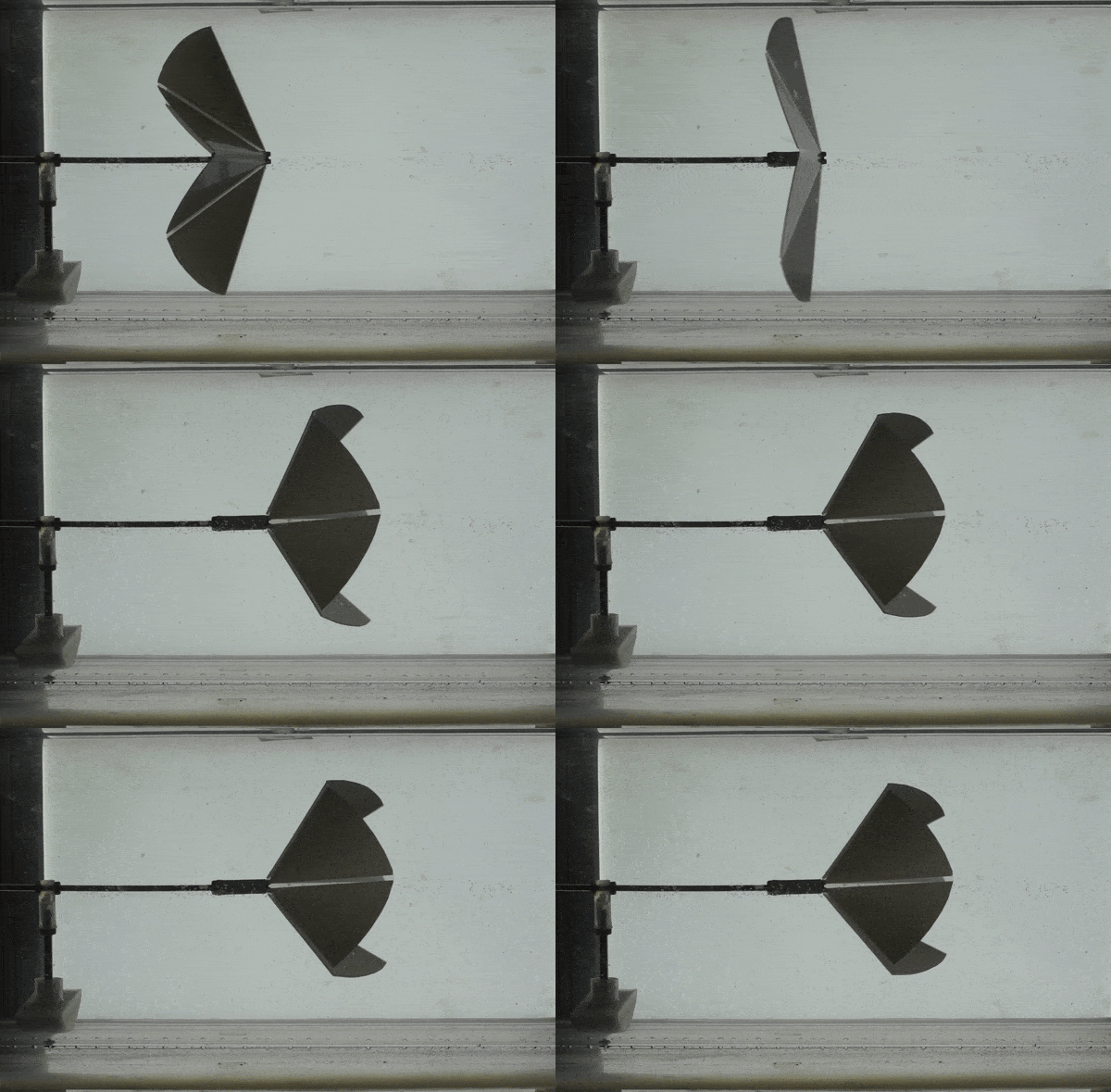
A significant advantage is that a flexible object tends to adapt easily to its environment, whether it is stable or subject to changing conditions. “It’s like the fable of the Oak and the Reed, the latter being flexible enough to cope with the wind,” she says. “This phenomenon can also be observed with seaweed, which can follow the sea current without being uprooted. But to design such an object, you need to be able to control how it will deform. Origami and kirigami allow you to do just that: control the deformation in a fairly complex way,” concludes Sophie Ramananarivo. “That is why this technique is of such great research interest.”
A myriad of applications
These Japanese arts allow the creation of flexible objects at a lower cost, more resistant depending on the conditions of use, and whose passive functioning could almost earn them the qualification of “intelligent objects”. Thanks to all these advantages, origami and kirigami have many applications in many fields.
“These Japanese arts could almost earn flexible objects the title of intelligent objects.”
In fact, this type of technique is already being used in everyday life, for example in a delivery box. It consists of three layers, one of which is made of corrugated cardboard – in the shape of a wavelet. This is an origami technique to absorb shocks during transport. The same goes for crepe bobbins, also made of cardboard, which use the kirigami technique to protect what they surround.
These assets can also enable technological innovations. For example, they allow the solar panels of a satellite7 to unfold and orientate themselves according to the time of day, giving it an ideal position in relation to the sun at all times. Once the control of the object’s deformation was acquired, researchers were also able to make a kind of shield to protect a drone: the rotarigami8.