States and businesses: the race for quantum computers


President Macron recently announced the French National ‘Plan Quantique’, promising a sum of €1.8 billion to quantum research over the next ten years. As a researcher in the field of quantum physics, why is the French government paying so much attention to the field now, specifically?
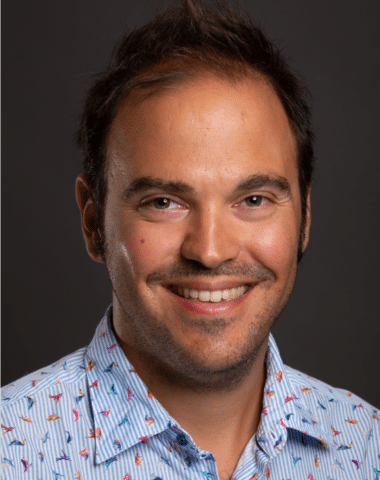
Landry Bretheau. It is happening now because it’s the right time – there are many who say we are entering the second quantum revolution. Bearing in mind that the first quantum revolution happened in the 1920–30s, with the work of now household-named scientists like Einstein or Planck.
Back then it was first a conceptual revolution when we came to understand concepts like ‘wave-particle duality’, ‘black-body radiation’ and ‘light-matter interaction’, which until quantum physics arrived scientists couldn’t explain. Their discoveries gave rise to game-changing technologies that moved engineering into the digital age, like lasers and transistors. The latter allow us to control electronic signals, an important technology for computer processors.
There was, however, an aspect that was confusing to researchers – the concept of quantum entanglement. Without going into too much detail, it was unknown for a long time whether the entanglement they predicted was a natural phenomenon or due to a misunderstanding of quantum physics. We now know that it is natural, thanks to experiments that were performed on individual quantum objects, in particular in the research of Prof. Alain Aspect, a pioneer in the field. He has actually been very instrumental in promoting the second quantum revolution and convincing the government that funding research is a good investment.
What is the significance of such a proposal?
In short, the ‘Plan Quantique’ is on the table because there is a promise of new technologies. Now that the phenomenon of entanglement has been well established, it is possible to imagine future applications using quantum technologies for calculation, communications, sensing and simulation with potential spinoffs in energy, health and security. But the main selling point, so to say, is the quantum computer.
Many people will have heard of quantum computers without knowing what they are, and it must be said that the word ‘computer’ is slightly misleading. It is unlikely that we will see a universal quantum computer in the future that will replace the PC or smartphone, for example. Rather, quantum computers are actually super-calculators, capable of running specific powerful quantum algorithms much faster than an ordinary processor.
The idea is to exploit quantum phenomena such as superposition and entanglement to perform faster computation. A quantum computer manipulates information using a large number of quantum bits, that can be prepared in massively entangled states. This allows one to encode multiple computational results in a single step, in a phenomenon known as quantum parallelism. This can lead to a quantum speed-up for specific algorithms, such as “prime factorisation”, which is the basis for RSA encryption. This encryption method is commonly used for secure data transmission in particular in banking operations. Even though cracking RSA security is extremely difficult with a standard computer, a quantum computer could do it much faster and thus decode encrypted communications.
That is why there is much interest in this technology, particularly in terms of military defence. If some states have that capability, then it could become a military issue. Hence why the US Department of Defense is heavily funding a research program into quantum computing.
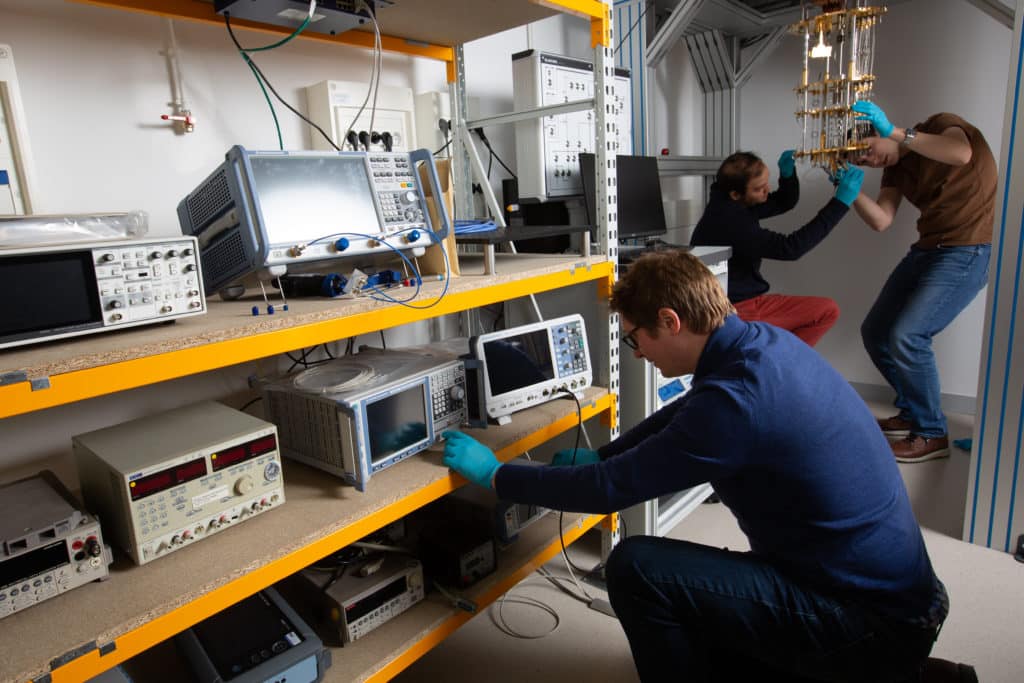
Big tech companies like Google and Facebook are already investing in quantum computers, as are the USA and China. Is there much hope that France will be able to keep up?
Since 2018 the USA announced a $2bn investment in research and China is said to have spent at least $10bn on their National Laboratory for Quantum Information Sciences. In Europe, funding has been going on for some time now too. Germany started their program three years ago and the EU has been funding the Quantum Flagship project since 2018, offering €1bn over the next ten years. So, yes, the ‘Plan Quantique’, which is based on the high-level research already present in France, will help us to keep up –we weren’t the first but we are very well positioned.
The French private sector will also be involved too, though. National and European companies like Total and Airbus have promised to invest. And start-ups are popping up across the country; Quandela, Pasqal and Alice & Bob, to name but three, are spinoffs from French research laboratories. So far, nobody has a fully functioning quantum computer with any meaningful processing power. Google is among the furthest along, with a processor that is limited to 53 quantum bits. This is truly an experimental tour de force but it is still too small at the moment for any useful application.
You might say, “oh well let’s just add more qubits to make the processor more powerful.” But there comes the problem. Quantum states are highly fragile – the more you have, the less stable it becomes. Hence, quantum computers need to be highly confined, i.e. isolated from their environment. This, however, in itself creates a paradox because the more confined it is, the harder it is for us to actually communicate with the computer to control what it does.
What will this mean for French research on quantum physics?
It’s not tomorrow that we will have a quantum computer. But funding like this is a way of opening up our chances and I think it’s a great thing that the money is being put forward. We might not even get a fully operating quantum computer in ten years, but it is certain that we will discover other exciting things along the way. And even when we’ll create one, it is unlikely to be an everyday item. Quantum computers will more likely be strategic tools, enabling specific applications and used for basic research, R&D or government purposes.
Moreover, innovations will not only take place on the hardware level (i.e. the machines themselves). There is also a need for new ideas in terms of software, too. Theoretical research, at the interface between physics, computer science and mathematics, must therefore discover new algorithms for quantum acceleration.
Such funding is very encouraging for young people entering the labour market! It can be helpful in choosing their career and encourage more to become quantum researchers or engineers. That being said, it is worth pointing out that there are already IBM quantum computers accessible via the cloud. Even if their performance remains rather limited, they allow students to familiarise themselves with quantum computing, and to carry out their first experiences!
Interview by James Bowers
Contributors
Landry Bretheau
Landry Bretheau graduated from Ecole polytechnique in 2005 and then completed his Ph.D. at CEA Saclay. Next, he conducted two successive post-docs at ENS (France) and MIT (USA). Since 2017, he has been building-up a new laboratory – QCMX Lab – together with his colleague Jean-Damien Pillet, which explores the physics of Hybrid Quantum Circuits. To develop this new activity, Landry Bretheau was awarded a Young Team Fellowship from l’X, a Young Researcher Grant from the French National Research Agency and an ERC** Starting Grant from the European Research Council. His work has led to major contributions in the fields of Mesoscopic Superconductivity and Quantum Circuits and was awarded the X Thesis Award and the 2020 Nicholas Kurti Science Prize. *PMC: a joint research unit CNRS, École Polytechnique - Institut Polytechnique de Paris. **Under the European Union’s Horizon 2020 research and innovation programme (grant agreement No. 947707).