The DNA computer: super hard drive of the future?



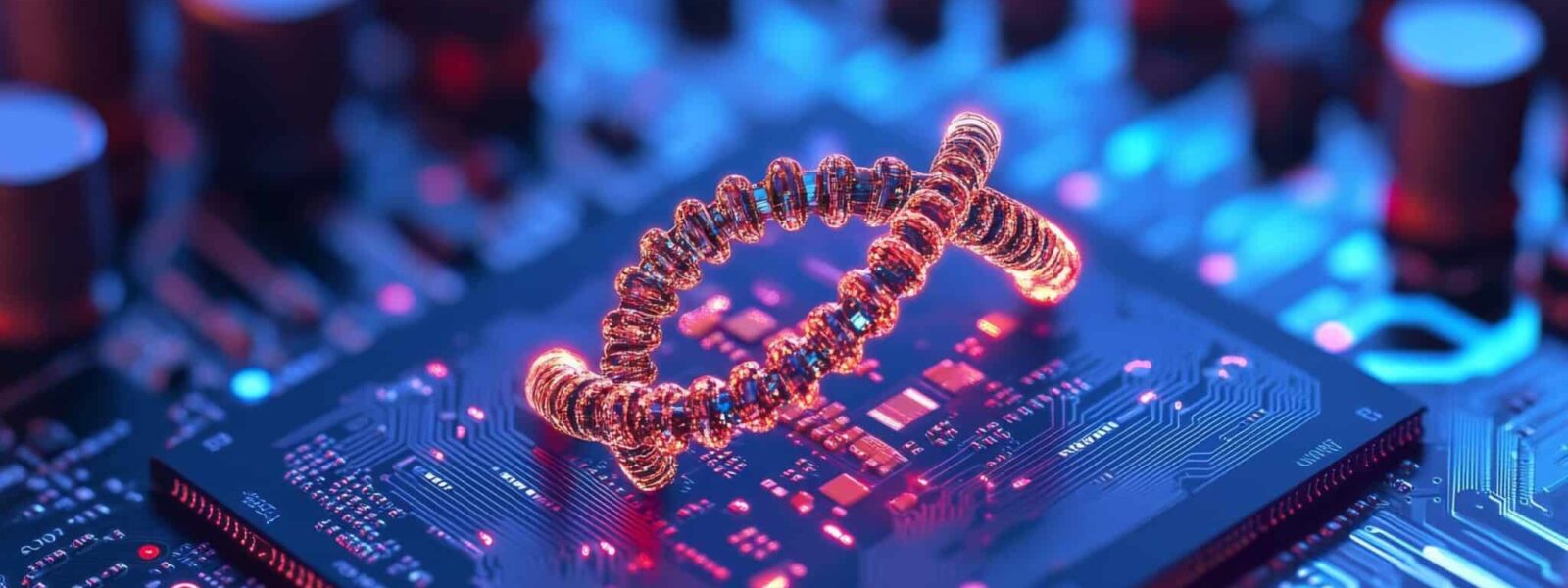
- DNA computers exploit the computational capacities of cells by replacing the binary code (0 and 1) with a four-unit code: ATCG.
- Although DNA is a biodegradable material, DNA computers will not replace silicon chips, not least because of the challenges involved in reading and writing them.
- DNA computers offer more durable and dense information storage, but their potential goes beyond that by using enzymes and cellular machinery.
- Research into DNA computers could shed light on the functioning of living organisms, even if this technology is still not fully developed.
- DNA computing raises major ethical issues, with its potential for transhumanism but also for the likely “invisibility” of its use.
Living computers are the promise of DNA computing. This technology proposes to exploit the computational capabilities of cells, replacing silicon systems with biotechnology. Although the approach is still in its infancy, it is already arousing a mixture of wonder and fear.
TRUE – By replacing the binary code, with its 0s and 1s, with a four-unit code, ATCG, we can create a DNA computer.
There are the four symbols, based on the nucleotide bases, which are the molecules that constitute the DNA alphabet. A for adenine, T for thymine, C for cytosine and G for guanine. So, just as we code in binary (0, 1) by playing on the difference in electrical charge, we can encode information in A, T, C and G. In principle, the concept not particularly complicated to do. The proof: in 2020, Twist Bioscience, an American company specialising in DNA synthesis, Netflix and the Zurich Polytechnic announced that they had encoded the entire German series Biohackers – which centres its plot on the world of synthetic biology – on only a few strands of DNA. A cutting-edge communications coup!
FALSE – DNA computers are just storage systems.
In fact, in terms of storage, DNA computers are much better than electronic systems. DNA stores information for thousands, even millions of years without any energy input. Fossil DNA, for example, has shown us this. So, in that sense, it is a more sustainable solution, with greater information density and biodegradability. But the technology will not stop there. With an enzyme that can edit bases, a DNA sequence and cellular machinery that reads DNA and produces biological molecules, we already have a DNA computer. The real challenge is the architecture of such systems. Lest we forget John von Neumann, the Hungarian-American mathematician who enabled modern computing to emerge by inventing an architecture enabling processors to communicate with random access memory (RAM) when he was a consultant at IBM. This is what DNA computers need today: an architecture.
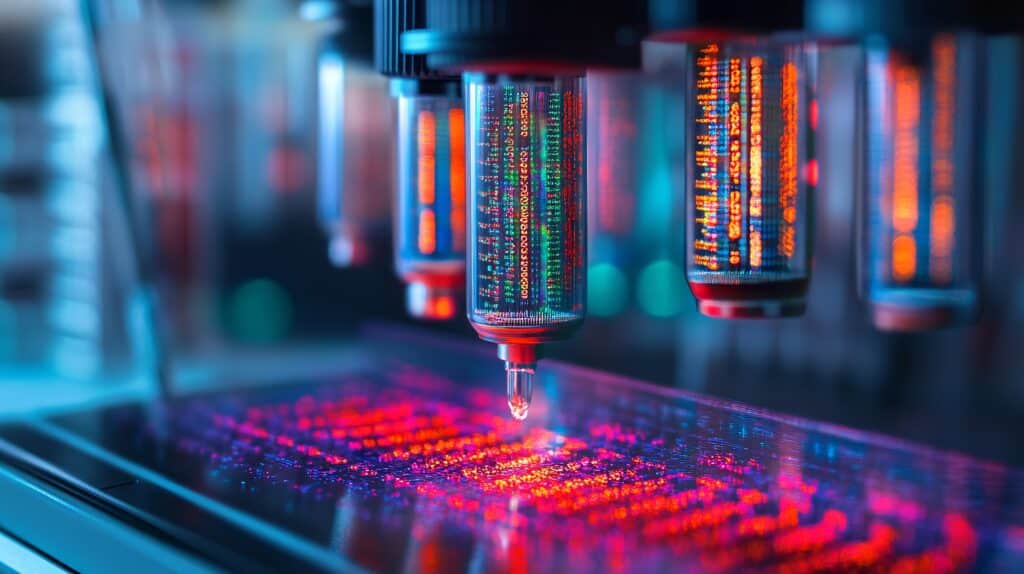
DNA molecules are memories. As far as processors are concerned, recent work has highlighted ‘transcript hubs’ in stem cells, i.e. regions concentrating a large number of systems for reading and controlling DNA machinery. These regions are linked to the organisation of DNA in space, to the way in which distant sequences of the genome can come together when the DNA strand folds. They are like the microprocessors in DNA computers, which can control both access to and the reading of different regions of the genome. Thanks to this discovery, we can imagine that within 10 or 20 years, laboratories will have real demonstrators of biological computers.
TRUE & FALSE – DNA computing will lead to more sustainable electronics.
DNA is a biodegradable material. However, DNA computers will never entirely replace silicon chips. We won’t see DNA telephones, for example. This is because to read information in DNA with current sequencing techniques we must extract the genetic material from the sample and therefore destroy the chip or cell that contained it. What’s more, to encode the information requires synthetic biology, which is time-consuming, costly, and difficult to generate long fragments. A great deal of research is needed to improve these processes.
TRUE – DNA computers will help us to unlock the secret of life.
In any case, the research that needs to be carried out to imagine DNA computers will be very instructive about how living things work. In this sense, even if this technology never comes to fruition, it will advance our understanding of life. In the same way that the steam engine made it possible to master the laws of thermodynamics, DNA computers will help us to understand the thermodynamics of life.
TRUE & UNCERTAIN – This technology will help us communicate with other life forms.
Programming a cell is a way of talking to a life form. By producing transmissible transformations in these DNA computers, we will be able to communicate with living beings over several generations. DNA is a universal language between species on Earth. In this sense, isn’t reading the DNA of an extinct species a form of communication, even if it is one-way? However, the language of living things is not like a human language. We shouldn’t hold out too much hope that we can crack jokes with trees or talk to a woolly mammoth as if we were talking to our dog.
UNCERTAIN – With this technology, we are going to go beyond biology, create a supra-biology that verges on transhumanism.
DNA computing has the potential, yes. But is it acceptable? Just because we have the power to do something doesn’t mean we should. Purpose is a bioethical issue that must not be ignored while we develop this technology. And this question is all the more important because most DNA computers will not be visible. It will be hidden inside cells, similar to those that make up our bodies. Only specialists will recognise the presence of DNA computers.