



In early 2024, Emmanuel Macron convened a commission of experts on the effects of screens on young people’s health. After more than three months’ work, the commission noted the predominant – and sometimes unintentional – use of screens by young people, with potentially harmful consequences. In its report1, the commission proposes a comprehensive action plan to help young people to better live with these tools that have become an essential part of their lives.
What was the aim of the commission of experts appointed by Emmanuel Macron?
One of our tasks was to build a scientific consensus on the impact of screens on young people’s health. We also had to assess the effectiveness of existing measures and put forward ideas for future action. Our aim was to put the child back at the heart of the process and to propose a systemic action plan. The reason why no directive had been drawn up until now was precisely because we couldn’t be satisfied with a single-sector solution.
Our committee was made up of ten experts, including Servane Mouton, a neurologist, and Amine Benyamina, an addiction psychiatrist, who co-chaired it. We had extremely varied backgrounds and, through our experiences, different opinions on the subject, which is why we were keen to find and put in place something we could all agree on.
How did you carry out this study?
We conducted a large number of hearings with 180 experts. By pooling our work, we were able to draw up a number of conclusions and identify avenues for reflection. We were also keen to include the views of young people, which is why we also organised workshops to gather their testimonies and opinions, exchange ideas and get them to react to our areas of work. Specialist organisers with experience of this kind of exercise were called in.
We put together a panel with as much diversity as possible in the time available. As a result, 150 children were interviewed. This provided us with valuable input for our discussions. We were reassured by some things and surprised by others. In all cases, the panel highlighted certain critical aspects. We then had to digest this information and draw up guidelines, which we set out in detail in our report.
What are the effects that have particularly struck you?
What struck us most was the phenomenon of “techno-conferencing” for children aged between 0 and 3. In their early years, if they are to develop, they need interaction and special moments with their parents. This involves gestures, words, listening and looking. Putting a screen between parent and child interferes with the creation of this crucial bond, without us necessarily being aware of it. We didn’t realise how critical this is in today’s society.
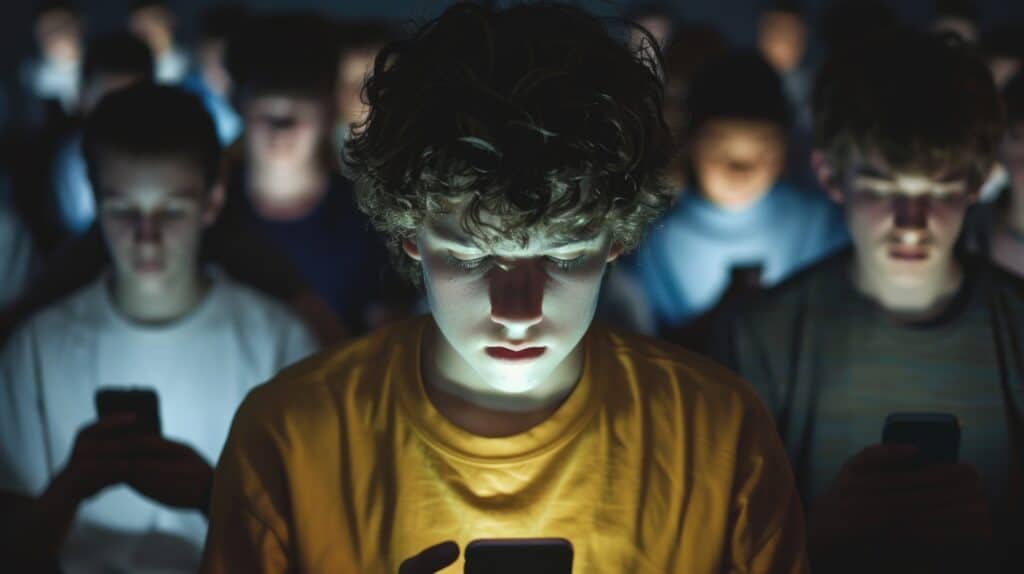
Secondly, the arrival of mobile screens has led to new modes of consumption that raise other issues: sitting with their screen on their lap, users are exposed to a source of light from below. Initial results show that, in this configuration, blue light is particularly harmful to eyesight. Depending on usage, excessive use can lead to myopia (the eye being less exposed to natural light and less accustomed to looking at the horizon), disrupt sleep and contribute to a more general sedentary lifestyle, which has an impact on physical capacity. Physical capacity has fallen by 30% since the 1990s.
The aim of this observation is not to get rid of screens, but to think about when to use them and how; to learn to control their use so as to retain the benefits. We can adopt a healthier lifestyle to minimise the impact on eyesight, sleep and activity, but we can also turn to alternatives that need to be supported and made visible.
Why is it important to offer alternatives?
We need to re-establish spaces outside the home for young people. We’ve built societies where we can’t stand children making noise or running around in the street. Or, as parents, we are afraid and we ask our children to stay at home. But we’ve seen how important it is to get outdoors and be physically active.
To address the problem of excessive use of screens, we need to ask ourselves why we use them, but also what young people are looking for in them. When we reach adolescence, problems of identification emerge, a need to fit in with a group. Social networks respond to this need to socialise. But when confronted with economic models designed to capture our attention, we quickly become captives, trapped in bubbles. Similarly, if we have questions about our love life, our sexuality, our body or our discomfort… Who can we turn to? Where can you find support and answers? If you don’t know, you go online. If you’re not warned, you run the risk of coming across content that is shocking, violent or even dangerous.
Did you observe this relationship with screens during your workshops?
The workshops gave us a real insight into the daily lives of teenagers, their exposure to screens and the ways in which they use them. We discovered that they are navigating a world that can become an absolute jungle if they are not prepared for it, or if they are not accompanied: shocking content, harassment, sextortion [Editor’s note: extortion of sexual favours via the internet], deepfakes [Editor’s note: misleading images and videos generated using AI], sexual predators… Girls and boys are equally affected, and the most vulnerable can find themselves confronted with dangerous content very quickly. The most striking thing about the young people’s testimonies is the way in which they can easily come across shocking content and accept it with a kind of resignation, which is reflected in the way they tend to trivialise it when they talk about it. However, they all told us that they wanted to be protected from such content, while at the same time seeking to maintain this link with knowledge and others.
The most striking thing about the young people’s testimonies is the way in which they can easily come across shocking content and accept it with a, kind of, resignation.
These risks are part of the first line of action we are recommending: protection and regulation. This also involves identifying dark patterns [Editor’s note: interfaces designed to mislead users], rabbit holes [Editor’s note: mechanisms designed to keep users on a platform as long as possible] and bubble systems in which users can find themselves trapped. It’s also about denouncing business models that capture short attention spans and exploit human bias to get more and more viewing time.
What conclusions did you reach?
We identified that it is absolutely essential to regulate the platforms and make them accountable, especially the big players. But we also need to educate and support young people in becoming autonomous in their digital lives. We can’t prevent everything – and that’s probably not the solution – so we need to educate. This means passing on the rules, codes and challenges of the digital world, but also preparing children for future developments by giving them the keys, the benchmarks and the means to exercise their own critical thinking and rise to the challenges of the future.
Digital education must be a step-by-step process, and school is a safe, supervised place to learn how to master this tool. As I said earlier, the best way to protect is to inform. This means understanding the impact on health and the body’s need to adopt a healthy lifestyle, but also understanding the content and the intentions of those who are offering it to us.
This learning process involves raising awareness among education and health professionals, as well as parents. In a world where digital technology is everywhere, we all need to realise that these objects and their content are not harmless, and that at every age we need to adapt our support, but also propose and promote alternatives.
In our work, we have been keen to put forward complementary proposals and to work towards a coherent systemic response to these issues, which affect all areas of our society (health, family, education, economy, etc.). This means more than just banning mobile phones from schools, as the media coverage might suggest.
How will your work be put into action?
We have delivered and presented our report to the President of the Republic and the Prime Minister, as well as to the departments most closely involved, i.e. Digital, Education, Family and Health. The objective will then be to find out how each of them will take it on board and propose actions. With the political ups and downs of the summer, we’ve only just begun to meet the new government players, but our work has been circulated.
Our support continues: we are responding to requests to explain and see how we can implement some of the actions we have proposed. We talk to elected representatives and people with structures in place to make progress on the issue. Digital technology can be beneficial, if not indispensable, just like the tools we use to help dyspraxic children learn. It’s important to know how to master it so that we can continue to benefit from it and grasp the challenges of its development. It’s important to provide this kind of understanding.