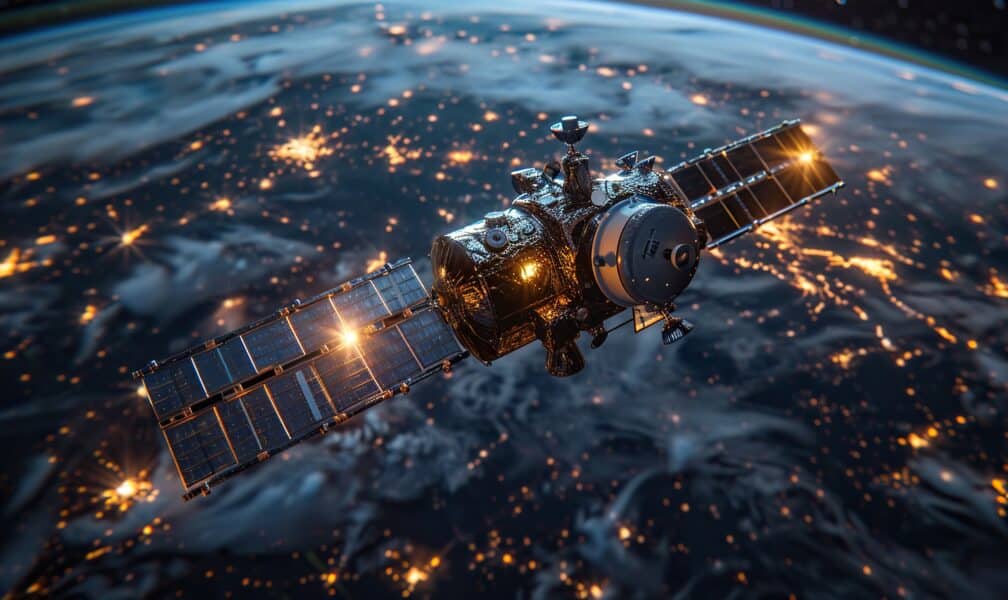



According to new analyses carried out by aerospace engineers at MIT, increasing greenhouse gas emissions will make it progressively more difficult to sustain satellite operations in low Earth orbit. This is because carbon dioxide (CO2) and other greenhouse gases have the effect of ‘shrinking’ the thermosphere, a layer of the upper atmosphere where most satellites currently orbit. This contraction decreases the density of the thermosphere, which in turn reduces atmospheric drag, a force that pulls used satellites and other space-borne objects down to altitudes where they can burn up. William Parker, a graduate student researcher at AeroAstro, discusses the findings of this research.
What effects will this reduced atmospheric drag have?
William Parker. This reduction in drag means that space junk will stay in the thermosphere for longer periods of time, so littering this important region and increasing the risk of inter-satellite collisions. Our analysis shows that if we continue to emit greenhouse gases at the current rate, these emissions will reduce the number of satellites we can safely operate in the years ahead.
The Earth’s upper atmosphere plays a critical role in clearing space debris: for most objects, atmospheric drag is the only natural removal mechanism. However, as greenhouse gas emissions increase, the upper atmosphere is cooling and contracting, retreating from the region where we depend on it to clean up debris.
We know that greenhouse gases cause warming near the Earth’s surface by trapping heat that would otherwise escape into the upper atmosphere. However, these gases make it easier for the upper atmosphere to radiate energy into space, leading to long-term cooling and contraction at higher altitudes.
How can we model the effects of this change in the energy balance, and what are the results?
To model the effects of this shifting energy balance, we used simulations of the entire atmosphere to examine how changes in surface CO₂ concentrations affect the temperature and density structure in the region of the atmosphere where satellites orbit (that is, up to 2,000 km from the Earth’s surface). This region is known as low Earth orbit. These satellites are important for providing essential services for the Internet, communications, navigation and weather forecasting, to name but a few.

We simulated several greenhouse gas emission scenarios for the 21st Century to study how they impact atmospheric density in the thermosphere and the associated drag. For each altitude range or ‘shell’ of interest, we modelled the orbital dynamics and the risk of collision between satellites based on the number of objects within the shell. We then used this data to determine the ‘carrying capacity’ of each shell, that is, the maximum number of satellites it can sustain.
We analysed several scenarios: one in which greenhouse gas concentrations remain at the year-2000 level; and others in which emissions increase according to the Intergovernmental Panel on Climate Change (IPCC) Shared Socioeconomic Pathways (SSPs) to the end of the century. We found that the latter scenario could significantly reduce the carrying capacity. Indeed, the simulations predict that by 2100, the capacity of regions at altitudes of between 200 and 1,000 km could be reduced by 50 to 66%. This situation could even occur before the end of the century, especially as some regions of the atmosphere are already becoming crowded with satellites. ‘Megaconstellations’ such as SpaceX’s Starlink, which comprises fleets of thousands of small Internet satellites, are an example of this type of satellite.
Climate change was already disrupting the status quo, and now we are seeing a massive increase in the number of satellites launched in recent years. Indeed, more satellites have been launched in the last five years than in the previous 60 years combined. There are now more than 10 000 satellites in low Earth orbit.
Is low Earth orbit becoming increasingly congested? What can be done to counter this trend?
We already knew that the thermosphere naturally contracts and expands every 11 years as a result of the Sun’s natural cycle of activity. When the Sun is in a phase of low activity, the Earth receives less solar radiation and its upper atmosphere temporarily cools and contracts. It then expands again when solar activity increases. Researchers wanted to find out how the thermosphere behaves in response to greenhouse gases in addition to this natural solar cycle. Early studies revealed that the thermosphere should shrink, thereby reducing atmospheric density at high altitudes. We have been able to measure changes in drag on satellites in recent years, and these measurements have shown that the thermosphere is contracting in a way that cannot be explained by solar activity alone.
Low Earth orbit is becoming increasingly congested and contested, so accurate atmospheric models are essential for predicting the long-term evolution of this debris. These models must therefore take into account changes in the upper atmosphere.
Our work demonstrates that variability in the spatial environmental plays a key role in determining the tipping points for sustainable activity in low Earth orbit. It also highlights the advantages of exploiting lower altitudes, where atmospheric drag allows for rapid removal of any problems in the event of failure, thereby reducing long-term satellite pollution. The conclusions of our study underscore the urgent need for international coordination in managing space traffic, without which we risk crossing dangerous thresholds that could lead to a tragedy of the commons.
Interview by Isabelle Dumé
Reference:
- Greenhouse gases reduce the satellite carrying capacity of low Earth orbit, Nature Sustainability 8 363–372