



The global video game market is a colossal entertainment sector, currently estimated at over €100bn. Certain technological developments have been made only because of the new opportunities offered by video games. The most striking example is computer graphics cards that evolve rapidly today thanks to the video games sector pushing real-time 3D to its limits. The same goes for real-time rendering algorithms. Investments and the subsequent progress that goes with them would not happen at the same pace without the video game economy. Not to mention augmented reality (AR) or virtual reality (VR), for which the same it happening. As such, video games have an impact on research, particularly artificial intelligence (AI).
What’s more, AI implemented in video games is a specialised sector. Indeed, in a video game, contrary to what one might think, the goal is not necessarily to beat the player at all costs. Rather, it’s more about offering a challenge. The AI must win some of the time, but also lose from time to time otherwise players stop playing. But AI in video games is not just about animating the opposition. There are other objectives, too.
Objective 1: understand players
First, AI is useful in terms of the player’s perception of their environment; meaning how the camera positions itself in a coherent way in relation to the avatar, the way light diffuses on the environment, the music, etc. When I am moving in a game, my environment must adjust based what I am doing, and anticipate what I want it to do to assist me.
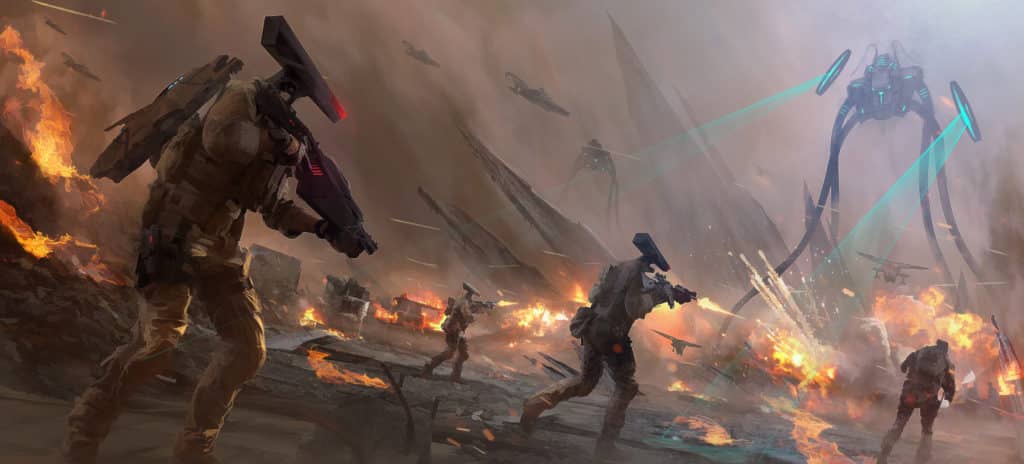
But what people first perceive of AI in video games are the NPCs, the “non-player characters”. Their purpose is to create a brief illusion. In a war game, most players don’t play around watching guards for half an hour. Instead, the player will see the character for a few seconds before shooting it or being shot themselves. An AI that works well is above all an AI that you don’t see is there, they blend into the game. The situation to avoid is an NPC that stumbles endlessly on the edge of a table being blocked from returning to ‘normal’ behaviour.
The AI of opponents is thus much easier to code than that of computer-controlled allies.. This is because, with the opponent, the relationship is brief. He doesn’t need to really understand what I’m doing, whereas an ally does. It must know if I need help catching enemies in secret or covering me in an attack. That’s why we often use orders, it greatly simplifies the programming of ‘ally’ AIs.
Objective 2: Surprise players
If the first level of AI in a game is to do everything to produce a coherent and credible environment, the second level is to surprise the player; a more advanced task. Some succeed, others don’t. The history of gaming is littered with many famous examples of AIs. From Pac-Man’s ghosts, through HalfLife’s marines (able to coordinate for tactical actions), Captain Blood’s aliens (with very realistic dialogue capabilities), Creatures (real pets with a certain intelligence) or Black & White’s semi-autonomous avatars (able to learn your play style to adapt their behaviour), or Event0’s space station (emotional AI that you have to convince to help you), many games are based more particularly on more complex AIs.
Objective 3: adapt to players
The third function is to analyse the player, his reactions to the challenges, where we find the trend of adaptive AI or statistical learning. The game sends data to the servers of the publisher or studio, and this data will be analysed to find out what was appreciated or not in the game. And this data analysis will be traced back to the game designer. Today, in a market that has become largely online, this process has become simpler. Very early on, alpha or beta versions of a game are launched to have as many people as possible play them and collect as much data as possible so as to modify the game accordingly for the time of the official release; it has a lot of positive effects.
For example, it creates a community and some game studios, very few of them, are doing research on real-time content modification. It’s a real breakthrough in the concept of real-time analysis. A new step would be to have a relationship with the player, not necessarily via dialogue, but a relationship that is credible enough for the player to feel that they are dealing with real human intelligences. This would be in line with the initial utopia. But we are not there yet. For video games, and even if it plays an important role, AI is still a secondary artefact, second only to the visuals, which are still the main selling point. It’s easier to quickly convey the key points of a game (its universe, its story, its characters) through visuals than through AI, which takes longer to experiment with and is therefore less of a marketing point.