


What if blockchain technology were to profoundly change the video game landscape through an unprecedented transfer of ownership in the form of non-fungible tokens (NFTs)? The market for avatars and non-fungible objects has already entered the virtual game world in a haphazard and often experimental way. Studios and publishers such as Ubisoft, through its Strategic Innovation Lab, are now looking at this new model that the video game industry could popularise worldwide.
What is the mission of Ubisoft’s Strategic Innovation Lab?
Nicolas Pouard. To anticipate the future of the video game industry and help Ubisoft prepare for it. As such, we’ve created a foresight team that conducts fairly standard studies to project ourselves into the future based on trends and weak signals. And we try to translate this prospective research into concrete and practical terms.
Firstly, we have a prototyping team that gets its hands dirty. For example, very early on we worked very early on subjects such as augmented reality (AR) or machine learning algorithms and, for the past four years, we have been working on blockchain. At the time, it must be said that there were relatively few applications, yet we were able to put together a small team and work on this subject over a long period.
The second path chosen by the Ubisoft Lab is a startup incubator that allows us to work directly with entrepreneurs and to help them understand the technological challenges they face. And of course, the new markets they are trying to create. In 2019, we selected the startup Sorare as part of Ubisoft’s Entrepreneurs Lab programme. A few days ago, Sorare announced that they had raised €580m of investment, the biggest fundraising project of the whole of French Tech. Indirectly, it’s quite flattering.
What link do you make between blockchain technology and video games?
Four years ago, it was the arrival of one of the most important blockchains, Ethereum, which really put forward the concept of Smart Contract, or decentralised automation. At the time, there was a lot of talk about a revolution, all industries included. Obviously, we wondered what this meant for video games and for gamers in particular. There was talk of more control over game items for players or subscribers, their virtual items, and skins, that it would give new power to communities. We’ve been talking about guilds or teams for a long time in video games. Again, there was a sense of a new era for these communities to move towards decentralised autonomous organisations, entities that would manage themselves through code, etc. To be honest, there was also a sense of a new era for these communities, yet there was also a lot of unknowns.
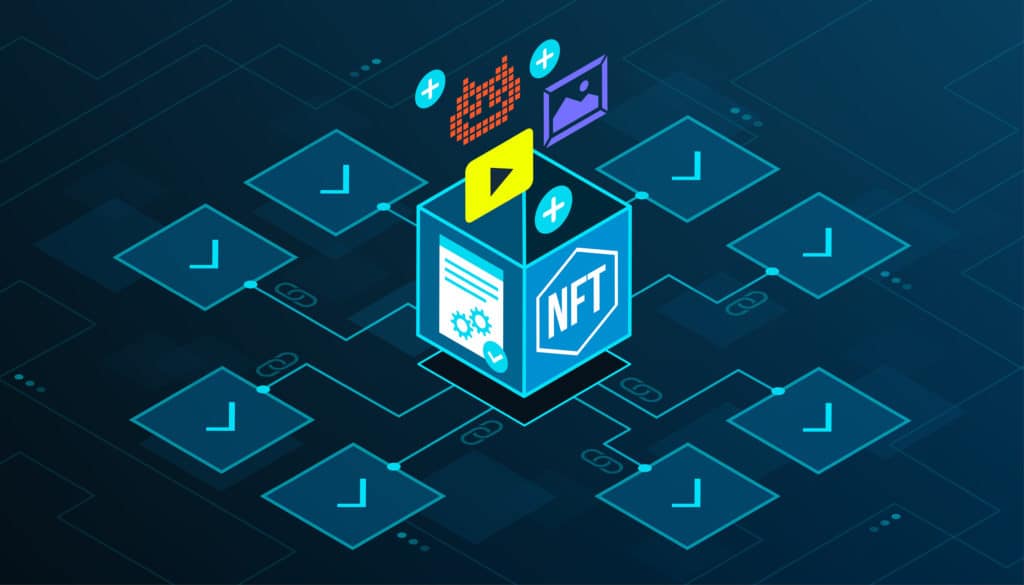
Then we met B2Expand in Lyon, which was one of the first startups in the world to work on the use of blockchain in video games. As we were setting up our incubator at the time, we brought them in. We were able to see first-hand what it meant for video games, i.e. increased user control over game objects. And here, NFTs, or non-fungible tokens, are really the heart of the proposal. These digital assets are issued and exchangeable on a blockchain, but they are unique and non-divisible. One NFT will always be different from another NFT. It is a proof of ownership of sorts.
Today, if you buy a car in the video game The Crew or a skin in Rainbow Six Extraction, you pay for access. The existing technological limitations mean that the publisher retains, by default, all control over this content. If there is no immediate need or demand from users for more control, there has been a rare situation where there is a sense of injustice that a publisher can change the rules of the game and alter the power of an item for example.
Blockchain technology has a very experimental dimension because, suddenly, the economy of a video game can be shifted more to the players’ side and not enclosed in the publisher’s ecosystem alone. We, as publishers, are still wondering how to make this accessible to go in the direction of the player. The technology is quite immature in some respects.
So, it’s all about reliability?
For Ubisoft, this reliability requirement is essential, primordial. And then, we must see to what extent this technology is disruptive or not in the production process. If it doesn’t transform production methods, it can be integrated quickly. If it transforms the representations we have of how to make a game, that poses more problems. And so, typically, blockchain is a point of friction on projects already in production. But if we start early, it allows us to have a whole phase of experimentation to check the reliability of the technology to develop a discourse which allows us to integrate these new ways of doing things into production. First, however, we must demonstrate the reliability of the NFT and the benefits for the players. Otherwise, the production teams will not adhere.
Can video games popularise NFT?
We are players that people trust. We have this level of reputation which means that, if tomorrow we propose to distribute NFT in our games, people can come with confidence. In the long run, and if this movement is global, it could make blockchain invisible in a way, reducing it to an infrastructure technology. It’s the use that will come first. And the primary use that we see today is indeed this transfer of ownership for our players. Our main challenge remains the same, whatever the technology: only implement an innovation if it brings meaning and added value to the players and their gaming experience.