



Is sailing propulsion a serious option for reducing the carbon footprint of maritime freight?
Since 2011, we have seen the emergence of projects for the use of diesel propulsion in the merchant navy. And the current situation – in particular the very high cost of energy – is increasingly favourable to the sector. Wind is a source of energy that is free from the problems of speculation, security, and infrastructure. In addition, the International Maritime Organisation and the European Commission are demanding increasing decarbonisation efforts from shipowners, and sea freight is expected to be included in the EU Emissions Trading Scheme by 2023.
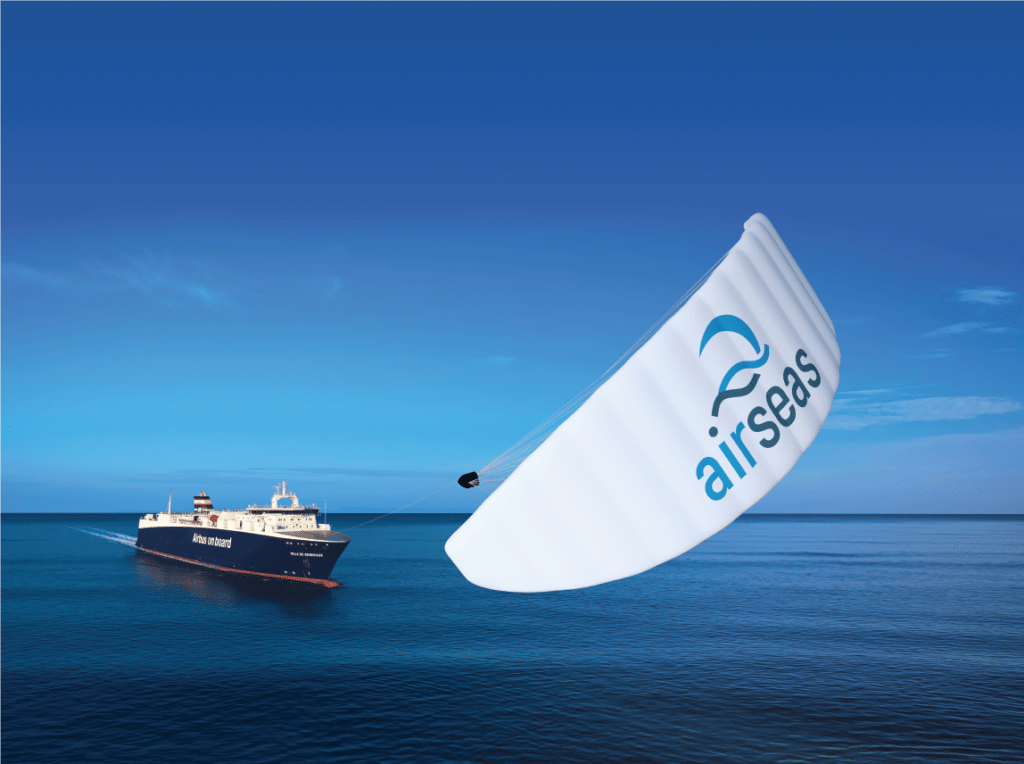
The huge advantage of diesel propulsion is its availability: it is an ideal solution in the short term, and complementary to alternative fuels in the longer term. There are already 15 ships in the world that are using sail propulsion systems. Some technologies are mature, such as Flettner rotors, and others will be tested very soon. For example, the Nantes-based start-up Airseas has been testing its kite since December 2021 on a ship chartered by Airbus between France and the United States. Zéphyr & Borée plans to launch its Canopée sailing cargo ship this year, which will transport the future Ariane 6 launcher from mainland France to French Guiana.
You mention several technologies: in concrete terms, what is the nature of sail propulsion?
There is a real proliferation of innovations and technical solutions. The most mature solution is the Flettner rotor, discovered in 1924. Since 2010, the firm Enercon has demonstrated that this technology is compatible with the constraints of maritime freight. The rotors need to be rotated by means of another energy source, a motor, or a huge fan in the case of suction profiles. Currently, oil-fired generators are used on board to produce this power, and alternative fuels could be considered in the future.
There are also other wind propulsion technologies that use only wind power. Conventional flexible fabric wings, such as those on old rigs like the three-masted Belem, age quickly and are not very efficient. Today, shipowners are turning to rigid panels, made of composite material, or thick profiles that resemble an aircraft wing.
All these systems are located on the deck of the ship, and therefore require space. One of the latest solutions explored is the kite: this time the wing is aerial. This is quite innovative, and the technology is currently being developed.
Can all ships be equipped, and can we achieve 100% wind propulsion?
It is possible to retrofit existing ships today. A study 1 estimates that 40–45% of the world fleet (37,000–40,000 ships) could be retrofitted by 2050, due to the lower cost of this propulsion and its wide availability. Wind will in most cases be an auxiliary energy source, partly reducing the need for the ship’s combustion engine.
New ships will have to be built to achieve almost entirely wind propulsion (they will still carry an engine to secure the port approach). This performance can only be achieved by ships designed for this purpose, and not by retrofitting: their hulls must integrate anti-drift systems linked to the use of sails, and the positioning of the masts must respect the balance of masses and access to cargo spaces by port services. The Neoline sailing freighter, currently under development, will be equipped with four masts providing 90% of the energy requirement for its propulsion.
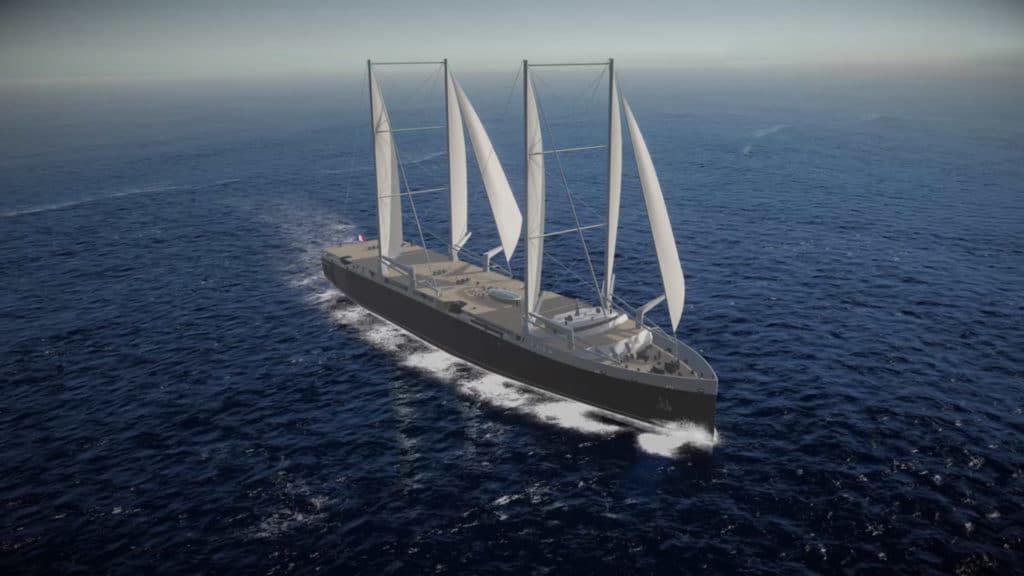
The heavier the ship, the more power is needed to move it. Sailing propulsion makes sense on medium-sized ships – up to 200 metres in length – at a speed of about 15 knots. By comparison, a container ship can be up to 400 metres long and travel at 20 knots.
So, deploying vee-propulsion on a large scale will require a reorganisation of maritime trade?
Yes, the concept of massification using container ships and logistics hubs is outdated. Ship propulsion addresses new tasks, such as the long-distance transport of goods on intermediate-sized vessels. They can call at more ports, especially secondary ones: this brings the goods closer to the consumer and reduces pre- and post-carriage, which is usually done by road. Speed is also reduced: the Neoline cargo ship will sail at an average speed of 11 knots. This does not prevent shippers such as Manitou and Beneteau from showing interest. It will be a virtuous logistics chain, and consumers must be involved by accepting longer delivery times to avoid a rebound effect.
Another change concerns the mode of navigation. Wind propulsion needs wind so sometimes sea routes will have to be modified to take advantage of it. To do this, crews can rely on maritime routing – taking into account the weather conditions – which is essential for sailing solutions. But shipowners are not used to this type of navigation, and there is a psychological brake. Finally, it should be noted that the propulsion of sailing boats is more favourable on transatlantic routes in the North, and less so on the route between Europe and Asia.
What is its decarbonisation potential?
We do not know precisely. A study 2 shows that 3,700 to 10,700 ships could be equipped with diesel propulsion systems by 2030. This could avoid the emission of 3.5 to 7.5 million tonnes of CO2 in 2030. We can also rely on the estimate of the retrofit potential of existing ships produced for the UK government (37,000 to 40,000 ships) 3: if 10% of fuel can be saved by the use of sail propulsion, an overall reduction in consumption of around 3% is achieved.
But the major uncertainty concerns the actual energy gain of the systems. There are no standards for measuring performance, only the manufacturers provide an estimate of the gain made by their solution. On this basis, it is estimated that the energy gain associated with Flettner rotors is around 8%, up to 20% for the kite or even up to 30% for thick profiles. But these are theoretical measurements: today we lack measurements in navigation as well as a standard, such as an ISO norm. This is an important issue, which would enable shipowners to accurately assess the return on investment of these decarbonisation solutions.