


To what extent does the agricultural sector contribute to energy consumption?
First of all, it should be pointed out that the agricultural (and forestry) sector is a special case. Only 13% of the greenhouse gases (GHGs) released – in this case CO2 – are linked to its energy consumption in France1 (editor’s note: most of the emissions are linked to the release of CH4 and N2O, see also article 1). These emissions linked to energy consumption represent 2% of France’s total emissions.
The sector consumes 4.5 million tonnes of oil equivalent per year in France, mostly for agricultural machinery (75%). Livestock buildings and heated greenhouses are the other two energy consumption items. Agriculture’s final energy consumption represents 3% of France’s total energy consumption, a figure that has remained stable since 20042.
How can the sector’s energy footprint be improved: should we consume less, or consume better?
Another particularity of the agricultural sector is the composition of its energy mix, which is dominated by oil products. The most important step for reducing the energy footprint is to reduce dependence on fossil fuels. The other step is to reduce energy consumption, and the evolution of agricultural practices makes it possible to intervene on both levels.
It is a question of rethinking the use of machines to limit interventions: land consolidation, modification of cultivation schemes or even reducing the number of weeding trips. The electrification of machines or the use of biomethane are also interesting, but these technologies are not yet mature. Other technical modifications also make it possible to reduce the energy footprint of farms. For example, insulating greenhouses, rethinking their layout to maximise solar gain and limit heat loss, equipping livestock buildings with energy recovery systems, and micro-sprinkler or drip irrigation systems.
We have quantified the possible reductions in a prospective exercise designed with the players in the sector. Energy savings amount to 26% by 2050 for a trend scenario where the best current technologies are massively deployed. They can reach as much as 43% in a the most proactive scenario.
The other part of the energy transition concerns the production of renewable energy. What is the role of farms?
The agricultural sector accounts for 20% of France’s renewable energy production, equivalent to its total energy consumption3. This production comes from nearly 50,000 farms, i.e. about 13% of the farms in operation.
Most of the production is based on biofuels, to which 800,000 to one million hectares in France are devoted. I think that the future lies more with second-generation biofuels, which make use of by-products such as wood waste. However, this is still a relatively new field
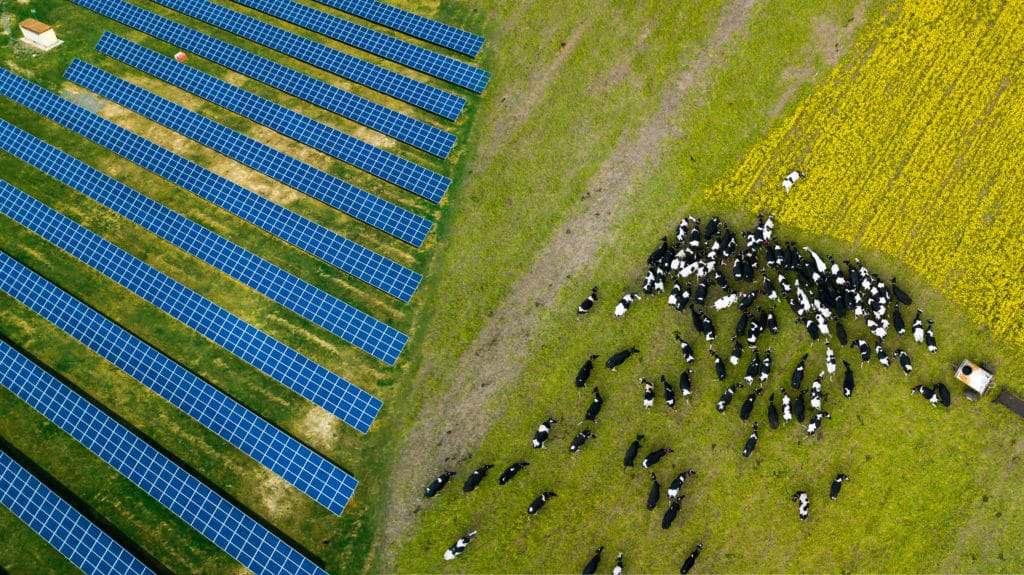
Farms account for 83% of wind energy production, as well as 13% of photovoltaic solar energy, mainly installed on livestock buildings. This production is increasing in line with national development. Biomethane production has been developing rapidly in recent years. The number of installations is growing rapidly – more than 1,100 at the beginning of 2022 – and is increasingly making use of crop residues and intermediate crops. Moreover, the majority of installations are moving towards the introduction of biomethane into the gas network. We estimate that the production of renewable energy by the agricultural sector should triple between 2015 and 2050.
Doesn’t energy production jeopardise food production?
This is the question currently being asked in the face of the boom in anaerobic digestion (methanisation) and requires further consideration of the framework for its development. For example, if it is developed to maintain a system of intensification of livestock farming, we are not heading in the right direction. In Germany, crops dedicated to anaerobic digestion have emerged, which divert food production to energy production.
Beyond a simple energy production process, anaerobic digestion responds to many other issues and can be used in support of a virtuous agricultural project: better use of effluents, planting of plant cover and reduction in the consumption of synthetic inputs through the adapted use of digestates.
Questions have also been raised about the risk that agrivoltaics would pose to agricultural land… wouldn’t a framework be necessary here too?
Many energy operators are interested in agricultural land. The roofs of buildings have long been equipped with photovoltaic panels, and wind turbines have been installed in the fields: these installations generate additional income with very little impact on agricultural land.
We are currently evaluating agri-voltaic systems – which we define as projects where the photovoltaic production system provides an agricultural service – such as protection against frost or hot weather (shading, photovoltaic greenhouses, etc.). The sector is extremely new and little data is available: for the moment we are promoting experiments on small areas to quantify the impact of such systems on farms.
And in the world?
Agri-food systems as a whole – including production, transport, processing, marketing, etc. – consume 30% of the world’s available energy. But the food production stage accounts for only a quarter of energy consumption4. More specifically, in 2019, the agricultural and forestry sector consumed 2.7% of all oil products consumed according to the International Energy Agency (IEA). With 407 million tonnes of CO2 emitted in 2019, food production is responsible for 1.2% of global CO2 emissions. According to the Food and Agriculture Organisation of the United Nations, improving energy efficiency is based on production activities in developed countries. For developing countries, on the other hand, it is necessary to focus on the energy used after production.