



According to the FAO, in 2010 livestock farming was responsible for the emission of 8.1 billion tonnes (Gt) of CO2 equivalent, mainly due to cattle farming (62% of the sector’s emissions)1. Of course, reducing these emissions depends primarily on consumers’ food choices. But the sector also has a number of means of reduce its climate impact: the mitigation potential is estimated at 2.5 Gt CO2 equivalent, or 33% for consistent production. These levers are based on the sector’s three main emission sources: enteric fermentation (44% of global livestock emissions), animal feed (41%) and manure management (10%), according to the FAO.
Enteric fermentation takes place in the rumen of ruminants (cattle, sheep, and goats), during the transformation of food into nutrients. It produces methane (CH4), belched out by the animals (burps and not farts, as legend has it). It is the main GHG emitted by livestock farming, which is responsible for one third of anthropogenic CH4 emissions2. Reducing methane emissions (from all sources) is one of the priorities of the EU, which adopted a methane strategy in October 2020 as part of the global objective of a 50% reduction by 2050.
Methane emissions from livestock are relatively stable in Europe and low compared to Asia, South America, and Africa. In these regions, they are increasing due to population growth and thus the size of the herd. China and India are the largest emitters.
Means of reducing emissions
It is important to understand that emissions are directly linked to our food consumption. Cattle (dairy or beef) are the biggest emitters: the bigger the animal, the more food it consumes and the more methane it produces. A cow emits about 600L of CH4 per day, compared to 60L for a sheep. These emissions are attracting the attention of the industry: reducing them is of nutritional interest to the animal and environmental interest to humans.
There are various ways of reducing methane production in ruminants, starting with the feed ration. In the rumen, certain micro-organisms break down carbohydrates (cellulose, starch, etc.). This reaction leads to the production of gases, including hydrogen, which is converted into methane by other micro-organisms. In order to reduce CH4 production, the production of hydrogen can be reduced or used in ways other than to form CH4.
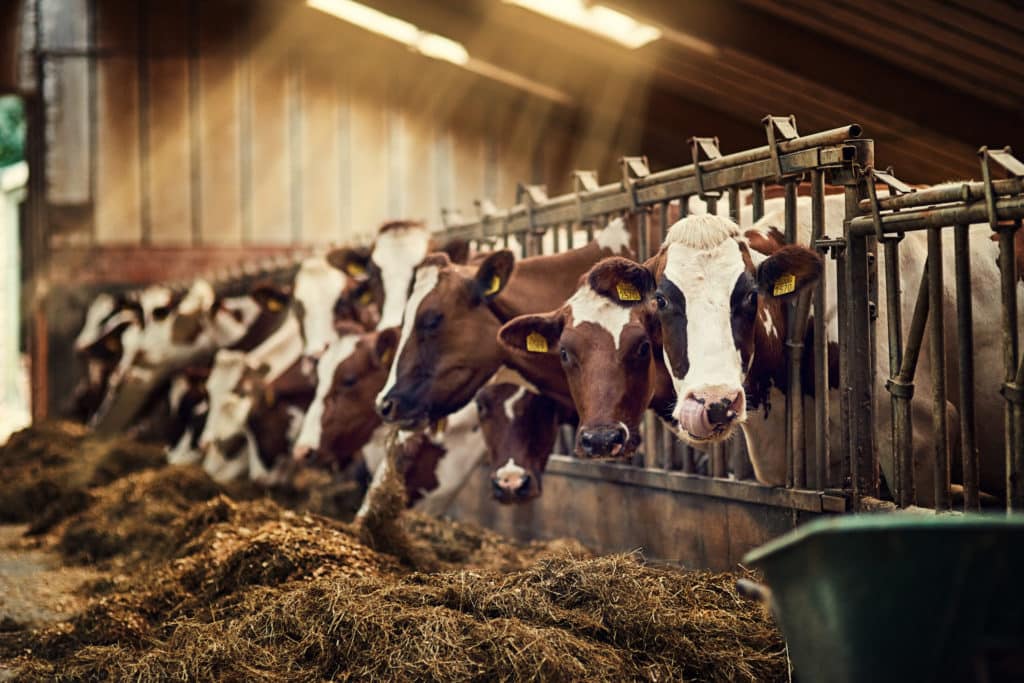
Some means are well known and used by farmers. Increasing the amount of starch in the ration (more cereals), without exceeding a certain threshold, favours certain micro-organisms that produce little hydrogen. CH4 emissions can be reduced by 10–20% for consistent production. Increasing lipids in the ration (thanks to sunflower, rapeseed, flax, etc.) increases animal performance and offers the same potential to reduce CH4. Finally, the more digestible the forage, the less CH4 the animal produces, even if the potential reductions from this are lower. Certain species rich in tannins, such as chicory, plantain or sainfoin, can also be introduced into temporary grassland: they reduce CH4 emissions but also nitrogenous discharges.3
However, these means of mitigation must be considered on a broader scale. While the consumption of cereals reduces the animal’s CH4 emissions, the cultivated surfaces store less carbon than permanent grasslands. And these crops emit GHGs during transport. The competition between human and animal feed should also be considered.
Can certain additives reinforce these effects?
The first synthetic food additive recognised as anti-methanogenic, 3‑NOP, was authorised in February 2022 in the European Union. It acts on one of the enzymes responsible for methanogenesis in the rumen: studies show that it has the potential to reduce CH4 production by 20–40%. It has been shown to be safe for animals and humans and does not affect productivity. However, this product has a cost, and offers no direct benefit to the farmer: it is essential that the efforts of farmers to reduce their GHG emissions are rewarded.
Nitrates, which have feed ingredient status, reduce CH4 production by capturing hydrogen in the rumen and converting it to nitrite. They are effective in reducing CH4, but complicated to use and have a significant environmental impact. Many other additives of natural origin are being studied: for example, we are working with a producer of wild plants from Auvergne and are currently testing some of them in vivo.
Genetics or biotechnology to reduce emissions
Genetic selection of animals is highly developed for the cattle industry (especially dairy) and is starting to be developed in sheep farming. For the same diet, some animals emit less CH4 than others. The difference is small, less than 10%, but this is not negligible on a global scale. It has now been established that this trait is repeatable with different diets, and hereditary: this makes it possible to envisage long-term effects of genetic selection. However, it is not just a question of considering the animal’s methanogenic potential: today, research is interested in a range of traits, such as production, health, etc. We need to find the best compromise for selecting lines.
As far as biotechnology is concerned, several avenues are being explored to directly manipulate the microbial flora of cattle. New Zealand is at the forefront of creating a vaccine against methanogenic micro-organisms. An initial trial showed potential to reduce methanogenesis, but to date this has not been replicated.
A study4 also suggests that it is possible to manipulate the microbiota using the feed additive 3‑NOP: in young cattle supplemented for a few weeks, a persistent effect was measured up to one year after the supplementation was stopped. These results also need to be reproduced and monitored in the longer term.
Priorities for accelerating mitigation
One of the approaches studied is to combine tools: we assume that the effects are cumulative. We have demonstrated this with the combined use of flax and nitrates, which enhances the reduction of CH4 emissions by affecting both the production and use of hydrogen.
It is also very important to improve productivity, which benefits the climate and the farmers. Many potential solutions exist at the herd management level: reducing the age of first calving, improving health, and reducing the turnover rate of animals to reduce the unproductive period. Changing the feed ration, which is beneficial for CH4 emissions, also increases productivity to a certain extent. Improving productivity is an interesting strategy for high emitting countries where animals are often low producers.