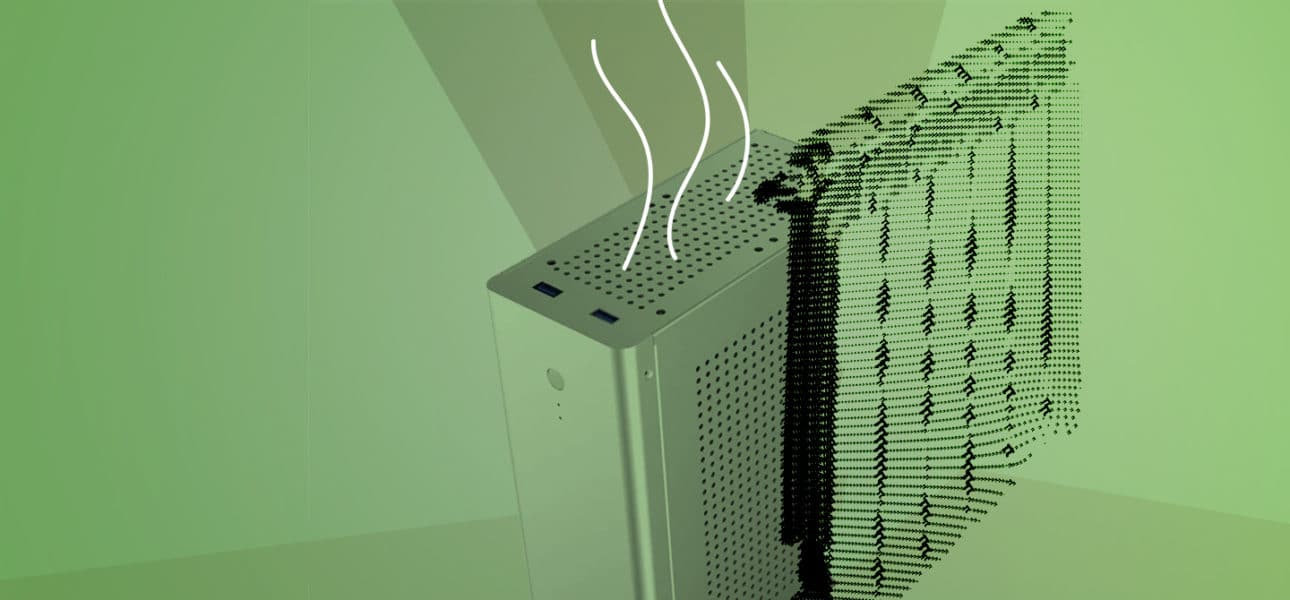



Paul Benoit and Miroslav Sviezeny founded Qarnot Computing in December 2010. Their idea was to use warmth emitted by computer servers, known as “waste heat”, to heat entire buildings. Rather than recovering this heat and transporting it somehow, they chose to transform the servers themselves into “radiators” that can be installed directly on premises. To do so, a centralised digital platform sends computer calculations – financial calculations, 3D imaging etc. – to the servers and brining the results back together to reconsolidate them. These “computer radiators”, called QH‑1, are equipped with a thermostat and a switch, allowing them to be adjusted on demand.
Three years on, Qarnot tested its first models in homes Paris, followed by a new build in Bordeaux. Next, they moved on to fundraising, prestigious clients, the development of a digital boiler called QB‑1, and a partnership with the Casino group to heat their warehouses. Today, the company employs around 70 people, including 50 engineers who develop new “ecological heat” applications.
Qarnot says it sells “ecological heat”. Can you explain what that is?
Quentin Laurens. First and foremost, Qarnot primarily sells a computing service, but we do make use of fatal heat that is a consequence of the activity of servers. After creating the “computer radiator”, i.e. heating a building with computing power, Qarnot extended its range with a digital boiler that produces hot water at over 60°C. As a term to define our products and the different markets they address, we now say that we provide low carbon computing. This means that we produce heat or hot water from the temperature released by computer processors. Our expertise lies largely in the platform that distributes the calculations to be performed in a way that is totally transparent to the occupants of the premises where the devices are installed.
Until now, our activity has mainly been of interest to two types of users: large consumers of computer processing such as banks, cartoon studios, local authorities or social housing landlords, and energy companies that install our devices in their buildings. But now there are new sectors that are beginning to take interest, particularly in fields like artificial intelligence and machine learning, fluid mechanics software and medical research.
Would you say that ecological heat makes digital technology “greener”?
Be careful, we are not saying that we are zero carbon or zero emissions. However, we do that our technology is more than just another low carbon solution – our model is a real paradigm shift. For a data centre, you have to construct a building, supply it with energy for operations and to cool the servers, connect it to international networks, install a generator with fuel, etc. However, the Qarnot model removes the need for an external data centre and its subsequent cooling. The only thing needed is an energy source for the processing power, which produces heat, and a fibre optic connection. We try to optimise the life of servers and microprocessors by using ‘peak power’ (the maximum power of a device) ensuring that good performance and heat emission are combined. In doing so, we estimate that we reduce CO2 emissions by 81% compared to a traditional data centre model because we don’t have any negative externalities, it minimises the effects and impacts.
How did you calculate this reduction in emissions?
Today, we do not have a precise calculation, so it is rather an estimate that we have calculated ourselves. We have just launched the development of a calculation method that allows us to go to a great degree of finesse in measuring the carbon footprint, by integrating each of the parameters (carbon footprint of the source of electricity depending on the country, material used, rate of heat recovery, etc.). With this model, we will be able to precisely calculate consumption and quantify greenhouse gas emissions of a computer calculation or an activity. This methodology is currently being certified. As such we will be able to estimate the cost of computing in a data centre, considering the differences in electricity prices and emissions across France, which produces nuclear energy, and other countries that produce electricity in coal-fired power stations.
What are the possibilities for developing ecological heat?
We recently developed and improved our QB‑1 boiler, and we are currently conducting tests with the Open Compute Project to recover servers from large data centres when they renew their fleets and recondition them into boilers. For the moment, we are mainly selling computing or heating services. In the near future, we plan to sell the boiler as a stand-alone service, i.e. a customer could buy boilers and use them for both computing and heating water.
On the user side, there are many markets that are interested and with whom we are developing projects. Farmers are testing the Qarnot solution to heat greenhouses to help produce tomatoes and strawberries all year round. Breweries are considering using it to heat water. Heating networks, particularly in northern European countries, are increasingly interested in recovered energy. We already have projects with several cities. There is no shortage of projects. All these challenges are exciting for our engineers because they respond to their environmental concerns. Ecological heat is still in its infancy, there is much yet to come.