


You could be forgiven for thinking that everything has already by done in aerodynamics. We already know that reducing planes’ vapour trails allows them to consume less fuel, therefore limiting release of greenhouse gases. To be exact, each unused kilogram of kerosene saves 3.16 kg of CO2 from being released. However, progress remains to be made. “There are still areas where we can continue to reduce drag,” Marie Couliou, an experimental aerodynamics researcher at aerospace lab ONERA, says.
The goal is to control airflow over the plane. This can be done in passive ways by adding appendages to modify the airflow path or changing the roughness of surfaces. Or active methods can be used, by installing pulsating jets that force airflow to follow a certain topology, for instance. But whereas a lot of research has gone into the former – particularly at Boeing and NASA – they have been used on very few planes so far.
Beforehand, tests are required to better understand how these appendages age throughout the life of an aircraft. As for active methods, a major obstacle has presented itself: the energy required. So, even if these active systems work well in wind tunnels, implementing them in real conditions may be a whole other story. However, if successful, these flow control systems could save a few percentage points of efficiency, which would represent colossal amounts of fuel.
Changing plane configurations
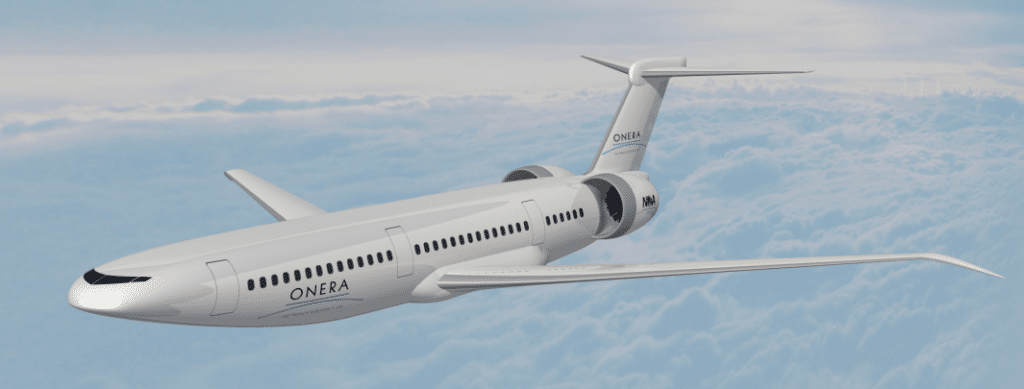
Interestingly, ONERA has developed a very innovative plane concept: Nova1. It was designed to optimise aerodynamics. Specifically, the jet engines are partly integrated, instead of being located outside the fuselage. As a result, the air entering the engines comes from layers running off the fuselage, which are therefore slowed down by friction. “This concept should decrease fuel consumption by 15–20% compared to current models of medium-haul aircraft,” the researcher states.
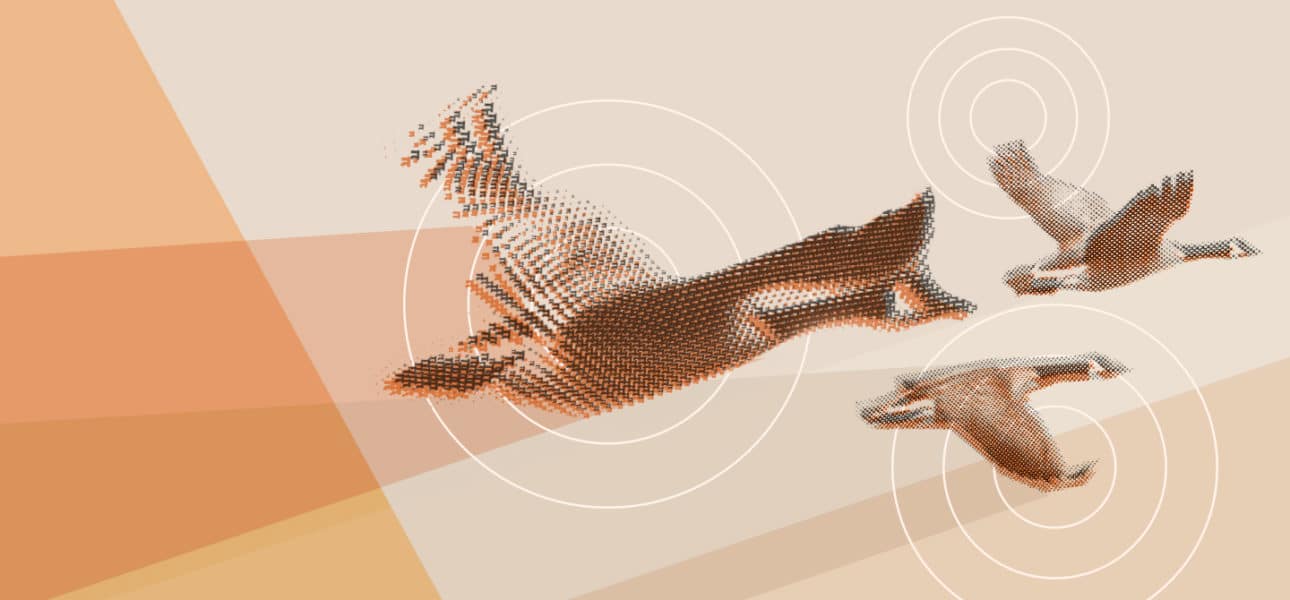
Reducing vapour trails does not concern only single planes, it can also be used on groups. Why not imitate the “V” formation of migrating birds? Airbus believes that this concept could reduce fuel consumption by 5–10%. With each plane creating wingtip vortices, this accelerated air would give extra lift to nearby planes. However, they should not fly too close to one another, for safety reasons. The balance between efficiency and safety is yet to be found.
Condensation trails
Decreasing friction is not the only aim of aerodynamics research. One lesser known problem is that of contrails, those long white lines that can be seen after planes pass at high altitudes. They occur when ice crystals form around soot particles emitted by jet engines, and they can have a serious impact on the climate. Under certain conditions, they turn into cirrus, wispy clouds that appear at high altitudes. Although the sun’s rays can pass through them, they partly reflect rays bouncing from the earth back towards the ground, thereby contributing to climate imbalance 2. This effect has been well known for a long time but, thanks to progress in climate science, we now know for certain that this has a significant negative impact.
“It’s difficult to measure the effect of contrails; there is still a lot of uncertainty, but they could have as big an impact as planes’ fuel consumption,” the researcher confirms. According to German climate scientist Bernd Kärcher, condensation clouds are responsible for the vast majority of the radiative forcing caused by the aviation industry. Radiative forcing measures the way in which a factor disrupts the Earth’s energy balance. In the case of aviation, contrails contribute more to this problem than the industry’s CO2 emissions3.
Preventing these aircraft-induced cirrus clouds is therefore crucial. However, we first need to better understand how they form and evolve. In addition to water vapour, jet engines emit soot, which serves as the trigger for ice crystals to form. These crystals are then scattered by wingtip vortices. “Understanding the conditions in which these contrails form and disperse, according to the position of the motor in relation to the wingtips, would mean we can reduce their impact on the climate,” Ms. Couliou adds. There is still much progress to be made in this area.