


A major new telescope, the James Webb Space Telescope (JWST)1, is scheduled for launch a few days before Christmas this year. It will leave Earth on an Ariane 5 rocket from the European Space Agency’s (ESA) spaceport in Kourou, French Guiana. The long-awaited mission is often described as being the successor of the renowned Hubble Space Telescope.
Deep exploration
As the most advanced space observatory ever built, the JWST will operate primarily at near- and mid-infrared wavelengths rather than the visible-spectrum used by Hubble. As such, it will allow for the most detailed exploration yet of the very distant and ancient galaxies and stars. JWST will also study nearby celestial bodies, extrasolar planets and our own solar system. It is a telescope that should revolutionise our understanding of exoplanets and how the first stars and galaxies formed in the Universe.
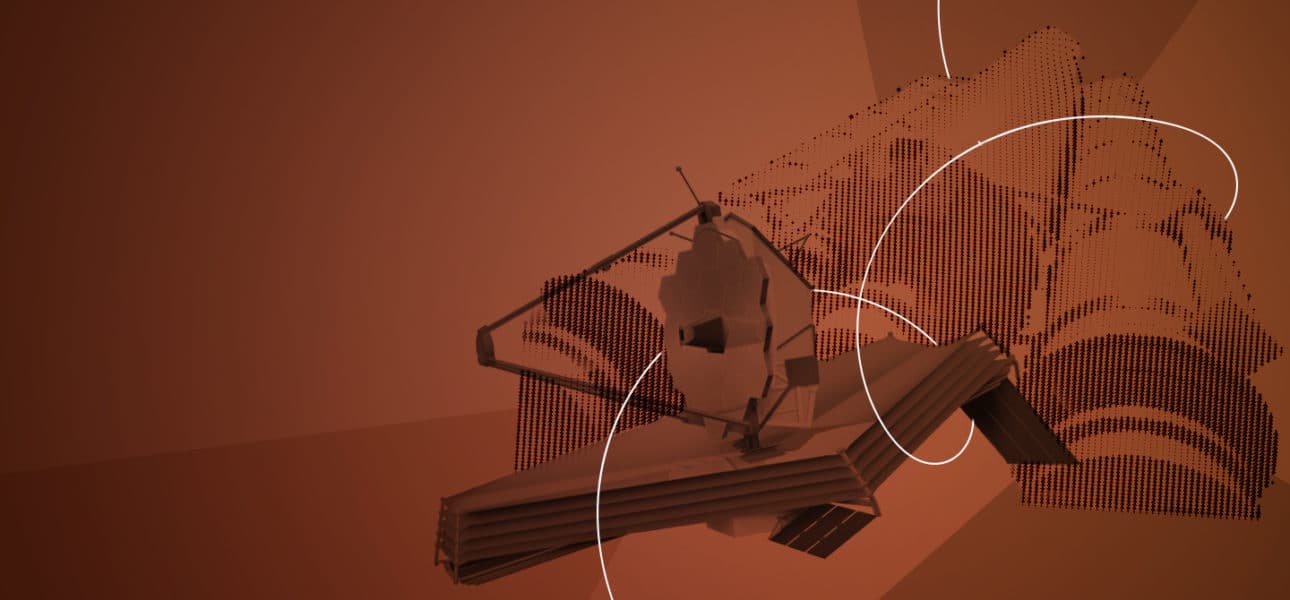
The JWST is the joint flagship project between NASA, ESA and the Canadian Space Agency. It boasts a 6.5‑metre-diameter segmented mirror – three times the size of Hubble’s – making it 400 times more sensitive than current ground-based or space-based infrared telescopes. The mirror is so large that it has to be folded in three and will be unfolded once the telescope has reached its destination.
It will span the long-wave visible spectrum and infrared wavelengths from 0.6 to 28 microns and will carry four scientific instruments. Operating for at least 5–10 years – hopefully more – it will be sent to the Lagrange point L2, which is 1.5 million kilometres from Earth, behind the orbit of the Moon. Again, this makes it very different from Hubble, which has remained in Earth’s orbit. The JWST is also equipped with a very large 22 x 10 m sunshield to cool it down and protect it from the Sun’s infrared radiation.
The four science instruments onboard the JWST Integrated Science Instrument Module (ISIM):
- Visible/Near Infrared Camera (NIRCAM),
- Near Infrared Spectrograph (NIRSPEC),
- Mid-Infrared Instrument (MIRI),
- Fine Guidance Sensor/Near InfraRed Imager and Slitless Spectrograph (FGS/NIRISS).
The main scientific objectives of JWST will be: ‘First light and reionization in the early Universe’, ‘Assembly of galaxies’, ‘Birth of stars and protoplanetary systems’ and ‘Planetary systems and the origins of life’.
Studying the ‘reionisation’ era
In its first year of operation, or “Cycle 1”, JWST will look for atmospheres on nearby rocky exoplanets and probe the earliest galaxies in the Universe – those that formed less than a billion years after the Big Bang. These galaxies are so faint that they could not be detected by previous telescopes, with the exception of a handful discovered by Hubble. These new observations will help us understand an important part of the history of the Universe, known as the reionisation (or first light) epoch – a period spanning about 400,000 to 1 billion years after the Big Bang, when the first stars and galaxies emerged. It is possible that reionisation did not occur everywhere at once, but in pockets and bubbles. These bubbles are related to the initial large-scale structures of the Universe, and JWST hopes to map this structure.
The JWST will be able to see much further back in time, to just 200 million years after the Big Bang, which occurred 13.8 billion years ago. Until now, we have been able to go back as far as 400 to 500 million years after the Big Bang with existing instruments, but JWST will be able to see the ‘first light’ of the Universe.
The total observation time in Cycle 1 will be split into several sub-categories: 32% for galaxy observations, 23% for exoplanets, 12% for stellar physics and 6% for our own solar system. Within these programs, there are small, medium, and large programs, some of which are regarded as ‘treasuries’, expected to provide huge amounts of data that will keep future generations of researchers busy for decades to come.
Studying the atmosphere of target exoplanets
JWST will also study the atmospheres of about ten of the thousands of exoplanets discovered in recent years and observe these worlds as they ‘transit’ in front of their host stars. These observations will allow astrophysicists to determine whether they have an atmosphere and to analyse the composition and basic structure of any atmosphere present using spectroscopy.
The targeted exoplanets will be between one and three times the size of Earth and are known as ‘super-Earths’ and ‘sub-Neptunes’. JWST could transform our understanding of these planets. To be able to detect biosignatures on potentially habitable planets, we first need to understand the full diversity of planets that have been discovered to date. Super-Earths and sub-Neptunes appear to be the most common types of planets in the galaxy, even though we still don’t know what they actually are.
The JWST is a ‘titan’, built to transform our view of the Universe and to perform ground-breaking astronomy. It will shed light on the furthest reaches of space ever. But it will also take images to show the world beautiful objects for the sake of it. These images will kindle the imagination and encourage reflection. What is our Universe? What are we in the midst of all this? And that’s another reason why the JWST is so wonderful.