Electric dependency: what strategies for the EU?



-
- China holds a monopoly on rare earths, which are key components in the manufacture of many cutting-edge technologies (screens, electric cars, etc.).
- Today, China accounts for 83% of global rare earth production, giving it significant leverage for political pressure.
Greenland is believed to possess 23 of the 24 critical raw materials, and 1.5 million tonnes of exploitable rare earths within its territory.
- However, Greenland lacks the resources needed to develop mining activities: a suitable climate, infrastructure, labour force, public support, etc.
- To reduce its dependence on suppliers, the European Union’s RESourceEU plan, adopted in late 2025, aims to develop the refining and recycling of rare earths.
Sought after by the industrial and defence sectors, rare earths have become essential industrial components. Once processed, they possess magnetic or optical properties necessary for the manufacture of screens, electric vehicles, wind turbines, fighter jets and all cutting-edge technology. In October 2025, Beijing introduced new restrictions on the export of rare earths and “reformed the export licensing regime, a decision that exposes importing manufacturers to uncertainty regarding prices and available volumes,” explains Gilles Lepesant, research director at the CNRS. Facing considerable challenges, the European Union must adapt to this new situation whilst demand continues to grow.
China’s near monopoly: a worrying lever of power
Since the 1970s, China has gradually established itself as the dominant force in the production chain, from the extraction to the refining of rare earths. “Although they are not actually that rare, since they are found across large parts of the Earth’s crust, it is nevertheless Beijing that controls almost the entire global supply of rare earths, accounting for around 83% of world production 1,” points out Gilles Lepesant. Given the expertise required to separate and refine rare earths, the challenge is in fact a technological one rather than a geological one.
Today, China no longer hides the fact that it uses this leverage as a diplomatic tool to settle its disputes. Tokyo recently felt the brunt of this. When Prime Minister Sanae Takaichi raised the possibility of Japan’s involvement in the event of a conflict over Taiwan, Beijing responded by blocking exports of “dual-use goods”, including rare earths, to its Japanese neighbour on 6th January 2026. On 4th February 2026, Washington, Brussels and Tokyo joined forces, despite underlying tensions, to counter China’s stranglehold. A strategic partnership was formed to secure each country’s supplies of critical minerals. The partnership plans to set minimum prices in a coordinated manner. At the same time, the White House announced a new stockpiling strategy backed by a $12 billion fund.
Is Greenland in the news because of its mining potential?
As recent news reminds us, Greenland is the focus of intense interest. According to a study by the Geological Survey of Denmark and Greenland published in 2023, 23 of the 24 critical raw materials (as defined by the European Commission) are present in this territory, which is said to hold 36 million tonnes of rare earths. However, only 1.5 million tonnes are believed to be exploitable. Two mines are currently active on the island, one for the extraction of anorthosite, the other for gold. As for rare earths, two promising deposits have caught the attention of major powers: Kvanefjeld (the world’s fifth-largest uranium deposit and second largest for rare earths) and Kringlerne. Gilles Lepesant points out, however, that for the moment “these two projects, the only ones submitted to the authorities, have not received mining permits”.
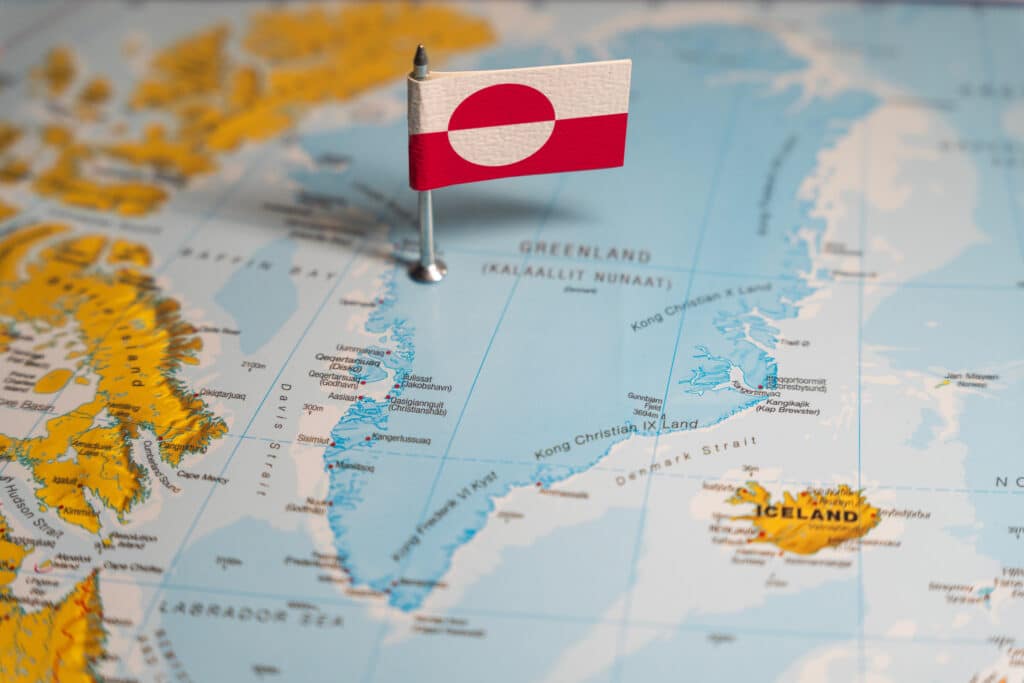
He adds that strong local opposition persists, whilst the precise composition of the deposits remains uncertain. On the ground, everything needed for the development of mining activities is lacking: a suitable climate, infrastructure, labour (fewer than 60,000 inhabitants), capital and public support. It is also worth noting the hypothetical presence of fossil fuels. Indeed, 13% of undiscovered oil and 30% of undiscovered natural gas could be found in the Arctic, and in particular in Greenland (USGS). Local authorities have, however, banned oil exploration since 2021.
A strategic weakness for the European Union
Once a mining powerhouse in the 19th Century, Europe is now heavily dependent on its partners for almost all metals. “To achieve its energy transition, the EU relies on imports for between 75% and 100% of its supply, depending on the metal,” explains Gilles Lepesant. In early February, the European Court of Auditors highlighted new figures underscoring the EU’s dependence on Beijing: 97% of magnesium, 71% of gallium, 44% of barite and 31% of tungsten used in Europe come from China. This dependence is all the more worrying as demand is skyrocketing. “Demand for lithium – a key component of electric vehicle batteries – is expected to increase 18-fold by 2030 and 60-fold by 2050. Demand for rare earths is also expected to grow sharply.” European manufacturers find themselves on the front line facing two major risks: a disruption in supply (which could arise due to political deadlocks, social unrest or climate-related constraints in producing countries) and high price volatility.
To reduce its dependence on suppliers, the European Commission adopted the RESourceEU plan in December 2025. It is now up to the Member States and the European Parliament to turn the proposals it contains into action in the coming months. This plan has the potential to bring about a paradigm shift. According to Gilles Lepesant, the proposed roadmap suggests that “price should no longer be the sole criterion taken into account in public procurement. The Commission strongly encourages Member States to place greater emphasis on security of supply, even if this means turning away from the supplier offering the lowest price,” with a view to prioritising products sourced from within Europe. Like other major powers (such as the United States, China, Japan and South Korea), the European Union should also adopt a common storage strategy.
Refining and recycling: the new pillars of sovereignty?
Clearly, there are few active mines, and the chances of opening new ones are slim. “Geologically speaking, the European Union is not in a strong position; nevertheless, it can be so technologically. Refining and, above all, recycling are promising avenues,” according to Gilles Lepesant. By 2030, the EU aims to extract 10% of the metals it needs from its own soil, refine 40% of them and use 25% recycled materials. To achieve this, Brussels is considering classifying certain metals as “hazardous waste” to ban their export. At present, “a significant quantity of metals, led by copper, is sent to China or Turkey only to return to Europe in the form of finished products. The aim is to keep some of the waste within the European Union to boost the recycling sectors, which are already active in Belgium, Finland and France”. As for refining, which is mainly carried out in China, it is conceivable that metals extracted in Africa, Asia or Latin America could be refined in Europe.
Despite the stated ambitions, several obstacles remain. Financially speaking, the announced budgets, although on the rise, remain modest compared to the resources deployed by Washington or Beijing. Furthermore, whilst the EU’s stated goal of sourcing 10% of its metal requirements from within its borders by 2030 is modest, it faces resistance from local communities. “The European Commission suggests revising certain environmental standards, but it will be difficult to overcome the reluctance of local residents. A case in point is Rio Tinto’s lithium mine project in Serbia, which has been under consideration for several years and remains at a standstill to this day.” Finally, whilst targets are set at European level, Member States retain the final say on the granting of mining permits.
As for manufacturers, several sectors, notably the automotive industry, have only recently become aware of their vulnerability. “Securing supply chains has become a major challenge, but the ‘made in Europe’ label will only gain traction if European supply is competitive,” concludes Gilles Lepesant.