
How national infrastructure is avoiding “digital fractures”



- The “Plan France Très Haut Débit” (PTHD) – the national French high speed internet plan – was launched in 2013 to ensure coverage of 43 million homes in France.
- By 2022, the PTHD has proved to be a great success: 99.2% are eligible for very high-speed broadband (VHS).
- This national rollout has targeted the same objectives for all territories, without distinction (rural or dense, metropolitan, or overseas areas).
- The structuring of an efficient industrial sector has enabled the implementation of the PTHD and the creation of 40,000 jobs.
- However, quality, network maintenance, resilience and effective access are still major challenges.
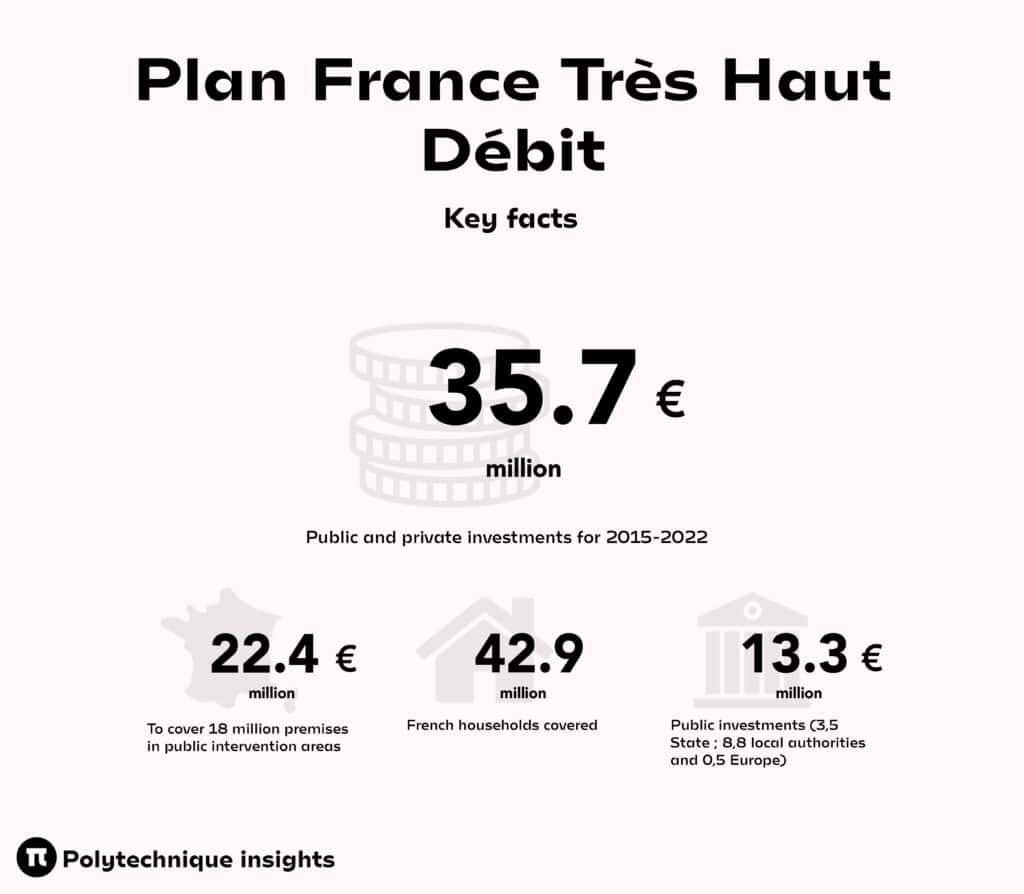
In 2015, 77.6% of the French population was still not connected to a broadband telecommunications network at home. Against this technological and social backdrop, objectives were set in 2013 to provide all of France with high-speed broadband connectivity – more than 30Mbit/s – by 2022. The aim was to encourage private investment to ensure coverage of the entire country – 43 million homes – while using public funds to finance areas where market shortcomings had been identified. To meet this ambition, almost 13 billion euros of public investment were planned and notified to the European Commission in 2016.
A successful national plan
At the end of the evaluation work carried out by France Stratégie, it was found that the France Très Haut Débit Plan (PFTHD)1 had been a success. By 2022, the initial coverage objectives have been achieved, with almost 100% of premises (99.2%) eligible for high-speed broadband, despite certain inequalities between regions and some difficulties in connecting final users. Technologically neutral, the Plan has relied on wireline and wireless technologies that are best suited to the specificities of each region. However, it has progressively broadened its objectives by prioritising the installation of fibre broadband in the home by 2025, the most efficient option capable of offering much higher speeds, in the order of hundreds of Mbits/s.
Another indication of the Plan’s success is its ability to target the same objectives in all regions, without distinction (dense or rural areas, metropolitan or overseas territories). France has thus become one of Europe’s best examples in terms of the deployment of fibre, whereas a decade ago it was ranked at the bottom. It should also be noted that this rapid implementation of a new national infrastructure was carried out while adjusting to each region’s specific requirements and controlling expenditure, which remained in line with the regulator’s cost estimates and did not exceed the budget.
This successful implementation of the PFTHD was made possible by the structuring of an efficient industrial sector, from the manufacture of cables to their installation in homes, representing a total of more than 40,000 jobs. By allowing the arrival of new players, and by reinforcing the expertise of private operators and local authorities who are potentially fully in control of their network, the existence of such a sector has been essential for the deployment, but it will be just as essential in the future to ensure the maintenance and resilience of the networks.
A network for uses and economic impacts
Echoing the massive rollouts, the adoption of fibre broadband is largely on track for private customers, who account for 79% of the total number of high-speed broadband subscriptions. Out of 31.5 million Internet subscribers, 18.4 million French people subscribe to a high-speed broadband offer, including 14.5 million to fibre – which amounts to 46% of the total number of Internet subscribers. In contrast, the level of adoption by businesses is still low – even if there is an upward trend in fibre subscriptions. Only 50% of businesses were subscribing to high-speed broadband in 2022, according to the industry’s figures. Faced with the speed of deployment and coverage, the transformation of uses and practices thus seems less rapid and less profound.
But coverage and adoption are not everything. The importance of high-speed broadband lies first and foremost in its expected impact. In this respect, the indirect effects of the Plan are already visible, even if, at the current early stage of deployment, they are still only weak indicators. But we can already observe that the arrival of high-speed broadband or fibre is accompanied by the maintenance and reinforcement of the appeal of all the regions: increase in the number of companies, increase in the added value or employment generated by the commercial sector, arrival of younger populations and greater resilience during confinements.
Rapid deployment, but lack of quality
Beyond these results, however, quality, network maintenance and effective access remain a cause for concern. Indeed, the counterpart of success in terms of coverage has been the priority given by all concerned to the speed of deployment. This has resulted in a widespread outsourcing of field operations, leading to many operators and subcontractors, without always having sufficient control over the quality of the services provided.
In order to achieve rapid deployment, there has been widespread outsourcing of field operations without always having sufficient control over the quality of the services provided.
The Plan has made it possible to organise the initial investments for the construction of infrastructures. But these infrastructures will have to be adapted to meet new uses and demographic changes. The funding envisaged for the moment for “routine” maintenance will not be enough. Future financing will have to be envisaged to ensure their technological upgrading, their adaptability to territorial transformations and the conditions of network sustainability.
The challenge today is therefore to ensure the quality and resilience of the infrastructures. This means securing the final connections, ensuring the high-speed broadband connectivity of the end premises – the most difficult and costly to cover – guaranteeing the maintenance and availability of the deployed networks, and ensuring their resilience in the face of climate and energy crises or cyberattacks.
What next?
The current challenge is therefore no longer just to finalise what remains to be done with the last connections, but also to retain and develop the skills acquired to anticipate and plan for the future. Providing an infrastructure is not enough. In addition to the economic effects that are beginning to be measured, the evaluation also emphasises the need to think in terms of stimulating uses and stimulating an application ecosystem. As one of our panellists said: “The adventure does not end when the connection is made, it has only just begun”.
These questions of how to anticipate the post-Plan period are being asked by all concerned. The role of the local authorities has been central to the success of the Plan, in particular thanks to the strong financial investments made to ensure that their staff become more qualified. They have created specific structures to develop expertise, pool resources and cooperate between regions: their role must now change from project leaders to ecosystem facilitators. For manufacturers, it is a question of anticipating the end of deployment by ensuring the conditions for the reorganisation of their activities in France and for international development, to enable jobs to be maintained and employees to be retrained in other digital technology areas. For the State and public players, the conditions of governance and sustainability of the commitment to the future of high-speed networks will also be raised, and even the question of their public ownership in the light of sovereignty issues.
The alliance between local authorities, the State and private operators within the framework of a national scheme has been particularly effective.
The collective success of the Plan was due to the adaptability of the relations between public and private actors and the regulatory framework: it made it possible to face a technological, legal, and economic environment that was uncertain at the outset. In this respect, the remarkable continuity of the actions carried out must be emphasised, despite the political changes that may have occurred at local or national levels. This continuity of objectives has enabled the various actors to remain committed to the projects over the long term. The alliance between local authorities, the State and private operators within the framework of a national scheme has thus been particularly effective, and in our opinion remains one of the most instructive experiences in terms of public policy management.