


According to Benchmark Mineral Intelligence (BMI)1, the price of the lithium-rich raw material spodumene rose by nearly 480% between January 2021 and January 2022. In January, for example, it jumped 45.5% to $2,400 per ton, up from $1,650 in December. Similarly, the price of lithium carbonate has increased fivefold over 2020 and similar price increases have been recorded for lithium hydroxide (lithium refined to various stages of purity) over the past year. BMI is forecasting that lithium prices will continue to increase for at least the next six months. But, what are the reasons for this staggering increase?
In 2019, economic market players thought that the supply of lithium was much higher than demand and that its price would go down2. The situation is completely the opposite now and we are observing a very high increase in demand.
Lithium is an important element in sustainable energy applications. Lithium-ion batteries, for example, dominate today’s market for rechargeable power storage thanks to the element’s low mass, large reduction potential and high energy density. These devices are also increasingly being used for batteries in electronics from smartphones to television as well as to store energy produced by solar panels and wind turbines and in electric cars.
Indeed, the association of European Automotive and Industrial Battery Manufacturers now forecasts3 that the EU battery market value will grow from €15bn in 2019 to an estimated €35bn in 2030 — with lithium-ion accounting for about half. The global market value will grow from €90bn to €150bn, so the price of lithium is unlikely to decrease in the near future.
Lithium and the energy transition
Europe’s New Green Deal, for example, which aims for carbon-neutrality for the continent by 2050, aims to slash greenhouse gas emissions by 55% by 2030 compared to 1990s levels and to reduce new car emissions to zero by 20354. This goal will require boosting the share of renewables to 40%. According to the World Bank5, the production of minerals, such as graphite, lithium, and cobalt, would need to increase by nearly 500% by 2050. And the European Council on Foreign Relations estimates6 that to achieve carbon neutrality by mid-century, it will require 18 times more lithium than it currently uses by 2030 and almost 60 times more by 2050.
We were fundamentally wrong in predicting what would happen. This is not surprising, as experts have often underestimated the adoption of new technologies. Renewable energy is a good example. Even though their adoption has grown exponentially, the International Energy Agency’s World Energy Outlook, for example, has consistently underestimated them year after year7. A similar situation has occurred with lithium.
Underestimating the importance of this market and the battery market in general has hampered the flow of capital into the industry along the value chain, meaning that demand is not currently being met and we will struggle to meet the high demand in the near future; for example, in electric cars, such as those from Tesla, for which there is a waiting list of months.
Difficult to mine and process
Another reason for the high price of lithium is that, although lithium is a relatively abundant metal on Earth, it is not easily extracted. Currently, it is extracted from deposits of a mineral called pegmatite and from brines by solar evaporation – an expensive and inefficient process that can take more than a year. Exploring for new sources can take 3–5 years, setting up mineral processing 2–3 years, and organising the whole supply chain and qualifying the workforce can also take a long time.
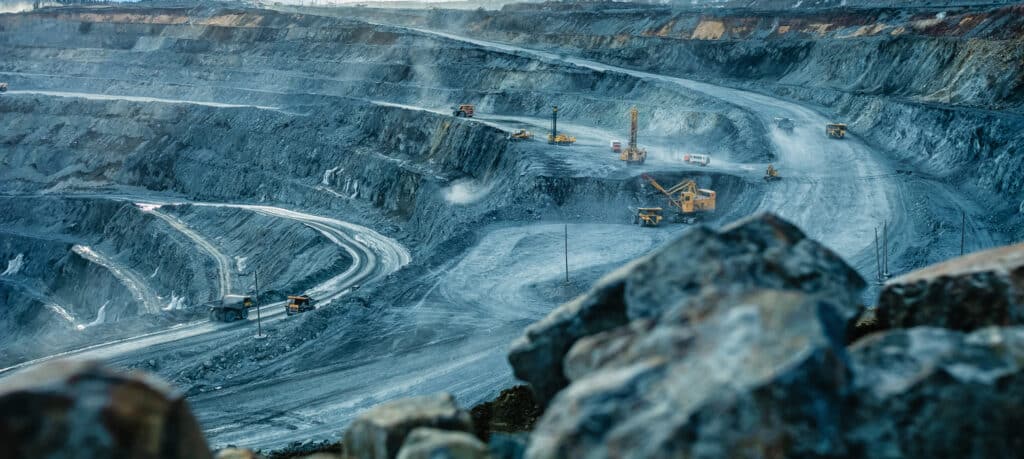
This is quite an exceptional situation: almost all the lithium we have in the world today comes from a handful of places in the world: 6 mining operations in Australia, 2 brine operations in Latin America (one in Argentina and one in Chile) and two (one brine and one mineral) in China. Almost all of its resources are then sent to China where 70% of lithium-ion batteries are produced8. This poses the problem of strategic dependence for Western economies as well as bottlenecks. Breaking this dependency will take a lot of time and effort, which, combined with the current geopolitical energy crisis, will inevitably drive up lithium prices – at least in the short term.
What should we do?
There are resources available in Europe and some projects are gradually being set up, but their fate is still uncertain. Beyond the resource, the concentration in the battery production market in China represents a very important barrier for the development of the electric car, in particular to achieve the decarbonisation objectives for private transport that Europe has set itself. This is where we can move faster by installing more gigafactories. Predictions indicate that we will have 35 gigafactories by 2035, with Germany as the first destination followed by France and Italy.
There are basically two things we need to think about now to improve the situation in Europe: the first is to invest more in lithium extraction in countries where it is more economical by diversifying where it comes from and our partners; the second is to invest in the whole value chain of the sector by positioning ourselves as a key player in battery production. Lithium for batteries has to be of a specific quality and its extraction is much more complex than that of coal, for example, so we have to invest in talent. This is where geopolitics can become an issue, because at the moment we are dependent on China for quality lithium processing. To solve this dependency, the US and Europe will have to join forces with countries like Chile, Argentina, and Australia. Doing so with the latter will be more complicated, as Australia and China currently have very good trade relations.