



Four billion people live at least one month a year with severe water shortages1. While the Earth’s freshwater resources are theoretically sufficient to supply the world’s population, the fact that they are unevenly distributed across the globe partly explains these shortages. The stakes are high: the water crisis is one of the five biggest risks identified in the World Economic Forum’s risk report2. Access to good quality water helps to ensure livelihoods, human well-being, socio-economic development, preserves ecosystems and a climate of peace and political stability.
Water stress, a global issue
In 2023, the World Resources Institute3 shows that 25 countries – home to a quarter of the world’s population – face extreme water stress every year. Qatar, Oman, Lebanon, Kuwait, Cyprus and others are consuming more than 80% of their available reserves. “However, we need to be careful about the difference between availability and access to water,” points out Marine Colon. “Access to drinking water requires infrastructure to collect, treat, store, and distribute water. It also requires organisations and an institutional framework that guarantees the sustainability of the service provided. Today, the lack of infrastructure and the failure of water services are the main obstacles to access to water”.
Water insecurity, unlike water shortage, considers the availability of the resource, but also access to distribution services, sufficient quality, and appropriate governance. “Technical solutions exist, such as desalination plants,” points out Stéphanie Dos Santos. “Desert countries with financial resources have no problem with access to water.” Some regions of the United States, Australia and southern Europe have major water deficits, but water insecurity is low there because of good governance, quality, and accessibility. Conversely, water availability is relatively good in many parts of Africa, but insecurity is high.
Climate change is clearly going to exacerbate inequalities
Since 2015, the Member States of the UN have committed to meeting 17 Sustainable Development Goals (SDGs) by 2030: universal and equitable access to safe drinking water at an affordable cost is one of them4. The situation has improved since then. The proportion of the population benefiting from safe drinking water has risen from 69% to 73% by 2022. But no region of the world is on track to meet the UN target – only 32 countries are on track, 78 are progressing too slowly and access to water is declining in 16 countries. Despite the commitment of governments, in 2022, 2.2 billion people will still not have access to safe drinking water5.
As for basic drinking water supply services, 703 million people are still deprived of them. “These international indicators assess access to water distribution facilities only, without taking into account the quality of the water,” adds Stéphanie Dos Santos. “They overestimate the proportion of the population with access to water.” For Marine Colon, these indicators, published each year by the joint UNICEF/World Health Organisation (WHO) monitoring programme, have provided continuous, universal monitoring since 2000: “They should be treated with caution, but they do give an order of magnitude.”
Some parts of the population are much more affected by water insecurity. For example, access to drinking water is highly correlated with a country’s income. By 2022, in less developed countries, only 60% of the population will have access to basic drinking water services, and 35% to basic sanitation services. Another observation is that the infrastructure needed to provide water is more available in towns than in rural areas (with the exception of Bangladesh, Bhutan, the Turks and Caicos Islands and Costa Rica). In 2022, 62% of people living in rural areas will have access to water that is managed safely. This figure rises to 81% for urban populations.
“It’s a question of installing infrastructure, but also of maintaining it,” explains Marine Colon. “The 1981–1990 Water Decade showed the lack of attention paid to the operation and maintenance of infrastructures: 40% to 60% of installations are generally out of order in rural areas6. It is vital to set up management systems to ensure the sustainability of infrastructure – training, supply chains for spare parts, equipment, funding mechanisms, etc.” The good coverage of urban populations masks other disparities.
The good coverage of urban populations masks other disparities. “People living in informal settlements find it difficult, if not impossible, to claim access to a water network”, says Marine Colon .This is particularly the case in sub-Saharan Africa, where the majority of the urban population lives in these neighbourhoods. Demographic growth, changing lifestyles, increasing pollution and accelerating urbanisation will continue to exacerbate these inequalities7.
Water widens gender inequalities
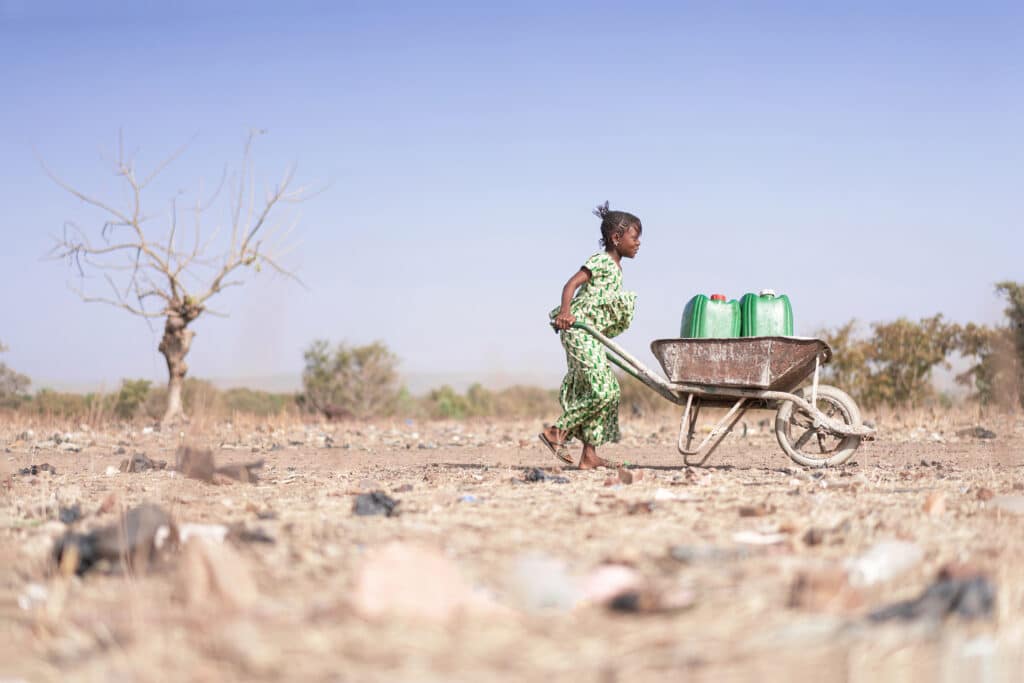
Another large part of the population is largely affected by the lack of access to water: women. Worldwide, 1.8 billion people collect water outside their homes, and in 7 out of 10 households, women are responsible for this task. “Access to water is at the heart of all development issues: schooling, poverty, gender,” adds Stéphanie Dos Santos. “When a child has queued all night at a collection point, or gets up early to fetch water, they can’t go to school.” This particularly affects women and girls in sub-Saharan Africa and Central and South Asia. The time spent per household collecting water varies from 55 minutes in Malawi to less than one minute in the Dominican Republic. In countries where water collection takes the longest, women are more responsible for this task: they can spend up to 10 times more time than men (Bangladesh, Chad, Gambia, Guinea-Bissau and Malawi).
In the future, the picture will be even bleaker. “Climate change is clearly going to exacerbate inequalities,” asserts Marine Colon. The availability of water resources will decrease, adding a billion people to the list of those living under extreme water stress by 2050.m In addition to the increasing scarcity of water in arid zones, other regions will be affected by a rise in extreme events.
“In Abidjan, the authorities are considering supplying the city with water from a lagoon,” explains Stéphanie Dos Santos. “However, the availability of water during extreme rainfall is an issue, because of the contamination of the water when the soil is washed away.” Other repercussions concern water distribution networks. “Extreme events are likely to deteriorate existing infrastructures, as happened during the floods in Derna (Libya) in 2023, and some infrastructures will no longer be suitable,” explains Marine Colon. “In some African towns, the level of boreholes is now becoming insufficient, or water intakes from reservoirs are being left in the open air.”
At a time when conflicts of use are already putting considerable pressure on water resources, climate change will exacerbate this effect. Demand for water is set to increase by 20–25% between now and 2050. It will explode in sub-Saharan Africa, rising by more than 150%. The proportion of displaced populations settling in informal settlements will increase as a result of climate change, sometimes provoking new conflicts. “In southern Tunisia in particular, we are already seeing conflicts over the use of water between the native population and the displaced population”, says Marine Colon. Stephanie Dos Santos concludes: “Investment and good water governance are essential.”