
Bitcoin: electricity consumption comparable to that of Poland



- As the price of bitcoin soars in 2024, so does the environmental cost of cryptocurrencies in general.
- Bitcoin’s high energy consumption is largely due to its mining system (the process by which bitcoins are issued and generated).
- For example, the annual electricity consumption dedicated to bitcoin mining is comparable to that of Poland.
- Scientists estimate that bitcoin’s water footprint between January 2020 and December 2021 is equivalent to that of 660,000 Olympic swimming pools.
- It is important to encourage greater transparency and regulation of cryptocurrencies, including the development of energy-efficient alternatives.
In 2024, the price of bitcoin soared, reaching its highest levels since its creation. Bitcoin is the most widely used cryptocurrency. Its market capitalisation reached over $1.3 trillion on October 21, 2024, compared with Ethereum’s $321 billion just behind. One bitcoin is worth over $67,000 (as of October 21, 2024). This surge has an environmental cost, which is also rising sharply. “Bitcoin is based on blockchain technology: by definition, computers perform identical calculations (around 15,000 times) to ensure the network’s security,” explains Jean-Paul Delahaye. “The protocol used for bitcoin has a very high energy cost; it’s an environmental waste.”
Bitcoin’s high carbon and water footprint
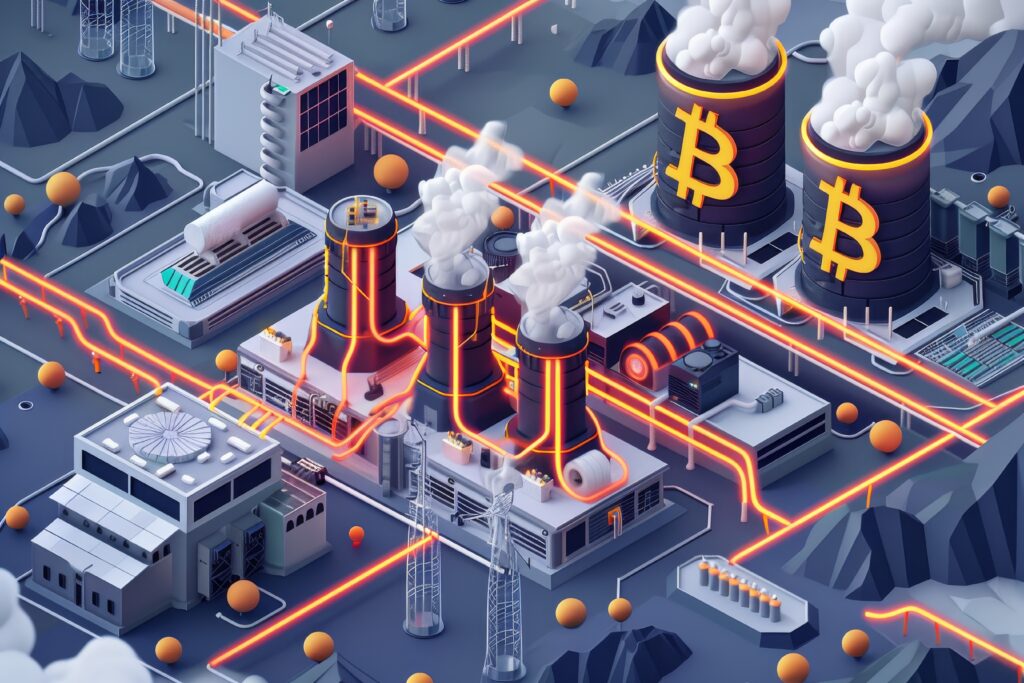
The annual electricity consumption dedicated to bitcoin mining [Editor’s note: the process by which bitcoins are issued and generated] is comparable to that of Poland. It is estimated at 155 TWh per year to 172 TWh per year (or 162 TWh per year according to the Cambridge Centre for Alternative Finance). The International Energy Agency (IEA), meanwhile, estimates that cryptocurrencies would have consumed 110 TWh of electricity by 2022, or 0.4% of annual global demand1.
As a result, bitcoin’s carbon footprint is significant, and some scientists are warning of the urgent need for action2. In 2021, bitcoin’s environmental footprint suddenly increased. While the majority of miners were based in China (73%), the country decided to ban bitcoin mining on its territory3. Most of the activity is now relocated to Kazakhstan and the United States. The carbon footprint of bitcoin mining is directly linked to the greenhouse gases released during the production of the electricity that powers the computers performing the calculations. The more carbon-intensive the country’s electricity mix, the higher bitcoin’s carbon footprint. The share of renewable energies powering bitcoin mining has fallen from 41.6% to 25.1% following the massive relocation in 2021. In 2022, the Cambridge Center for Alternative Finance estimates the share of renewables at 37.6% including nuclear power and 26.3% excluding nuclear power 4. As a result, CO2 emissions from bitcoin mining are estimated at 77, 85 or even 96 million tonnes of CO2 per year, depending on the source. By comparison, France’s equivalent CO2 emissions (all greenhouse gases combined) will amount to 385 million tonnes in 2023.
But the environmental impact of bitcoin mining is not limited to greenhouse gas emissions. In 2024, an article published in the journal Cell Reports sustainability5 estimates the water footprint of the cryptocurrency. The author estimates that it will amount to 1.5 billion litres of water in 2021. The culprit? The use of water for the cooling systems of the servers used for mining, and indirect use to produce electricity via the cooling of thermoelectric power stations. Other authors arrive at different estimates based on the environmental footprint of electricity production in the countries hosting bitcoin miners. Their estimates are much higher, due to the inclusion of evaporation from hydroelectric dams. They estimate bitcoin’s water footprint at 1,650 billion litres between January 2020 and December 2021 (the equivalent of 660,000 Olympic swimming pools), or around 800 billion litres per year. “I find the decision to include evaporation from hydroelectric dams in the water footprint of bitcoin mining a delicate one,” says Jean-Paul Delahaye. “It’s difficult to distinguish between water used for bitcoin and other uses.” As for the land footprint, for the same period it was estimated at 1,870 km2.
Reducing the environmental footprint of cryptocurrency by improving transparency and regulation
It is difficult to accurately calculate the environmental impact of bitcoin mining. There is no register of the machines used for mining and their exact energy consumption. “However, we do have a minimum estimate, which is enough to show that energy consumption is excessive,” asserts Jean-Paul Delahaye. The estimates are based on the “hash” computing power of the network – known to within a few percent – and on the minimum consumption by the best machines to produce 1 hash, which is an optimistic view of the hardware in use. “There are two main methodologies that have been developed in recent years to assess the energy consumption of the bitcoin network, one based on economic simulations and the other on technologies,” explains Christian Stoll. “But they produce similar results”. And with the rise in the price of bitcoin, the forecasts are fairly pessimistic: even if the relationship is not uniform, the higher the price of bitcoin – remember that it will reach record levels in 2024 – the higher the energy consumption will be6.
Bitcoin’s high energy consumption is linked to the way it works, as Jean-Paul Delahaye explained in a previous article: “The issue and circulation of bitcoin is managed by a network of computers that operates in a decentralised manner. Each computer on the network holds a copy of the “blockchain”, a file summarising all the information on the content of all the bitcoin accounts and all the transactions carried out on the network. To encourage new computers to take part in managing the bitcoin network, a reward is distributed every 10 minutes to one of them in a competition called proof of work. We know this process as “mining”, and it is precisely this process that involves a significant expenditure of electricity.” In 2021, around 2.9 million computing devices were dedicated to bitcoin mining. “Over the past 2 years, Ethereum has switched from a proof-of-work protocol to a proof-of-stake protocol: this has reduced the network’s energy consumption by at least a factor of 100,” points out Jean-Paul Delahaye. By improving transparency and regulation, developing alternative energy-saving cryptocurrencies and adopting greener blockchain validation protocols, the scientists are calling for several levers to be activated to reduce bitcoin’s environmental footprint.