What are the CO2 emissions of nuclear power?


- Many people in France think that nuclear power emits CO2, whereas the reality is quite different.
- To understand CO2 emissions, we must differentiate between the emissions of a technology during its operation as well as its overall carbon footprint, which includes those resulting from all phases of construction, operations, and decommissioning.
- Nuclear power has a very low carbon footprint, but it cannot meet peak demand on its own. It must therefore be complemented by renewable energies.
- Total emissions from each country's electricity mix is therefore important and in that respect France, as long as its nuclear power is strong, is very efficient.
- By way of comparison, in 2020, the emissions of France, Denmark, Spain, Holland and Germany were, respectively, 45, 102, 144, 290 and 300 g CO2eq/kWh.
In proportion to its population, France has the largest nuclear park in the world. Indeed, according to 2019 figures, 72% of French electricity comes from nuclear energy, 20% from renewable energy and 8% from fossil fuels. Nuclear energy enables France to be 50% energy independent, while allowing it to export electricity for profit.
Today, France’s objective is to reduce its greenhouse gas (GHG) emissions by 40% by 2030, compared to 1990 levels. It may have to decrease these even more, however, since Europe has decided to accelerate its decarbonisation programme with its “Fit for 55” objective (55% reduction by 2030) that takes into account carbon capture.
According to opinion polls, many French people still think that nuclear power emits CO2, but the reality is quite different. This misconception is understandable, however, since the energy transition programme states that GHG emissions need to be reduced but our reliance on nuclear power also.
What is nuclear energy?
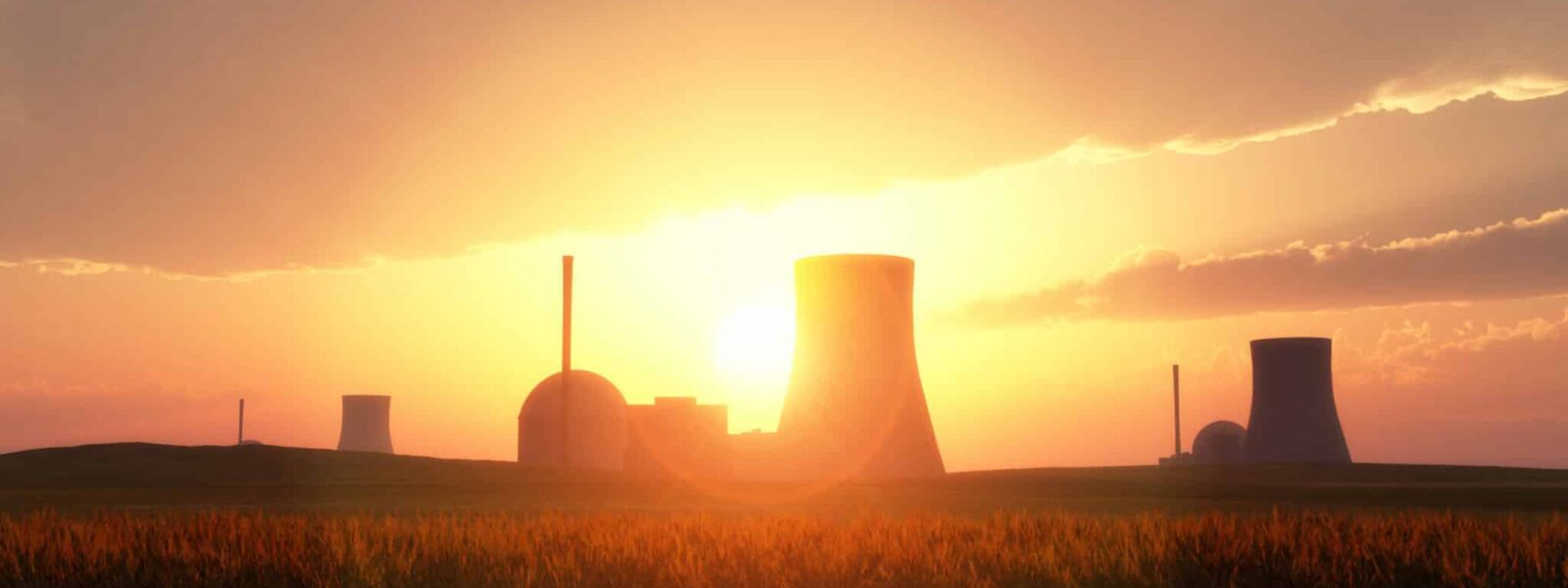
Nuclear energy is the fission of a fuel, uranium, which releases heat. This heat is used to heat water in the reactor to a high temperature of 330°C and a high pressure of 155 bars. A secondary circuit then produces steam at 220°C and 70 bars, which drives the turbine and the turbo generator.
How is the carbon footprint of nuclear energy calculated?
We need to differentiate between two concepts:
- CO2 emissions of a technology during operation: as for wind or solar energy, nuclear energy emits hardly any CO2.
- The carbon footprint, which includes emissions during the entire life of the installation, known as “from well-to-wheel”, that is, those resulting from all phases of construction, operation and dismantling.
There are two units of importance here: carbon dioxide emissions, expressed in grams of CO2 per kWh, or gCO2/kWh, and GHG emissions, which include all greenhouse gases in gCO2eq./kWh. The impacts of other GHGs are standardised as “CO2 equivalent”.
For example, in the case of nuclear power, in addition to construction, there is extraction of ore, enrichment of uranium by ultracentrifugation, transport, production and distribution of electricity and, of course, decommissioning and waste management must be considered, too.
Although such an analysis seems simple, these parameters are in reality extremely complex to assess, since they must directly take into account measurable activities as well as indirect contributions, possibly outside our borders. For example, for nuclear power France imports its uranium from mines in Canada, Australia, Niger and Kazakhstan, and must transport it after transformation to our ports. On the other hand, a significant part of the materials and equipment is available nationally.
If we look at other means of electricity generation, there is a massive amount of equipment that comes from abroad, such as wind turbines and solar panels, so we have to include their footprint in our own.
Nuclear power has a very low carbon footprint
The three technologies hydropower, wind and solar are very climate efficient. Even an error in assessment of a factor of two or three would not change this conclusion. Solar panels, although a little less efficient, still rank well. But, each country will benefit more or less from each of these technologies:
- Solar PV will be very efficient in a dry, low latitude climate, and certainly much less so near the Arctic Circle.
- Intermittent electricity will have to rely on backup capacity, which will very often be a natural gas plant, thus reducing its performance.
- Nuclear power itself will not be able to meet peak demand and will be supplemented by renewable energies, but also partly by fossil fuel power plants.
This is why we use the emission factor of each country’s electricity mix. From this point of view, as long as its nuclear power remains strong, France performs very well, if complemented by hydro and other renewables. By way of comparison, in 2020, the emissions of EU countries were the following (in g/kWh): Sweden (13), France (55), Austria (83), Denmark (102), Spain (190), Belgium (192), Italy (212), Germany (301), Holland (318) and Poland (724)1.
How do nuclear, renewable and fossil fuels compare?
We will limit ourselves to two reference documents, that of the ADEME (the agency of the Ministry of the Environment), and that of the IPCC (the Intergovernmental Panel on Climate Change), the former being rather hostile to nuclear energy and the latter neutral.
These figures are very comparable to those of the IPCC, with the notable exception of nuclear power, which has half the carbon footprint in France. This low figure comes from the fact that the Georges Besse 2 plant (for isotope separation), which enriches uranium, is powered by French electricity, which is remarkably carbon-free (unlike other countries that have mastered this technology and which still rely heavily on fossil fuels to produce their electricity).
Between opponents and supporters of this or that energy, the figures may differ, especially as the calculations themselves are technically complex, and may even be the subject of political choices: how can steel produced in each country be compared according to the level of technology and the use of coal of more or less good quality?
It is in this sense that the two assessments by ADEME and the GHG are interesting because they are very similar. The IPCC data have the advantage of being multinational, and the figures obtained are evaluated by experts from all over the world according to a highly structured process, with peer reviews.
But action is needed
To meet the objectives of the 2015 COP21 – which led to the Paris Agreement, signed by 195 countries committing to act to contain the rise in temperature below 2°C by 2100 – France must, like other nations, reduce its GHG emissions. This goal, which requires France to reduce its GHG emissions by 40% by 2030 (or even more with the new European targets, as mentioned), can only be achieved if it makes a radical shift towards a low-carbon economy.
An analysis of our country’s emissions clearly reveals the areas where action is urgently needed: in 2019, transport and buildings were responsible for 63% of emissions and it is repeatedly stated that we will have to reindustrialise our country if we want to reduce our carbon footprint. The solution can only come from an electrical vector which, according to the International Energy Agency (IEA), could carry 80% of the world’s energy needs by the end of the century (fossil fuels still provide three quarters of global consumption today).
Nuclear power, with its low carbon footprint and production flexibility, will necessarily play an important role, combined with hydropower and solid biomass (limited) to produce electricity when it is needed. These controllable productions will be supplemented by intermittent electricity, possibly based on a mass storage of electricity but they have yet to be demonstrated. This switch from a “fossil » society to an “electric” one is a real challenge, however, and will require huge investments. Being long term and highly capital intensive (this is true for both nuclear and renewable energies), our energy future depends on clear, robust and long-term strategies.
Political whims and often unfruitful quarrels have unfortunately weakened France’s position, as clearly evidenced by the surge in prices in the country this autumn. With a view to shutting down all our coal-fired power stations by 2024, having refused to launch new nuclear power stations for 15 years and forbidding the construction of natural gas-fired power stations, our controllable production fleet no longer has the necessary power. It is urgent to act, because even if nuclear power is relaunched, this will take more than a decade and we will not be able to avoid the construction of a few natural gas power plants as a transitional energy source.
In France, EDF has embarked on a major refurbishment of its reactors to extend their operation under the safety conditions recognised by the Nuclear Safety Authority. With the EPR2, it is also developing a new model that is more efficient in terms of both production and climate, with a gain of around 15 to 20%. We are still waiting on decisions, but the tide is turning and we can hope for a real relaunch of nuclear power in France and in Europe.
In parallel, many other efforts will have to be made to improve energy efficiency and reduce our climate footprint by repatriating industrial activities.
Interview by Isabelle Dumé
For more:
- V. Nian, S. Chou, B. Su et J. Bauly, “Life cycle analysis on carbon emissions from power generation – The nuclear energy example”, Applied Energy, no 1118, pp. 68–82, 2014
- https://www.ipcc.ch/languages‑2/francais/
- https://www.ademe.fr : base carbone ADEME
- https://www.edf.fr/groupe-edf/espaces-dedies/l‑energie-de-a-a‑z/tout-sur-l-energie/produire-de-l-electricite/l‑epr
- http://www.cap2030.com
Contributors
Jean-Pierre Pervès
Former deputy director of the CEA research center in Cadarache, then director of the CEA research centers in Fontenay aux Roses and Saclay. Areas of experience: operation and design of research reactors, nuclear instrumentation, design of small and medium power reactors, isotope separation, operation of research centers (waste, radiation protection, infrastructure, nuclear safety).