Energy in 4D: rethinking the energy transition as a strategic issue



- Changes in the energy sector can be analysed through four dynamics: deregulation, decentralisation, digitalisation and decarbonisation.
- These dynamics form a system of transformation that is redrawing sectoral boundaries, power relations and stakeholder strategies.
- Deregulation began in the 1990s with liberalisation policies that gradually dismantled public monopolies in favour of competitive markets
- Progressive decentralisation, meanwhile, has been made possible by the development of renewable energies and the falling cost of production technologies.
- The decarbonisation scenarios developed by the Réseau de Transport d'Électricité (RTE) show that carbon neutrality relies on a combination of levers: electrification of uses, energy efficiency, storage and network coupling, etc.
The energy transition is more a strategic than a technical issue. It corresponds to a profound transformation of the energy sector, which is radically changing its architecture, coordination mechanisms and value creation logic. The history of major technical systems shows that these transformations are less about linear breaks than they are about complex socio-technical recomposition processes, in which technologies, institutions and actors co-evolve1.
From this perspective, contemporary changes in the energy sector can be analysed through four interdependent structural dynamics: deregulation, decentralisation, digitalisation and decarbonisation. These dimensions are not isolated trends but form a system of transformations that are simultaneously redrawing sectoral boundaries, power relations and stakeholder strategies.
Deregulation: from vertical integration to the market
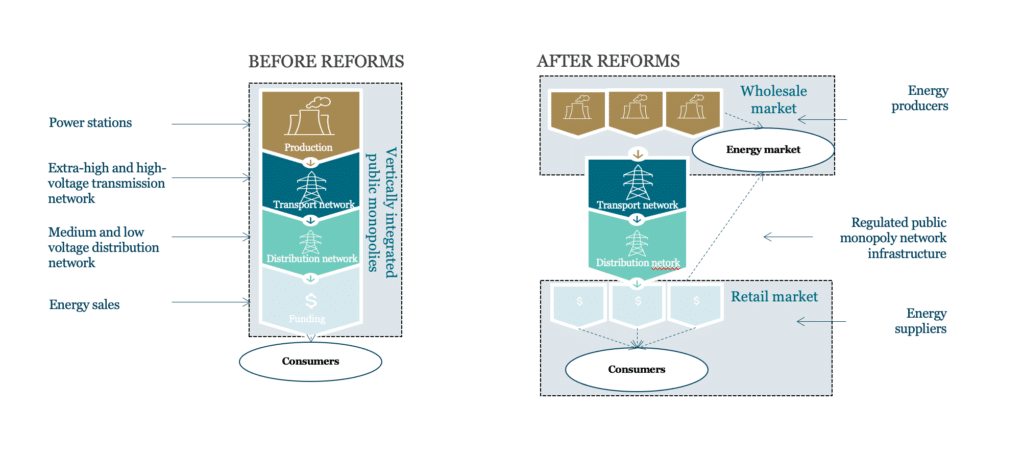
Deregulation was the institutional starting point for the transformation of European energy systems. Since the 1990s, liberalisation policies have gradually dismantled vertically integrated public monopolies in favour of competitive markets built around three key principles, the implementation of which may vary from one industry or country to another23.
- Opening up sectors of activity historically reserved for public monopolies to competition. This involves removing legal barriers preventing new competitors from entering the market.
- The dismantling of historically vertically integrated monopolies, such as EDF in France. Often accompanied by at least partial privatisation of the company, this involves vertically separating natural monopoly activities – which generally remain under state control – from service and production activities, which become competitive. In France, for example, this principle led to the creation of Réseau de Transport d’Electricité (RTE) and Enedis, which remain public monopolies separated (at least in accounting terms) from the competitive activities of energy sales.
- The establishment of an independent economic regulatory institution, which consists of institutionally separating regulatory activity from the political and administrative sphere. Sectoral regulators such as the Commission de Régulation de l’Énergie (CRE) were born out of this third principle.
Deregulation is therefore a form of (re)regulation of economic activities developed with the aim of separating politics from economics, while ensuring the proper functioning of economic and commercial activities within a particular sector. The aim is to minimise state intervention in the markets.
This development has profoundly transformed the governance of the sector (see Figure 1). The separation of production, transport, distribution and supply has encouraged the entry of new players – independent producers, alternative suppliers, aggregators – while maintaining the networks as regulated monopolies. While these reforms have helped to improve economic efficiency, they have also increased institutional complexity and the need for coordination between players4.
The merit order mechanism, which is central to wholesale electricity markets (editor’s note: where energy is purchased “wholesale” as opposed to “retail”), illustrates this tension. Designed to ensure efficient allocation in the short term, it nevertheless exposes consumers to high price volatility in a context of dependence on fossil fuels. Recent debates on the reform of the European electricity market highlight the limitations of this model in terms of the long-term objectives of security of supply and decarbonisation5.
Decentralisation: from network to usage
Deregulation has paved the way for the gradual decentralisation of the energy system, made possible by the development of renewable energies and the falling costs of distributed generation technologies (see Figure 2). The system is evolving from a centralised, linear and unidirectional architecture to a multi-level, multidirectional and usage-centric system6.
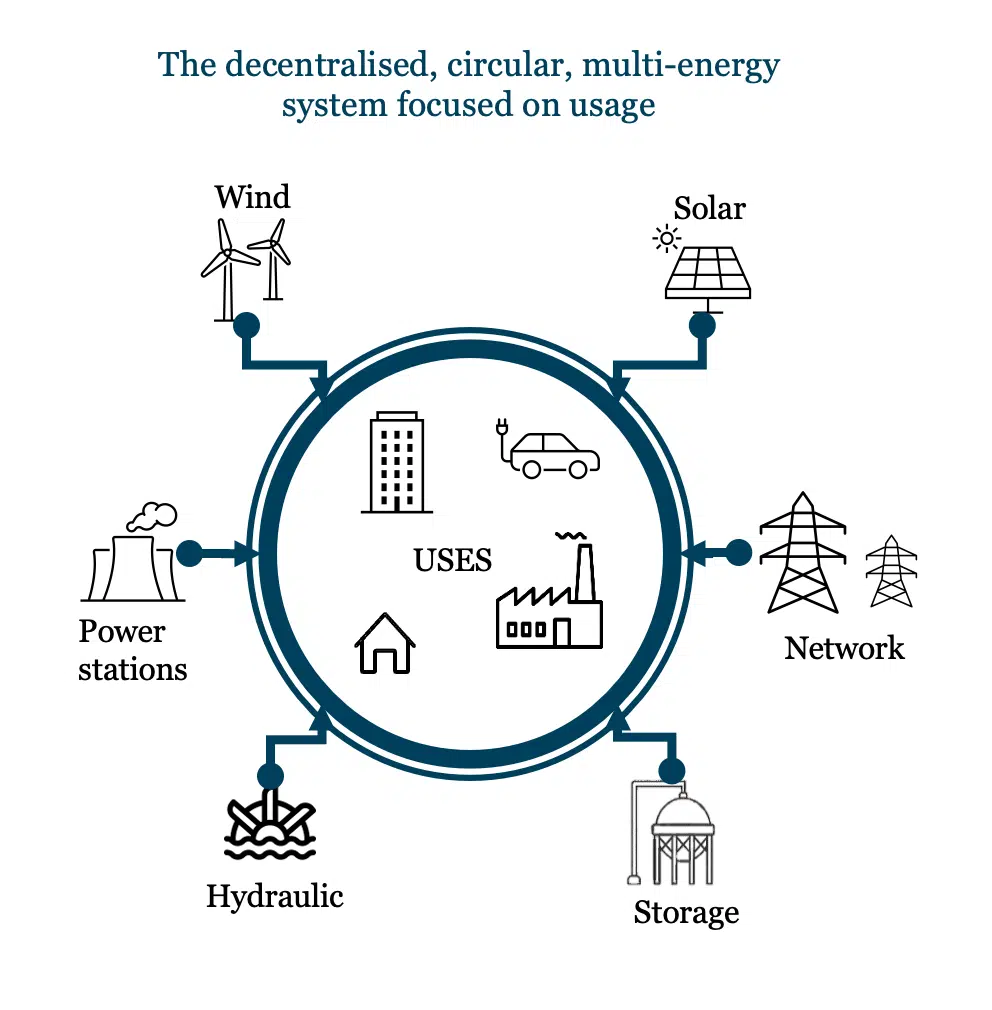
Analyses by the International Energy Agency (IEA) show that this development is fundamentally transforming the role of networks, which are no longer limited to transporting energy, but are becoming infrastructures for coordinating local flows, combining production, storage and usage, which can be mobilised or not like other assets in the system7. Similarly, vehicle-to-grid, or more generally vehicle-to-anything, which involves using electric vehicle batteries as a source of energy, is part of this decentralised energy architecture in which all system assets are interconnected8. Microgrids, collective self-consumption, energy communities and new-generation heating networks illustrate this decentralisation of energy in a usage-based approach.
However, this decentralisation raises major technical and governance issues. The coordination of heterogeneous actors at the local level requires specific institutional arrangements capable of managing the distribution of costs, risks and value. Furthermore, the management of multidirectional and decentralised flows poses new technical challenges for network balancing, while paving the way for “consum’action”9 (or prosuming) approaches associated with new economic models that have yet to be fully explored.
Digitalisation: towards a data-driven energy system
Digitalisation is the foundation that underpins all of these other transformations (see Figure 3). According to the IEA, digital technologies now permeate the entire energy value chain: production and consumption forecasting, asset management, smart grid management and the emergence of new energy services10.
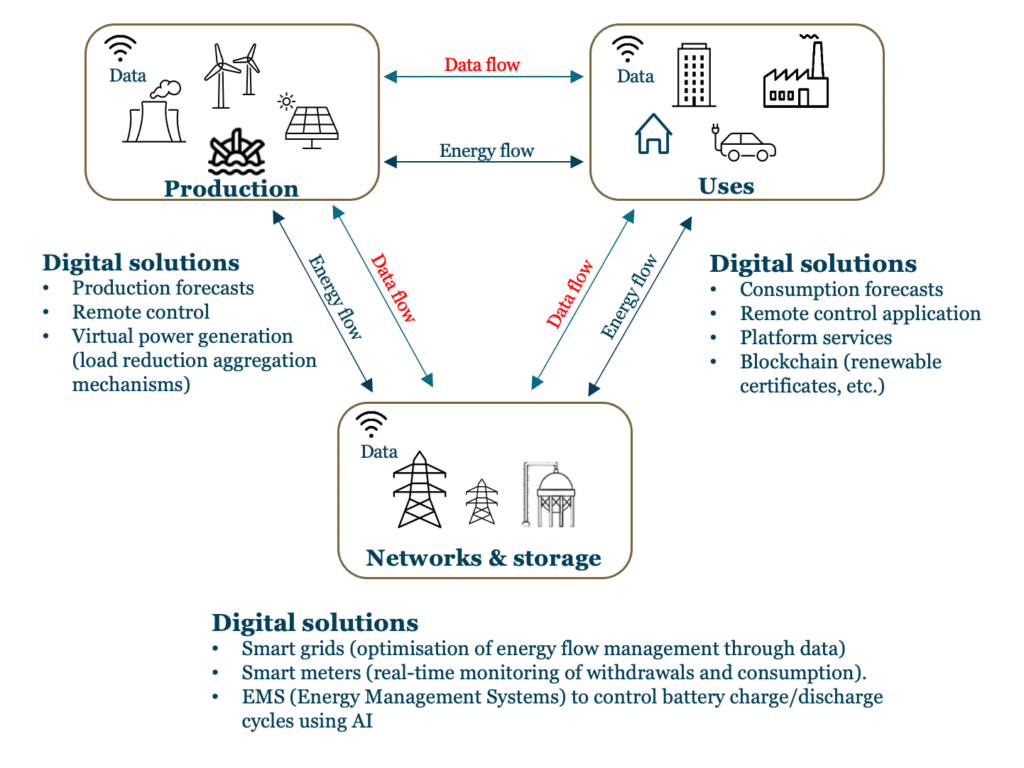
The deployment of smart grids, smart meters and energy management systems enables real-time management of increasingly complex energy flows, characterised by the variability of renewable energies and the proliferation of injection points. Digitalisation is therefore becoming a key lever for optimisation, but also a factor in the transformation of economic models and power relations within the sector.
Control over data, platforms and algorithms is now a key strategic advantage, with the potential to redistribute positions between established energy players and new entrants from the digital sector. However, this development is accompanied by growing risks related to cybersecurity, technological dependence and the sovereignty of critical infrastructure.
Decarbonisation: a systemic structuring process
Decarbonisation is both the central political objective and the structural process of the current energy system. It is not limited to a transformation of the production mix, but involves a global reconfiguration of uses, infrastructure and value chains11.
The forward-looking scenarios developed by RTE in Energy Futures 2050 show that achieving carbon neutrality depends on a combined approach: widespread conversion to electricity, development of renewable energies, energy efficiency, storage and network coupling12. None of these measures is sufficient on its own, confirming the profoundly systemic nature of the transition.
Academic studies also highlight that decarbonisation raises major industrial, social and geopolitical issues, particularly in terms of resource availability, social acceptability and infrastructure governance. It is therefore a long-term strategic issue that goes far beyond simple technological substitution13.
New areas of value
The interaction of these four dimensions gives rise to a non-linear energy system, which can be represented as a “spaghetti dish”, in which the traditional boundaries between sectors – electricity, gas, heat, mobility, industry – are blurred in favour of multiple points of conversion, storage and control (see Figure 4). As a result, the roles played by network entities are becoming intertwined, with consumers becoming producers (prosumers), waste becoming a resource (waste heat, biomass) and markets converging.
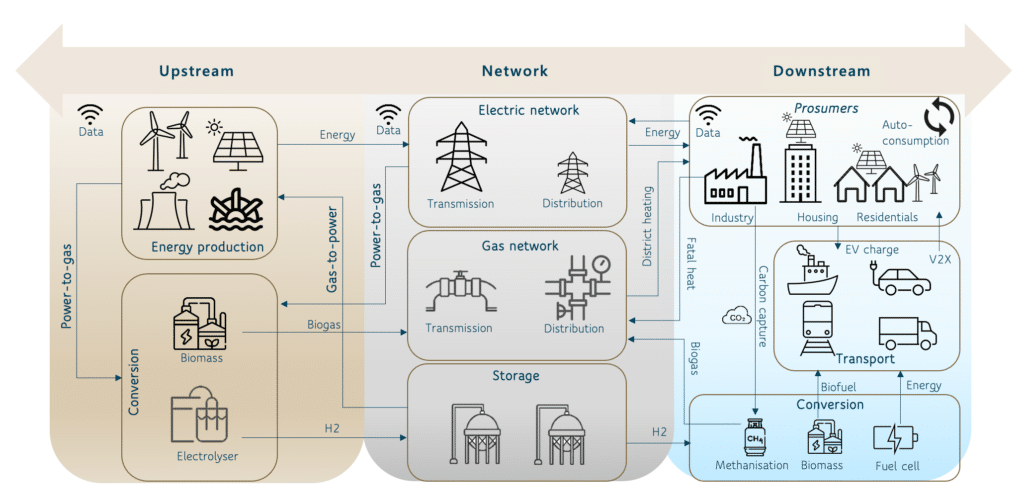
In this configuration, value creation is shifting towards interfaces: multi-energy integration, flexibility, user services, flow orchestration and data management. Players are repositioning themselves less by sector and more by function, blurring the distinctions between traditional energy companies, manufacturers, local authorities and digital players.
This strategic restructuring is accompanied by a profound transformation of economic models. Volume-based approaches are gradually giving way to service-based approaches (energy-as-a-service), resilience and systemic performance, in which the ability to cooperate becomes as strategic as the ability to invest.
Considering the energy transition as a strategic issue
The 4D energy system highlights a now well-established reality: the energy transition is neither linear nor solely technological. It constitutes a systemic strategic transformation, characterised by complex interactions between regulation, territories, technologies and uses14.
While these transformations open up major opportunities for innovation and value creation, they also increase risks: fragmentation of governance, systemic vulnerabilities and social tensions. To address these challenges, a strictly sectoral approach appears insufficient. The energy transition therefore calls for an integrated strategic approach, capable of coordinating infrastructure, institutions, economic models and territorial dynamics. Only then can the energy system evolve towards a model that is decarbonised, resilient and economically sustainable.