


The first ever direct observation of gravitational waves in 2015 by the LIGO Scientific Collaboration in the US is undoubtedly one of the biggest scientific discoveries of the last decade, or even this century. Six years later, what can we say about these waves, and why is it so important to study them?
Gravitational waves (GWs), first predicted to exist by Albert Einstein in 1916, allow for a brand-new way of looking at the universe. Before their detection, astronomers could only observe the sky using visible light, and other types of electromagnetic radiation (including infrared, ultraviolet and gamma rays).
While light is the propagation of electromagnetic fields vibrating in space and time, GWs are completely different: they are ripples in the very fabric of space-time itself. They can thus be emitted by non-luminous objects.
Studying black hole mergers
Creating such ripples in the (rather rigid) fabric of space-time is not easy though. Indeed, GWs can only be produced by accelerating very small and extremely massive objects close to the speed of light. The best candidates are therefore black holes (which are the most compact objects in the universe), and certain very dense stars known as neutron stars (which are between 1.4 and 2.4 solar masses with a diameter of less than 20 km). To compare, the Sun has a diameter of 1.39 million kilometres.
In general, an isolated black hole does not produce GWs. It needs a companion to which it remains bound for a long time (much like Earth is bound to the Moon) to form what is called a binary system. As they are extremely dense, the black holes deform space-time in their vicinity as they orbit each other, generating GW ripples that propagate across the universe at the speed of light.
As it emits these GWs, the binary loses some of the energy that binds the black holes, which end up spiralling ever closer to each other. This infernal waltz produces more and more intense GWs (that can travel billions of light-years across the universe) until the black holes eventually merge. From time to time, one of these binaries produces GWs with an amplitude that is just large enough to be detected when it reaches Earth, even though the signal is extremely weak.
The LIGO detection
The first signal from such a binary black-hole coalescence, which occurred approximately 1.3 billion light-years from Earth, was detected in September 2015 by an instrument called LIGO (for Laser Interferometer Gravitational-Wave Observatory)12. The coalescence includes the “inspiral” (when the black holes become closer), the “merger” (when they touch) and the “ringdown” (when the newly formed, bigger black hole relaxes into a steady state).
a single black hole of 62 solar masses. The 3 solar mass difference was entirely converted into gravitational energy carried by the GWs.
LIGO is a collaborative project with over 1000 scientists and engineers from more than 20 countries, and three of its members were awarded the 2017 Nobel Prize in Physics3. It took nearly 50 years of intense research to build the GW detectors, and in June 2016 the researchers announced that they had observed a secondary binary black hole coalescence4. The observation was made on 26 December 2015, and this time, the black holes were about 1.4 billion light-years away. Roughly 50 such merger events have been detected since this time. All these discoveries greatly advanced many research fields and kicked off the era of gravitational-wave astronomy.
Tiny length changes
Instruments like LIGO and other ground-based GW detectors, such as Virgo in Italy and Kagra in Japan, rely on an advanced sensing method called laser interferometry. This technique has long been used to detect different sorts of signals, but it had never been pushed to the limit needed to detect the very weak signals that GWs produce.
The LIGO facility basically works by sending twin laser beams down two 4 km-long “arms” arranged in an L‑shape and kept under a near-perfect vacuum. The beams are reflected by mirrors precisely positioned at the ends of each arm. As a GW passes through the observatory, it causes extremely tiny distortions in the distance travelled by each laser beam. The instrument is thus able to measure the local contraction and expansion of space-time caused by the GW.
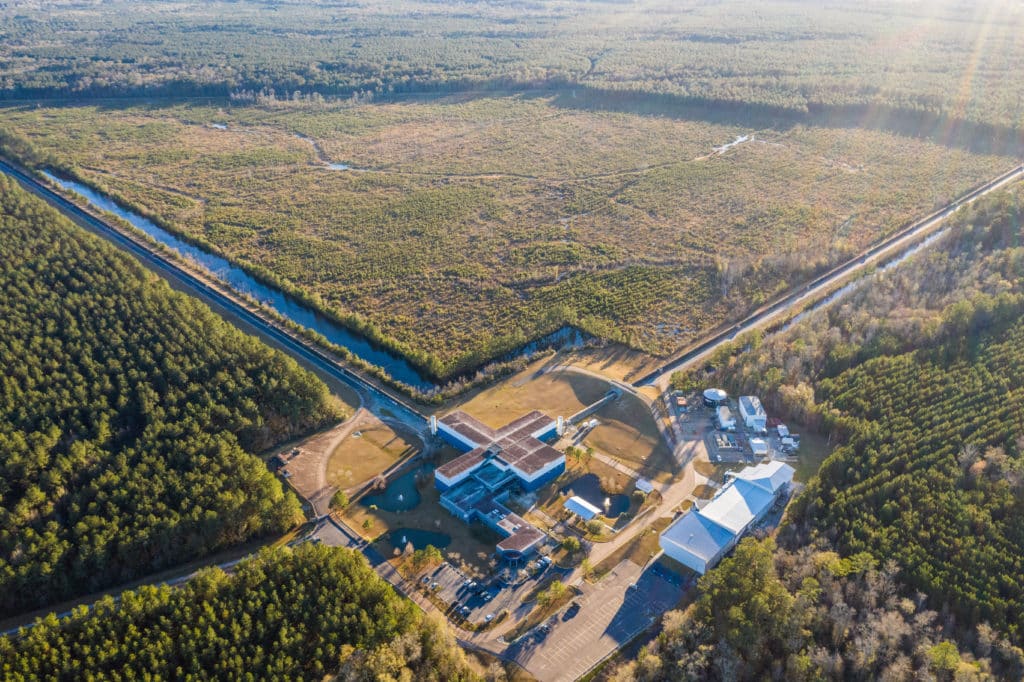
The extreme sensitivity of the instrument means that it is prey to all sorts of external vibrations (such as those from planes flying by and waves on a distant shore). LIGO engineers therefore had to design several ingenious noise-reduction systems that not only greatly enhance the precision of the detectors, but also allow them to differentiate between terrestrial artefacts and the precious GW signals.
By measuring how long it takes for the laser beams to travel along an arm, researchers can extract information such as the frequency and amplitude of the GW from the signal. These quantities are of major importance since they contain key physical information about the source of the wave, such as its distance from Earth and its position in the sky, as well its mass and whether it is a black hole or a neutron star.
Future detectors
The characteristics of interferometers like LIGO makes them sensitive only to gravitational waves within a certain frequency band, from about 10 Hz to 10 kHz, which corresponds to black holes of about 10 to 100 solar masses.
To extend this frequency range, the most promising future project is the Laser Interferometer Space Antenna (LISA)5. This European space-based observatory, due to come online in 2034, will target frequencies in the lower millihertz range to detect waves from the merger of much bigger black holes. These “supermassive” objects are found at the centres of most galaxies – including our Milky Way – and have masses that are millions or even billions of times that of the Sun.
LISA should also be able to observe “asymmetric” pairs, such as a neutron star orbiting a supermassive black hole, and even the so-called “cosmic gravitational-wave background”, which is very important for cosmology since it contains information about the primordial GW created right after the Big-Bang6. Far more precise than its terrestrial cousins, LISA will be a millions-of-kilometre-long instrument consisting of three tiny robots positioned in an equilateral triangle pattern in solar orbit just behind Earth.