What are the risks of nuclear power plants in wartime?






- The conflict between Russia and Ukraine is unprecedented in terms of nuclear safety. It is the first armed conflict in a country with a major nuclear programme: Ukraine derives about 50% of its energy from fission.
- A plant can be damaged in a number of ways: breaching missiles, a power cut leading to core meltdowns, etc. This can have serious consequences for the environment and the health of the population.
- Moreover, no specific treaty exists to deal with this threat. However, Protocol I and II of the Geneva Convention allow for “norms” of behaviour in wartime that should be respected.
- One of the most effective ways to minimise the risks would be to create a demilitarised zone around nuclear power plants to protect the population.
The recent occupation of two nuclear sites in Ukraine by Russian forces has highlighted the importance of monitoring such facilities in wartime. This is the first armed conflict in a country with a major nuclear programme: Ukraine derives about 50% of its energy from fission.
The world’s nuclear power plants were built in peacetime and were not designed to withstand all types of bombing. In times of conflict, the radiation monitoring devices of these facilities can be disconnected by the attacker, making it difficult to monitor the levels of radiation in the surrounding environment in real time in case of a problem.
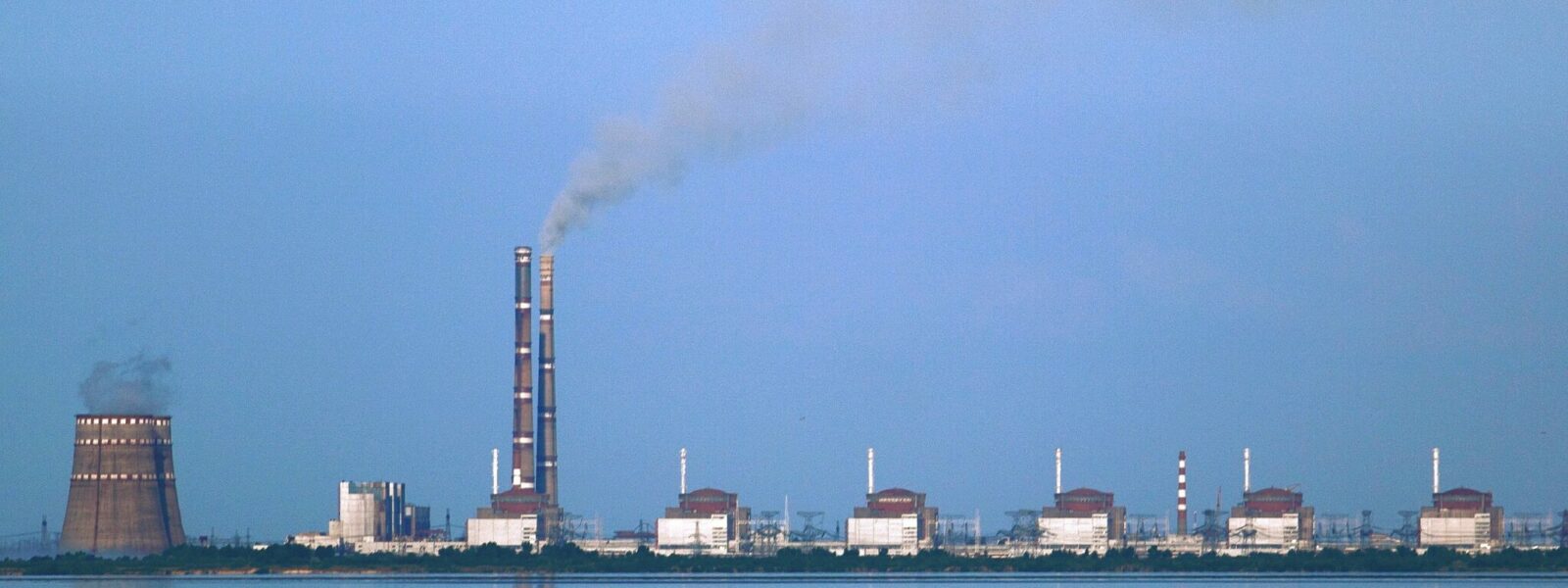
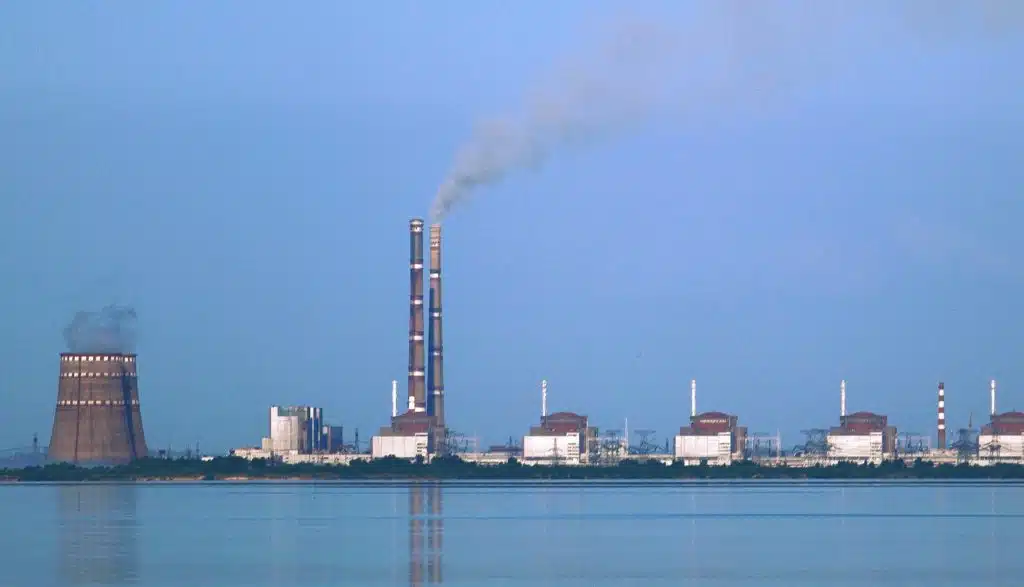
In Ukraine, the country’s nuclear regulator informed the International Atomic Energy Agency (IAEA) of its difficulties in communicating with staff at the Zaporizhzhia plant (one of the sites that is occupied), following the deactivation of some mobile networks and because Russian forces blocked the internet1. The IAEA considers that this situation is contrary to one of the seven pillars2 of nuclear safety3.
The dangers of spent fuel
A nuclear power plant can be damaged in a number of ways during a war: missiles can hit safety-critical reactor equipment – for example, breach the reactor containment and impact the core cooling systems, causing radioactive material to be dispersed over a wide geographical area; the power or water supply to a nuclear reactor can be disabled, leading to core meltdowns (as happened in the Fukushima accident)4. However, the Zaporizhzhia reactors are of relatively modern design and, unlike the Chernobyl reactor, are enclosed in a pressurised steel vessel, which is itself housed in a massive pre-stressed concrete containment structure. Such a structure is very robust.
Any damage to spent fuel assemblies – as a result of bombing, for example – could lead to a radiological emergency.
Nuclear reactors contain spent fuel during operation. Spent fuel contains an accumulation of highly radioactive fission products, including iodine, caesium and strontium. Any damage to spent fuel assemblies – as a result of bombing, for example – could lead to a radiological emergency (defined as a situation in which there is a risk of abnormal exposure to workers and the population living nearby).
Nuclear reactors are housed in buildings made of robust materials. They also boast a number of safety systems to ensure that the core remains cool, even if some of the systems are destroyed. That said, they were primarily designed to withstand a falling aircraft, for example, but not high-intensity projectiles, such as those used in warfare.
International regimes and treaties
The possibility of a nuclear risk in Ukraine is of concern to the United Nations Security Council, which held an emergency meeting in early March. The US ambassador said at that session that the attack on the Zaporizhzhia nuclear power plant “poses a serious threat to the world5”. In addition, the IAEA Board of Governors adopted a resolution condemning the Russian invasion and calling for Ukraine to regain control of its nuclear facilities. This resolution was in line with an earlier UN General Assembly resolution6.
The risk of nuclear reactor facilities being attacked in wartime has long been of concern7 and the international regime relating to attacks on nuclear reactors and associated facilities8 includes a number of treaties, agreements and “standards of conduct”.

No specific treaty
There is, however, no specific treaty, even though there have been a number of attacks on reactors in recent decades91011. However, as early as 1956, the International Red Cross proposed “immunity from attack for installations”, including nuclear power plants, where the attack might endanger civilian populations. This proposal eventually led to an amendment to Protocol I of the Geneva Convention12. Thus, even in the absence of treaties, this protocol and Protocol II13, as well as the other rules mentioned above, prohibit such attacks because they have created “norms” of international behaviour that should be respected.
The IAEA, for its part, has long recognised the need to prohibit armed attacks on nuclear facilities. In 1987, the Agency’s General Conference adopted a resolution concerning the protection of such facilities. It stressed that the consequences of a radioactive release would be widespread – literally – as it would affect territories within and beyond the borders of the attacked country. The Agency also highlighted the need to reach an international agreement on this issue14.
Demilitarised zones?
Although many experts do not want to be too alarmist15, wars are, by nature, unpredictable. According to Najmedin Meshkati16 of the University of Southern California, the only way to avoid a catastrophe is to establish demilitarised zones around nuclear power plants. “The IAEA, for example, should ask the attacking country to declare a no-fight zone around these facilities and, most importantly, allow plant operators to rotate their crews so that they can rest because human error is a major factor in such a situation,” he says. “The operators, who are the first and last line of defence in these facilities, work under conditions of intense wartime stress while worrying about their families and loved ones and the general consequences of war”17.
Veronika Ustohalova18 of the Öko-Institut in Germany adds that the power supply to a reactor must be maintained in the event of an attack, something that could be difficult to do in wartime, to ensure the reactor continues to be cooled and so avoid core meltdown. “During a conflict the safest solution is to shut down all nuclear reactors,” she says. “The problem is that in discussions on nuclear safety, violent conflicts or wars have so far been considered unlikely or not addressed at all,” she points out. “There is no international set of rules defining the criteria by which nuclear reactors in war zones should be shut down.”
Moreover, international norms may be difficult to enforce when the violating party is a major power.
The safety of French nuclear power plants
In terms of nuclear safety, Olivier Gupta, Director General of the French Nuclear Safety Authority (ASN) and President of the Western European Nuclear Regulators Association (WENRA) explains in an article published in Les Echos on 13 March that “WENRA and other international bodies have proposed support for the Ukrainian Nuclear Safety Authority, but it is not easy to implement”19.
In the event of a serious accident, there are actions to protect the population that could be implemented: “What could lead to the most severe accident, with the most releases into the environment, is a scenario with a core meltdown in an active plant. Based on the work carried out in 2014 following the Fukushima accident, it can be estimated that in the event of a very serious accident, without damage to the reactor building, it might be necessary to evacuate the population within a five-kilometre radius and to shelter those living within a 20-kilometre radius. If, on the other hand, we imagine an accident with loss of the reactor containment, we would have to extend these zones to 20 kilometres and 100 kilometres.”
An exclusion zone ensures that no one is exposed in the first few hours in the event of a core melt.
Karine Herviou, Deputy Director General in charge of the Nuclear Safety Unit at the IRSN (Institut de Radioprotection et de Sureté Nucléaire) adds, “most of the world’s reactors were reinforced [following the Fukushima accident] in the event of a loss of electricity. There are several lines of defence before core meltdown occurs. A reactor can self-power for a certain period of time and there are emergency generators with an autonomy of about ten days. Some of them are bunkered – that is, they are protected from the outside. These generators require fuel to operate; the sites have reserves to operate for about ten days.”
“Obviously, if external power cannot be restored and the site cannot be refuelled, there is a risk of core meltdown. However, some Ukrainian plants have an advantage over Fukushima: they boast systems that filter out radioactive releases – such as the radioisotope caesium, for example – in the event of a core meltdown. The loss of power supplies is a risk in a war situation that cannot be excluded. Indeed, this is one of the most important risks for us: the loss of power.”
What about the time it takes to cool down the plant in case of a grid failure, to remove the rods and allow the units to be shut down? “It takes months, even years. The proof is that the discharged assemblies, at cycle end, must be cooled for three years before they can be transported. They are then stored again in the pools at La Hague, where they are cooled once more.” The threat is therefore serious.
“An exclusion zone ensures that no one is exposed in the first few hours in the event of a core melt. Depending on the elements released and the radius of the exclusion zone, it may be necessary to take protective actions beyond this zone. There will be restrictions on the consumption and marketing of foodstuffs at least.”
“The power plant operating conditions are also important: the teams in place need peace of mind to work. In a war situation this is obviously not the case. This is another major risk for a reactor in a country at war.”
The conclusion is not a happy one: nuclear power plants are not compatible with war. As things stand, that the attacking power does not target nuclear facilities is perhaps all we can hope for. However, a site like Zaporizhzhia can also be considered unattackable for this very reason: the risk of a major nuclear accident. Indeed, after taking control in early March, the Russians immediately installed tanks and ammunition depots inside the plant because they were convinced that the Ukrainian army would never dare attack the site with heavy weapons20.