


A crop without prestige or mythological significance, soybeans have become a strategic resource in less than a century, serving as a lever of influence and an instrument of domination. Mainly used to feed livestock, this commodity has become essential to meeting the large-scale demands of our meat-based diet. Compared to other crops, “soybeans are the most dynamic: annual harvests are expected to double between 2000 and 2025, from 175 to 420 million tons,” says Olivier Antoine, CEO of the consulting firm ORAE Géopolitique and author of Géopolitique du soja (The Geopolitics of Soybeans)1.
China, birthplace of the soybean
Confined for thousands of years to northeastern China, in the province of Manchuria, soybean cultivation only slightly spread to Japan and Korea. Recognised for its protein content for both humans and animal consumption, soybeans spread throughout the world starting in the 1850s, with the Opium Wars. “The oil extracted from soybeans became very lucrative for China, to such an extent that it was its leading export product for many years, ahead of silk and tea,” adds Olivier Antoine.
At the beginning of the 21st Century, as China became an industrial power, a food transition took place: domestic demand for meat exploded. “To meet this demand, Beijing had no choice but to import soybeans, a key ingredient in livestock feed. The turning point came when the country shifted from being a producer-exporter to a producer-consumer, becoming the world’s largest importer.”
On the other side of the Pacific, shortly after Japan’s invasion of Manchuria in the 1930s, the United States decided to launch its own soybean production to meet domestic demand, eventually becoming the leading exporter and turning it into a powerful commercial, diplomatic, and geopolitical weapon.
Global consumption on the rise
Currently, the main producers are concentrated in North America, with the United States, and South America, with Brazil and Argentina. “These three countries alone account for around three-quarters of global soybean production and 80% of global exports. On the other hand, imports are mainly driven by China, which accounts for 60% of trade,” explains the researcher.
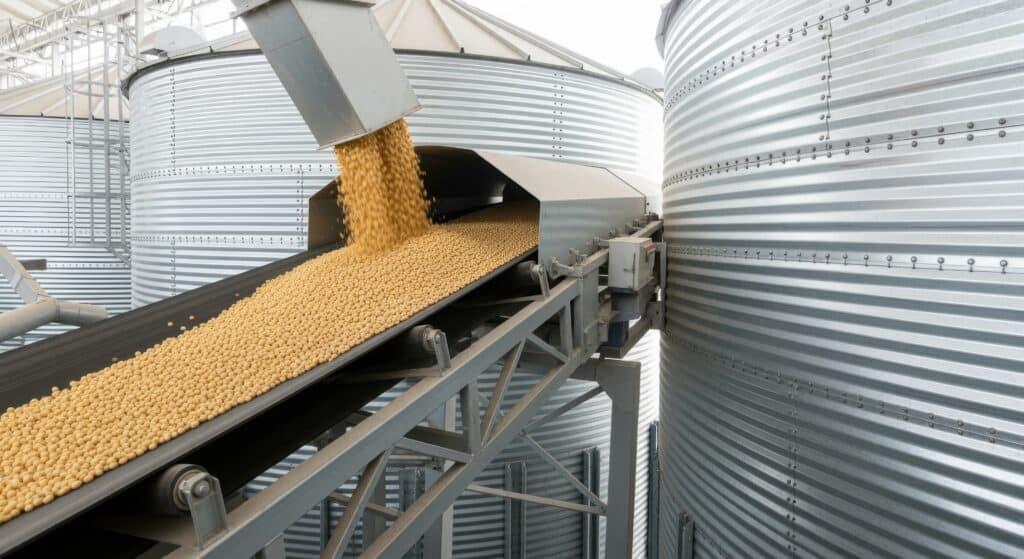
Elsewhere, in Asia, Africa, and Latin America, many countries are seeing their populations become wealthier and more urbanised and are incorporating meat into their diets. This nutritional transition continues to stimulate the soybean market. “It should be noted that around 80% of soybeans produced are used for animal feed.” The rest is sold in the form of oil for human consumption and is one of the three most widely consumed oils in the world.
Soybeans at the heart of the Sino-American trade war
Food security is one of China’s weaknesses, and the country remains dependent on imports for one of its most strategic commodities: soybeans. With a history marked by episodes of famine, Beijing is particularly cautious and seeks to protect itself from the risks of socio-political instability that could result from price increases. Its main supplier, the United States, is also its main geopolitical and geoeconomic adversary.
“In 2018, when Donald Trump decided to impose a 25% tariff on Chinese steel, Xi Jinping retaliated by imposing a 25% tariff on American soybeans,” continues Antoine Olivier. The doctor of geopolitics explains that American soybeans are produced in the grain belt (Illinois, Iowa, Wyoming), which is made up of strongly Republican regions that brought Donald Trump to power. Taxing soybeans is tantamount to striking at the American president’s electoral base. This customs retaliation cost the United States $28 billion in compensation and compensation nets for American soybean farmers.
Chinese investments: towards global control of production?
Beijing took advantage of this trade dispute to divert some of its purchases to Brazil. “By studying the soybean value chain, from seed to final processing, Chinese companies have become involved in every stage of production.” It finances logistics infrastructure to develop production areas in Brazil, Argentina, and Paraguay, and owns numerous processing plants.
The largest soybean storage and processing area in South America, in the port of Santos in Brazil, belongs to COFCO (China National Cereals, Oils and Foodstuffs Corporation). “This Chinese state-owned conglomerate is designed to compete with the four major American companies that managed 80% of the grain trade (ADM, Bunge, Cargill, Dreyfus).” Today, COFCO is one of the world’s largest soybean traders. China has succeeded in reducing its dependence on US imports and partially dominating the value chain of its new suppliers.
“The history of soybeans tells the story of the United States’ desire to become the world’s leading agri-food power. It accompanies Brazil’s entry into the court of nations while revealing the fragilities and contradictions of China’s rise to power. In short, soybeans are a revealing indicator of state strategies,” concludes Olivier Antoine.