Can medical advances cure HIV?


- It is possible to live with HIV but not to cure it, this is because it is a member of the retrovirus family, which is capable of inserting its genetic material into that of the cells it infects.
- However, there have been 3 apparent cases where HIV has been cured, each time through a bone marrow transplant for the purpose of treating leukemia or lymphoma.
- But bone marrow transplantation is not a treatment that can be applied across the board: it presents many risks, is difficult to implement and does not guarantee remission.
- The search for an effective vaccine is complicated due to viral adaptability: not all clinical trials have been conclusive.
- Even if we cannot cure HIV, we can reduce the risk of catching it with pre-exposure prophylaxis or with the right treatment we can live with it without being contagious.
Overshadowed since 2020 by SARS-CoV‑2, the Human Immunodeficiency Virus (HIV), is responsible for a pandemic that has lasted for over 40 years and has already been the cause of around 40 million deaths. In a previous article, we reported on the current situation of Acquired Immunodeficiency Syndrome (AIDS) in the world and on the progress of treatments and preventive approaches. A publication in the journal Nature in February this year, describing a patient who was demonstrably HIV-free1, has brought a fundamental question back to the forefront: can HIV be cured?
Marrow transplants and HIV
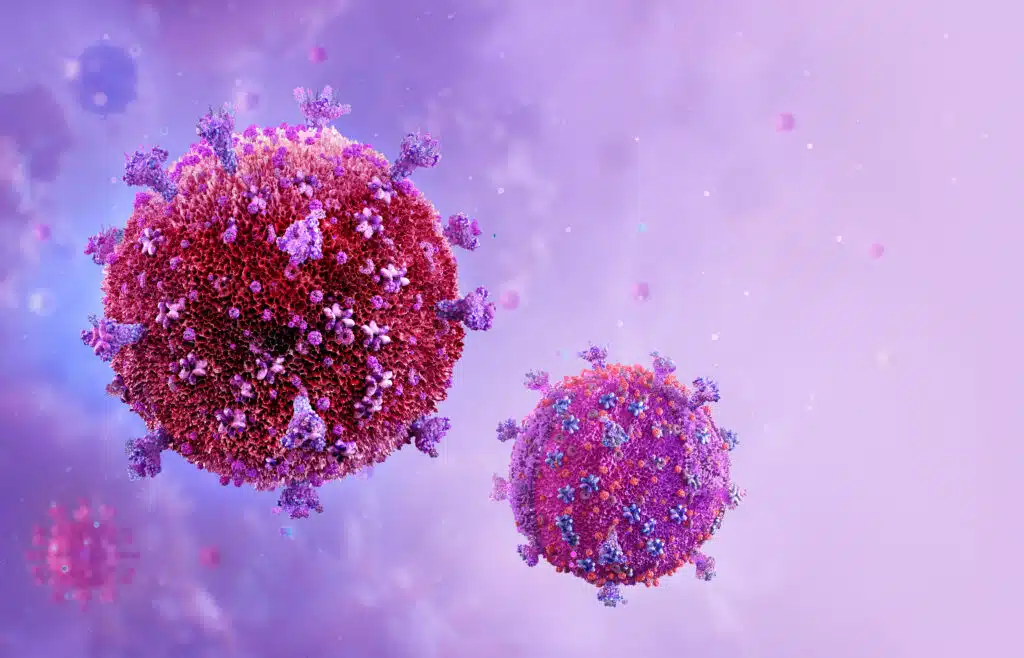
Today, thanks to tri-therapy, AIDS is now considered a chronic disease – it is possible to live with HIV, but it cannot be cured. This is due to a specificity of retroviruses, the family to which HIV belongs, which are capable of inserting their genetic material into the cells they infect. The viral genome can therefore remain hidden in the body and restart the proliferation of the virus if treatment is stopped. This persistent viral reservoir is the subject of much research and, although we know more and more about it2, it remains impossible to eliminate it effectively. With very few exceptions.
It is always difficult to talk about a cure for diseases that are known for being persistent, such as cancer or AIDS. Even if no trace of the disease is detected for long periods of time, there is no guarantee that this situation will be permanent. Specialists generally prefer the term remission and only use the term cure after a significant period of time, the length of which is necessarily arbitrary and varies from case to case.
However, three patients appear to have been “cured” of HIV, all of whom had similar treatment histories. The first, Timothy Brown, is known as the “Berlin patient”3. Having developed leukaemia, he was treated with a bone marrow transplant in 2007 to replace his blood cells. In the absence of detectable HIV, his tri-therapy was stopped in 2008 and no viral rebound was observed until his death in 20204. A decade later, in 2016, Adam Castillejo, the “London patient”, underwent a marrow transplant to treat lymphoma. His HIV treatment was stopped the following year and, after more than five years, the infection has still not returned5. Since February this year, the anonymous “Düsseldorf patient” has been added to the list! Having undergone a marrow transplant in 2013 to fight leukaemia, his antiretroviral treatment was stopped in 2018, with no resumption of the disease since. To understand how these transplants have helped control HIV, we need to look at molecular biology a little.
The few cases of HIV cures remain more interesting for research than directly promising for patients.
To infect a cell, HIV needs to enter it. This requires the envelope protein on the surface of the virus, which can be thought of as a molecular key, to meet the right locks. The main one is the CD4 receptor, which is found in particular on T4 lymphocytes. But it is not the only one, a co-receptor is also involved: it can be the CXCR4 protein or the CCR5 protein. The marrow donors selected for the transplants of the Berlin, London and Düsseldorf patients had been carefully chosen. In addition to being compatible with the recipients, they all possessed a mutation in the gene encoding the CCR5 protein. Called Δ32, this prevents the entry of HIV into the cells. After their transplants, the immune systems of all three patients rebuilt themselves from marrow carrying this mutation, and the HIV in their bodies found itself facing a closed door.
An exceptional treatment
The idea of a cure for HIV is exciting. However, there are a number of limitations that prevent this marrow transplant approach from being a treatment that can be applied across the board. The first is that the medical procedure is extremely cumbersome, can lead to death in about 10% of cases and has significant side effects. Its use is legitimate as a last resort in the case of treatment-resistant cancer, but in the case of HIV, the benefit-risk balance of triple therapy is indisputably better.
Moreover, in order to carry out such a transplant, a compatible donor must be found (which is already a delicate matter, as the campaigns calling for marrow donation remind us6) who is also a carrier of the Δ32 mutation. However, this mutation is rare. Its frequency varies according to the population but, at best, it is present in only about one person in a hundred: a rare find. An alternative is to produce a mixed graft, from umbilical cord stem cells and a donation, both of which are partially compatible. This approach was used in 2017 to treat a mixed-race woman with HIV and leukaemia. In March 2023, it was announced that the virus remains undetectable in her body despite her treatment having been stopped over two years ago7. It is possible that this remission will turn out to be a cure!

Finally, although it has received less media attention, not all patients who received marrow transplants with the Δ32 mutation have been cured of HIV. Whether this is due to problems with the transplant and the cancer it was intended to combat8 or to adaptations of the virus to dispense with CCR5 by using the CXCR4 co-receptor instead9, success is far from systematic.
The few cases of HIV cured to date are therefore more interesting for research than directly beneficial for patients, as are those of the few people who seem naturally able to control the virus10. The search for an effective vaccine is complicated by the virus’ capacity to adapt: all promising candidates have ended up being disappointing in phase 3 clinical trials, as the recent termination of the Mosaico trial reminds us11. However, even if we cannot cure HIV, we are far from helpless in the face of this virus! Pre-exposure prophylaxis, or PreP, considerably reduces the risk of catching it12 and treatments now make it possible to live with this virus without being contagious13.