Can AI replace animal testing?


- Given the effectiveness of AI in a wide range of fields, there is growing interest in using it to simulate living organisms and thus remove the need for animal testing.
- In research, animals are used to study and understand biological phenomena and to check the safety and efficacy of products.
- The 2010 European Directive provides a framework for animal testing through the three R’s: Replacement, Reduction and Refinement.
- Several uses for AI are emerging: “digital twin” systems, organoids, and biostatistics to “optimise” the use of animals.
- The debate is still heated, particularly over the use of substitute species, which are not covered by the law on the protection of animals in scientific research.
Artificial intelligence (AI) algorithms have proved to be highly effective when it comes to simulating human voices or the production of images. But are they also capable of simulating living beings well enough to make it possible to dispense with animal testing? The question has emerged in the face of growing concern around animal welfare. “We no longer think of animals as machines, and our society believes that humans are responsible for protecting them. In addition advances in ethology and animal psychology, and the emergence of concepts such as animal culture. All these factors are calling animal testing into question,” explains Jean-Michel Besnier, philosopher of science and professor emeritus of philosophy at Sorbonne Université. This societal concern coincides with a growing awareness of another issue. “It is not that easy to draw conclusions about humans from mice… What is the point of making animals suffer for results that are open to question?”
Animals are used in research for several purposes: to study and understand biological phenomena as part of fundamental research, and to check the safety and efficacy of a product or drug as part of regulatory and toxicological research. This issue has not been overlooked by the scientific community. The 2010 European Directive (2010/63/EU) provides a framework for animal testing through the three Rs: Replacement, Reduction and Refinement, which aims to reduce the suffering inflicted.
Replace
Can artificial intelligence systems replace animal testing? This is the aim of so-called “digital twin” systems. These are simulation programmes that, for example, mimic the biochemical or biophysical properties of human tissue. “This resource is increasingly used in the medical field, particularly in surgery, to give practitioners the opportunity to train before the procedure, on a simulation of an organ resembling the patient. This avatar reduces the risks involved in surgery,” continues Jean-Michel Besnier.
Toxicology is exploring another alternative avenue, that of organoids. These are three-dimensional cultures that are intended to represent an organ. “They are biological objects resembling an organ and produced in the laboratory from stem cells. However, it is not a real organ, and herein lie the limitations. There is no guarantee that the response of an organoid will be identical to that of a real organ,” explains Nicolas David, a developmental biologist at the Optics and Biosciences Laboratory (IP Paris), which is developing this approach(1)1. Similar systems are also envisaged for personalised medicine, to test the response of a patient’s cells before an anti-cancer prescription, for example.
Reduce
Fundamental research is certainly the field in which it is most difficult to replace animal testing. Recently, a team from Washington University School of Medicine in St Louis2 presented a machine learning algorithm capable of predicting how a network of genes and the regulation of their expression interact to construct the identity of a cell during development. The system predicts what drives a cell to become a muscle, skin or nerve cell, depending on the genetic levers activated. Called CellOracle, it compiles decades of research from around the world, drawing on public databases that catalogue known genetic interactions. For example, it can be asked what effect the disappearance of a gene will have in one of the model organisms that the software integrates. This saves researchers the trouble of designing animals that carry the genetic anomaly. “It’s an in-silico simulation of knock-outs,” explains Nicolas David, “animals whose genome contains a mutation preventing the expression of a certain gene.”
Certain molecular biology techniques have been reproduced so many times that they can be processed by a machine learning algorithm. “But if we are able to simulate a system, then we have understood it,” comments Nicolas David. Such systems save exploratory work or point to unexploited avenues of research, but their results are not infallible. Before embarking on an avenue and entering a phase of applied research, they need to be verified.
Refine
The systems also need to be verified using other mathematical approaches. “There are now biostatistical systems for anticipating the minimum number of animals that need to be used in research to answer a given question. This approach is deployed at the Institut Pasteur and helps us to reduce the volume of animal experiments through optimisation,” explains Jean-Baptiste Masson, a statistical physicist at the Institut Pasteur in Paris.
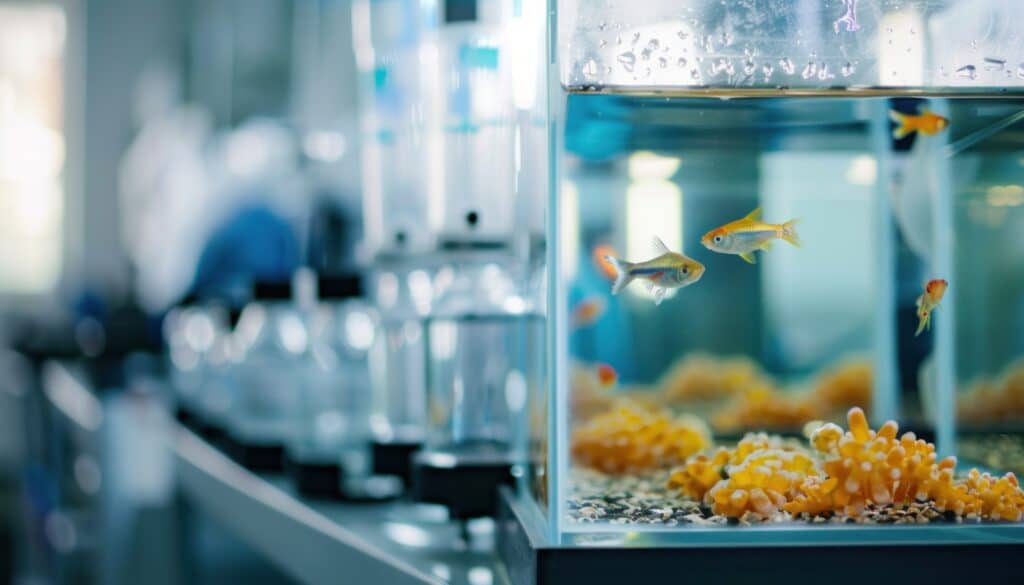
In recent years, new replacement approaches have emerged. Nicolas David explains: “Not all animals are recognised as sentient. We can try to use substitute species.” This may involve studying the earliest stages of development, before the organism is covered by the law on the protection of animals in scientific research3. “In mammals, this depends on the total gestation period. They are only protected after two thirds of normal development. The situation is more complicated when it comes to non-mammals. The law refers to an autonomous larval form. In fish, autonomy is interpreted as the ability to feed by itself, and therefore at the moment when the mouth opens,” explains biologist Nicolas David.
Finally, some teams are turning to invertebrate animal models, with one obvious constraint: the further one moves away from the human species in the evolutionary tree, the greater the risk that the conclusions will not be applicable to clinical research. This trend is also being challenged by the scientific community itself. Last April, 287 philosophers, ethicists, ethologists and neurobiologists specialising in animal consciousness signed the New York Declaration on Animal Consciousness4. This states that it is “irresponsible” to ignore the possibility that all vertebrates and several invertebrate species (such as cephalopods, insects and crustaceans of the crab and shrimp family) have a “conscious experience” in the light of a growing body of scientific research. The authors refer to groundbreaking work on bees5, octopuses6 and two species of snake7. This declaration therefore constitutes a precautionary principle in the face of the possibility that species used for scientific experiments may become conscious. All the more reason to resume the search for alternatives.