Fossil DNA: on the trail of human evolution


- Since the discovery of 2% of Neanderthal genes in the Eurasian genome, science has been studying the extinction of Neanderthals and the survival of Homo sapiens.
- Palaeogenomics allows us to observe the evolution of humanity through the genetic information of our distant ancestors.
- Our genetic heritage bears the traces of ‘selection pressures’ (climate, predation, sexual selection, or pandemics) that have shaped our species.
- Study of the DNA structure of Homo neanderthalensis explains its extinction by a selective disadvantage in the face of the ‘superiority’ of Homo sapiens.
- Palaeogenomics is fraught with difficulties, notably the conservation of ancient DNA and insufficient or missing documentation.
At the end of 2016, the news hit the headlines. Eurasians carry around 2% of the genes of Neanderthals, who disappeared around 40,000 years ago. This discovery, which was awarded the Nobel Prize in 2022, sheds light on the links between this species and our own and even suggests that they may have interbred on several occasions. Since then, new avenues have been opened up to understand the causes of Neanderthal extinction, as well as the factors that favoured the survival and subsequent expansion of Homo sapiens in the history of human evolution.
Ancient (or fossil) DNA is the key to accessing the genetic information of our ancestors. This tool is used by palaeogenomics, a discipline that combines DNA sequencing techniques with the analysis of ancient biological remains. By extracting and deciphering the DNA preserved in bones, teeth, hair, seeds and wood, scientists can access the genetic information of species, including that of our distant ancestors.
Ancient DNA: at the roots of the evolutionary tree
One of the first to succeed in ‘reading’ a fossil DNA sequence was biologist Allan Wilson, who in the mid-1980s sequenced DNA from a quagga, a zebra-like equine that had been extinct since the 19th Century. Biologist Svante Pääbo then went further back in time by sequencing preserved DNA from an Egyptian mummy. “Even though the DNA molecule is chemically more stable than RNA, its conservation over several millennia remained hypothetical. It was only after several decades of effort that we realised we could work on such ancient DNA”, explains Jean-Louis Mergny, Inserm research director and head of the biology department at Institut Polytechnique de Paris. Since then, the Swede’s work was rewarded with a Nobel Prize in Medicine (2022) and palaeogenomics is making giant strides. Jean-Louis Mergny emphasises that the emergence of this discipline “is a scientific revolution that enables us to go back in time to remote periods”.
This biochemist who is “fascinated by the unusual conformations and oddities of DNA” developed a passion for ancient DNA “after reading books on Neanderthals during lockdown and successive visits to the Musée de l’Homme”. As such, he initiated a research project to look for unusual structures in ancient genomes, first on a virus12, then on extinct human species.
The work that inspired the Jurassic Park saga was wrong; insect DNA is not preserved in amber.
The researcher has focused in particular on Denisovian and Neanderthal populations, two species for which the data (DNA libraries) are “available in open access and open to the scientific community”. The aim: to compare their metabolisms with those of anatomically modern humans (Homo sapiens) and detect genomic variations that could explain any selective disadvantage.
The problem is that fossil DNA is a fragile material. Time, chemical agents, micro-organisms and human manipulation degrade and contaminate it. Even Svante Pääbo, one of the leading figures in the discipline, encountered this difficulty when working on Egyptian mummies during his first attempts in the 1980s. “He realised afterwards that what he had sequenced contained parts of genomes that undoubtedly belonged to people who had manipulated the mummies”, recounts Jean-Louis Mergny.
Worse still, other less scrupulous teams subsequently published erroneous results based on DNA supposedly extracted from insects preserved in amber – the work that inspired the Jurassic Park saga. “We now know that DNA is poorly preserved in amber, and certainly not over tens of millions of years… science progresses through its mistakes!” smiles Jean-Louis Mergny.
In addition to the risk of contamination, which has now been partly brought under control thanks to stringent laboratory hygiene standards, multi-millennia-old DNA sequences are damaged and present themselves to scientists in highly fragmented form.What is an obstacle is also an opportunity, because, as the biochemist reveals, « we can more easily recognise what is old and unstable, and separate it from more recent contaminating sequences that remain intact”.
On Darwin’s shoulders: selection pressures and immune variations
Taking a journey through our genetic heritage, shows that it bears traces of the “selection pressures” that have shaped our species over the course of its history. These pressures are linked to changes in climate, the unavailability of certain resources, predation, sexual selection, parasites, and the emergence of pathogens. These constraints have ‘pushed’ our species to adapt and mutate its allele frequencies over the generations. In the catalogue of these selection pressures, palaeogeneticists are particularly interested in the impact of major pandemics on the evolution of our immune system.
In this context, scientists suggested in 20223 that European populations positively selected certain immune system genes that responded better to Yersinia pestis, the bacterium that caused the Black Death and decimated at least 50 million people in the 16th Century. Genetic markers of this episode are still present in Europeans, unlike populations in Asia or Africa, where the Black Death did not occur.
More broadly, in 2023, biologists Gaspard Kerner and Lluís Quintana-Murci (Institut Pasteur, Collège de France) published the results of a colossal palaeogenomic study, which compared 503 modern European genomes with more than 2,300 ancient genomes found on the continent and spanning the last 10 millennia. The scientists identified selection mutations in almost 90 different genes, including those coding for lactase (which enables milk to be digested), skin pigmentation (explaining the lighter skin colour of Europeans), and the immune response to certain infectious diseases (such as the Black Death).
Their work shows that these genetic mutations have a double-edged effect. They are positive in terms of resistance to infectious diseases, but negative in terms of the risk of developing autoimmune or chronic inflammatory diseases, such as diabetes or Crohn’s disease. This phenomenon, known as antagonistic pleiotropy, illustrates the evolutionary compromise that each living species makes to optimise its selective value.
The hidden structures of Neanderthal DNA
Let’s go back to Neanderthal. Jean-Louis Mergny has used this ability to determine the impact of selection pressures on the genetic heritage of a species as the basis for his current research. The biochemist has analysed Neanderthal mitochondrial DNA for genetic markers of evolution and links with Sapiens.
Remember that our researcher prefers non-conforming and ‘rebellious’ DNA to ‘the canonical double-helix structure’. This is why he focused on original genetic sequences located in the G‑quadruplexes (G4). “These are four-stranded secondary structures that form nodes in the genome”, he explains. However, the Neanderthal mitochondrial node “is much more ‘complicated’ than ours”, which would make replication of its mitochondria more difficult, “at least in the Homo sapiens context that we know”. Since these organelles are considered to be the energy powerhouses of cells, their poor reproduction is a priori a selective disadvantage for this species… “Unless Neanderthal had more efficient enzymes for unwinding these knots”, he adds.
All that remains now is to analyse the ‘nodes’ of its nuclear DNA: if the Neanderthal genome is now available, it was at the cost of titanic efforts. There was a great deal of selection pressure on this species and many hypotheses have been put forward as to the causes of its disappearance. For example, Homo neanderthalensis did not die out as a result of a cascade of food poisoning, poor tolerance of smoke inhalation, an insufficiently varied diet or excessive cannibalism. It is even less true that his cognitive abilities were too weak; he was undoubtedly very creative. But he had to contend with Homo sapiens, a “super-efficient” humanity as described by archaeologist Ludovic Slimak, who rushed to occupy the spaces left vacant by Neanderthal.
Neanderthal is not the Homo stupidus we have long imagined
“Palaeogenomics shows that Neanderthals were not the Homo stupidus we have long imagined, quite the contrary,” maintains Jean-Louis Mergny. We now know that they had the same genetic predisposition to language as Homo sapiens (the FOXP2 gene has been identified, including in its promoter regions); that, by practising patrilocality4, they avoided inbreeding as much as possible; and that they not only cohabited with Sapiens, but also assimilated (hybridised) with him. Children were born of this hybridisation, and humans of European origin today retain a visible trace of it in their genetic heritage, with an average of 2% Neanderthal DNA.
Many research teams around the world are now paying close attention to this heritage. Recent studies have shown that Neanderthal alleles have had an influence on our species in terms of immune response5, susceptibility to Covid-196, skin pigmentation7 for UV resistance, the sleep cycle8 and lipid catabolism9 (the breakdown of lipids to produce energy).
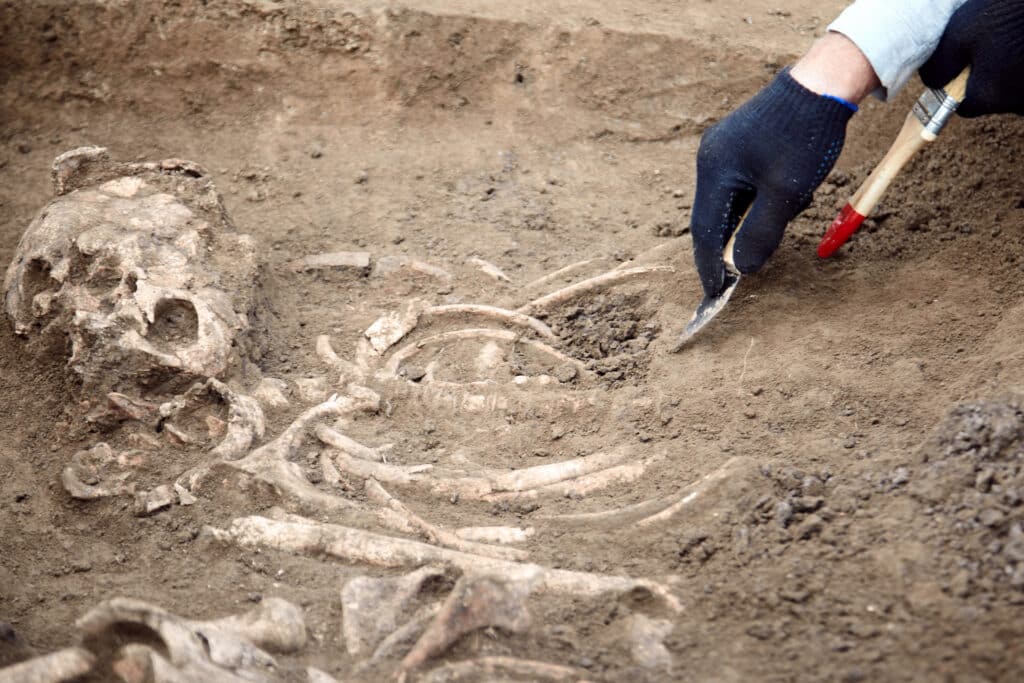
Palaeogenomics sheds light on the evolution of humankind and its immune system. But this discipline comes up against a major obstacle: the conservation of ancient DNA. This depends on the climate of the regions where the human remains were discovered. Temperate or cold areas of Europe are more favourable than tropical and humid zones, where other species or human lineages that have now disappeared probably lived. “This skews our perception of humanity », stresses Jean-Louis Mergny, especially in Africa, the cradle of our species. Finally, he stresses that palaeogenomics only makes sense “if it is combined with other disciplines such as archaeology and palaeontology”. It is difficult, for example, to date a bone precisely unless it has been discovered during rigorous excavations, which are absolutely necessary but extremely time-consuming. Unfortunately, most of the samples we have come from relatively old excavations, with insufficient or missing documentation. The proximity of two bones does not necessarily indicate that they are contemporary – hundreds or even thousands of years may have elapsed between the two deaths. But extremely rigorous analyses can sometimes answer this question.
New technical advances will undoubtedly reveal new fragments of humanity’s genetic heritage… or of these plural humanities. “If I had discovered this universe at the age of 20, you would probably have interviewed me on an excavation site,” concludes Jean-Louis Mergny.