Towards a quantum internet thanks to teleportation


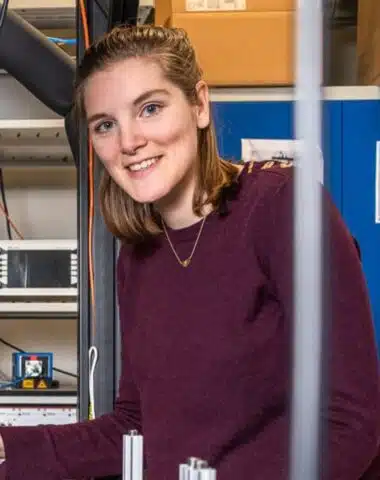
- Thanks to recent discoveries, researchers are developing a quantum internet in which “qubits” will be sent by quantum teleportation.
- This “unbreakable” teleportation corresponds to the instantaneous transport of a quantum state between distant particles.
- For the first time, a team at QuTech has succeeded in creating a quantum network with three network nodes.
- Once developed, this system will be able to carry out more complex protocols and be integrated into networks for practical use.
This article is part of our special issue « Quantum: the second revolution unfolds ». Read it here
Researchers at QuTech’s Ronald Hanson Lab (a collaboration between Delft University of Technology in the Netherlands and TNO) are working on the transmission of quantum information using quantum bits (qubits) in diamond. They recently demonstrated that they could transfer this information between two non-directly connected nodes by quantum teleportation – a first. Ultimately, this type of teleportation could be used to create a quantum internet, as it is robust and “unbreakable”.
Quantum teleportation often makes us think of Star Trek. While teleportation is not possible for objects such as human beings, it is possible for quantum states encoded on particles that behave according to quantum mechanics. The process does not involve any physical transfer of matter, but the instantaneous transfer of a quantum state between particles separated by an immense distance. It is erased on the sender’s site and appears immediately on the recipient’s site.
Spooky action at a distance
The basic idea behind teleportation is that two network nodes, traditionally called Alice and Bob, share a pair of entangled particles (in quantum cryptography, Alice is the sender of a message and Bob the receiver). Entangled particles are those that remain linked in a way that is impossible in classical physics, no matter how far apart they are. Albert Einstein called this effect “spooky action at a distance”. Alice then interacts with a third particle – in an unknown state – with her half of the entangled pair, measures the outcome of the interaction and informs Bob of the result via a classical channel. Armed with this information and a measurement of his half of the entangled pair, Bob can reconstruct the original unknown state, which is the one that was teleported.
Teleportation was first proposed theoretically in 1993 and demonstrated experimentally for the first time in 1997 with the teleportation of the polarisation of a photon. Since then, several teams of researchers have teleported the states of atomic spins, nuclear spins and trapped ions, to cite but three examples. Researchers have also succeeded in teleporting “two degrees of freedom” – spin and orbital angular momentum – between individual photons.
A three-node quantum network
Ronald Hanson and his colleagues recently produced the first ever three-node quantum network using “nitrogen vacancy centres” (NVs) in diamond as qubits. Nitrogen vacancy centres are defects in the lattice of carbon atoms in the material in which a nitrogen atom has substituted for a carbon atom. Each node contains a communication qubit and one node also contains a memory qubit that can store the quantum information in the node.
To teleport quantum information from a sender to a receiver, their respective qubits need to be entangled. When a “Bell state measurement” is performed on the sender’s qubit, its quantum state is teleported, that is, it disappears from the sender’s node and appears at the receiver’s node. This quantum state, which arrives in encrypted form, can then be decrypted using the result of the Bell state measurement, that is, by sending it to the receiver via a conventional channel, such as an optical fibre.
Until now, this process had only been demonstrated for two adjacent network points, Alice and Bob. Adding a third point (called Charlie) is not easy, as the entanglement between Alice and Charlie must be created via Bob. The entanglement must also be of a high fidelity for teleportation to succeed.
A host of improvements
Ronald Hanson and his colleagues achieved this by installing additional detectors that better identify “false” signals from unwanted photons emitted in their system. They have also improved the memory used to store information by protecting the memory qubit from interactions with the communication qubit and the crystalline environment. These interactions cause a phenomenon known as decoherence that makes the qubit lose the quantum information it contains. Finally, they improved qubit memory-readout by filtering out ‘bad’ readouts in real time, which ultimately increases fidelity.
All these measures allow them to teleport quantum information between the non-adjacent Alice and Charlie nodes. To do this, they first entangle Alice’s and Charlie’s qubits via Bob’s qubit. Charlie then stores part of the entangled states at his memory qubit and prepares the quantum state to be teleported on his communication qubit. Applying the Bell state measurement at Charlie teleports the state to Alice.
The researchers are currently working on increasing the number of memory qubits, which will allow for more complex protocols to be executed. They are also considering integrating conventional optical fibres into their experiment. This would help take the technology out of the laboratory and into networks already in use in the real world. Finally, the development of a quantum network “control stack”, similar to that used in today’s internet, will also be necessary for a future functional quantum internet.
Interview by Isabelle Dumé
References: