Africa: five ways to rebalance the value of agri-food chains



- The economic value of a product lies in the post-farm segments, with less than 20% of the final value of products going to upstream agriculture.
- This inequality in value capture can be explained by the location of high value-added operations, which are located in northern countries.
- Agri-food chains are organised around four main segments: primary agricultural production, industrial processing, logistics and distribution, and intangible services.
- For Africa, building food sovereignty involves a gradual shift towards these high-value segments in order to transform its agricultural potential into inclusive and sustainable economic development.
- Three levers are necessary for this transition: social innovation, scientific investment and territorial structuring.
Africa is making an increasing contribution to global food supplies. However, this development is accompanied by a structural imbalance: the continent remains largely excluded from value capture in international agri-food chains. High value-added activities – processing, logistics, distribution, research and development, financial services – remain mainly concentrated in northern countries. This configuration means that Africa provides the production while other regions capture most of the economic margins. At the same time, one in five Africans remains undernourished.
Agri-food chains are organised into four main segments: primary agricultural production, industrial processing, logistics and distribution, and intangible services (finance, certification, research, intellectual property). Economic analyses show that the share of value captured by upstream agriculture remains limited, generally less than 20% of the final value of products. Economic value is concentrated in post-farm segments, which are characterised by high capital intensity, strong technological content and significant barriers to entry.
This concentration explains why these activities are located in developed economies, whose roots lie in the economic organisation inherited from the colonial period. The export structures established during this period have shaped a system in which Africa focuses on primary production, while high value-added operations remain located elsewhere. A current challenge for the region is therefore to enable African territories to retain more economic value and strengthen their food sovereignty.
A three-pronged transition
For Africa, building food sovereignty involves a gradual shift towards these high value-added segments. This transition requires a combination of three levers: social innovation to transform organisational relationships and strengthen collective capacities, scientific investment to develop technologies adapted to local contexts, and territorial structuring to create favourable ecosystems. These changes will determine the continent’s ability to transform its agricultural potential into inclusive and sustainable economic development.
Social innovation is a key driver in this regard, offering solutions to problems that neither market mechanisms nor traditional public policies can solve on their own. Here are five possible areas for transformation.
#1 Strengthening the capacities of local actors
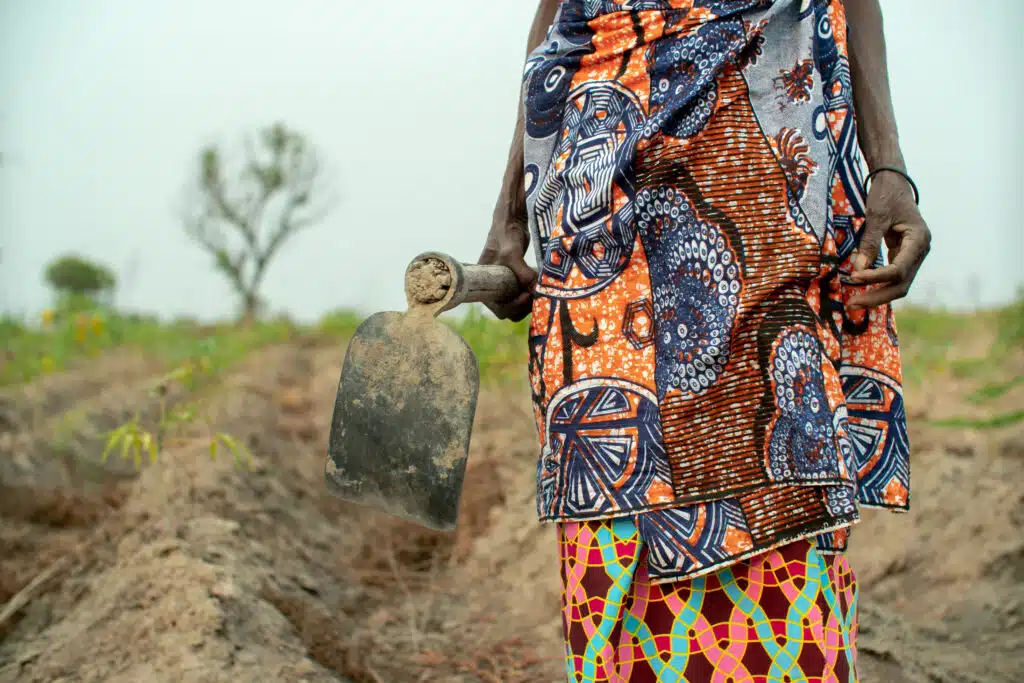
In many rural areas of Africa, producers are dependent on intermediaries who capture a significant share of the margins. This structural dependence is largely due to land ownership patterns: in sub-Saharan Africa, nearly 80% of farms are less than 2 hectares in size1, and this majority of farmers cultivate only about 25% of agricultural land. In other words, the vast majority of smallholders share a very small fraction of the land, while a minority of larger farms control the majority of cultivated land. This fragmentation of land ownership makes small producers particularly vulnerable. It limits their bargaining power, their access to formal markets and their ability to organise collectively.
Institutions such as the Socio-Economic Impact Institute at Mohammed VI Polytechnic University in Morocco are developing programmes that combine participatory diagnostics, promotion of local knowledge, entrepreneurial training and support for the structuring of cooperatives. When producers acquire these skills, they can negotiate more favourably, reduce their dependence on intermediaries and structure their activities in a more sustainable manner. Since its creation in 2019 under the name ‘Social Innovation Lab’, this Institute has been able to support 15 strategic sectors for nutritional security2 in Morocco. These efforts have resulted in the promotion of sustainable agricultural practices, the development of farmers’ technical skills and the improvement of commercial opportunities, with the aim of ensuring greater food security.
#2 Repositioning the company as a regional player
Some companies are gradually shifting their business model towards a territorial approach. This transformation involves securing natural resources (soil, water, biodiversity) in a context where ecosystem degradation is now considered one of the most severe global risks over the next ten years, according to the WEF’s Global Risks Report 20233. In this dynamic, business leaders are becoming more aware of these issues: according to the Deloitte CxO Sustainability Report 20234, 61% believe that climate change will have a high or very high impact on their organisation’s strategy and operations over the next three years, while 75% say they have increased their sustainability investments over the past year.
Thanks to this awareness, companies are increasingly engaging in locally based multi-stakeholder partnerships and directing their investments towards long-term impact. The Livelihoods Fund illustrates this approach. Funded by 21 multinationals, it supports ecological restoration projects that generate carbon credits and aim to stabilise agricultural sectors in the long term. In Senegal, for example5, noting the advanced degradation of mangroves, more than 100,000 villagers have been mobilised by the fund since 2009 to restore these ecosystems, which are essential to local fishery resources: 80 million mangrove trees were replanted between the Casamance and Sine Saloum estuaries. In 2019, 10 years after the launch of this project, a social and environmental impact study showed that 95% of the inhabitants surveyed noticed at least one positive effect on their food security: the return of fish, oysters and shrimps, an increase in rice fields… the ecosystem has regenerated.
This type of initiative shows that when a company becomes involved in regional development, it can contribute to the sustainable restoration of ecosystems while strengthening the livelihoods of local communities. However, the widespread adoption of such approaches requires future leaders to be able to integrate these socio-ecological principles into their economic models from the outset of their studies. However, according to a study by Acosta et al.6, although 85% of MBA students say they are very interested in environmental issues, they still struggle to clearly link these issues to economic dynamics, revealing a partial understanding of the interdependencies between development, natural resources and competitiveness.
#3 Integrating a market-logistics-research vision
Production fragmentation, infrastructure deficiencies and exposure to climate hazards are obstacles to value retention by local areas. To address this, several complementary approaches are being developed and are proving effective in the field. Some initiatives are reversing the traditional logic by starting with the requirements of end markets rather than production supply. The Badee Fund, a social enterprise accelerator in Morocco, illustrates this approach: the organisation, founded just two years ago, first identifies the standards required by the markets, then supports Moroccan start-ups and agricultural cooperatives. This includes 63% of all cooperatives in Morocco, according to statistics from the Office for the Development of Cooperation (ODCO)7, in their regulatory compliance, the establishment of traceability systems and the structuring of the value chain. This approach enables producers, mainly women, to respond precisely to buyers’ expectations and access more lucrative markets.
Sustainable influence on agri-food systems requires the formation of multi-stakeholder coalitions
At the same time, digital platforms facilitate connections between producers and processors. Agrosfer, for example, based in Benin, Côte d’Ivoire, Senegal, Togo and France, helps reduce post-harvest losses (estimated at 100 million tonnes annually in sub-Saharan Africa), secures access to inputs and formalises production contracts. These platforms act as trusted intermediaries between producer cooperatives and processing industries, helping to stabilise supplies while ensuring more predictable incomes for farmers. Since its creation, Agrosfer has connected 25,000 farmers to seven agro-industrial companies. The digital platform has three agrostores in West Africa, through which nearly 250,000 tonnes of agricultural products have already passed. The example of Agrosfer illustrates the importance of digitising agriculture in order to meet the population growth forecast for 2050, for which, according to the FAO, the global agricultural sector will need to produce up to 70% more food than current levels8.
The integration of scientific research into industrial models is another lever for transformation. The Ivorian company Cashew Coast, which specialises in cashew nut processing, is working with CIRAD to integrate climate forecasting, life cycle analyses, soil fertility preservation and deforestation prevention into its operations. This collaboration between science and industry helps to secure production bases while reducing the environmental footprint of activities. Côte d’Ivoire is the world’s leading producer of cashew nuts, with more than one million tonnes of cashew nuts9 produced in 2023 and a sustained increase in local processing thanks to companies such as Cashew Coast, which aims to develop the cashew nut sector through entirely local processing and a more equitable redistribution of profits to producers, in particular through a vertical integration model based on a network of cooperatives that promotes long-term partnerships.
#4 Building coalitions to influence public policy
Isolated innovations have limited structural impact. Lasting influence on agri-food systems requires the formation of multi-stakeholder coalitions. In Senegal, the DyTAES (Dynamique pour la Transition Agroécologique au Sénégal) coalition brings together producers, NGOs, researchers, businesses and local government representatives. This mobilisation contributed to the adoption of the first national agroecological transition strategy in West Africa, including measures such as subsidies for organic fertilisers. These coalitions make it possible to influence the development of sectoral standards, secure public incentive mechanisms and guide investment flows. DyTAES successfully advocated for this following a national consultation process10 involving more than a thousand stakeholders (farmers, processors, NGOs, researchers, businesses, local authorities, etc.) in seven major agro-ecological zones. The assessment identified 15 structural challenges for Senegalese agriculture, the most important of which is the development of family farming, which accounts for more than 95% of the agricultural workforce, according to the National Council for Consultation and Cooperation of Rural People in Senegal (CNCR). Other priorities include ensuring food sovereignty, making the sector attractive to young people, protecting water resources and restoring land.All of these issues give the agroecological transition strategy its global scope.
#5 Adapting financing mechanisms to African contexts
Small and medium-sized African agri-food businesses face difficulties in accessing finance. Financial institutions perceive these businesses as high risk, as they have limited collateral and are often poorly structured. Impact finance and blended finance mechanisms (combining public funds and private capital) help to mitigate these constraints. Sub-Saharan Africa accounts for 12% of global impact investment flows (USD 25 billion in 2021), according to a 2024 study by the Foundation for Studies and Research in International Development (FERDI)11, and almost all of the impact funds identified by this study do not originate from the African continent and are headquartered in North America or Europe. The main challenge therefore remains the mobilisation of African domestic savings and the establishment of specialised local financial institutions. Appropriate financing enables investment in high value-added segments: processing, storage infrastructure, logistics systems and research capabilities.
Critical transformations for the region
Rebalancing African agri-food chains is a challenge that affects food sovereignty, sustainable development and economic equity. This transformation requires a reconfiguration of production methods, skills development and coordination between scientific research, financial mechanisms, entrepreneurial dynamics and territorial development. The establishment of regional agri-food processing platforms, the development of locally based investment funds and the creation of logistics integration infrastructure are essential levers to enable territories to gradually move up to high value-added segments.
The transformation of African agri-food chains is part of a long-term process that requires the coordinated mobilisation of multiple actors: governments, local authorities, the private sector, research institutions, civil society organisations and producer organisations. Experiences in Morocco, Senegal and Côte d’Ivoire show that innovative approaches based on collaboration and local roots can gradually change the balance of power in value chains.
The success of this transition will determine the African continent’s ability to transform its agricultural potential into a driver of inclusive economic development, sustainable food security and resilience in the face of climate and demographic challenges. Social innovation, by changing organisational relationships and strengthening collective capacities, is a strategic lever for supporting this structural evolution of African agri-food chains.