



The ever-increasing number of screens and their daily use in our lives raises the question of their impact on our health. But what does the current scientific literature really tell us about the impact of screens on the physical and psychological health of children and teenagers?
An addictive practice?
This is one of the questions that the report “Children and Screens: In Search of Lost Time1”, submitted to French President Emmanuel Macron in April 2024 and previously reviewed by Catherine Rolland for Polytechnique Insights, seeks to answer. The title of this report, far from referring to the hours lost in front of screens, is in fact aimed at the delay in public policies to regulate their use.
The figures don’t lie, in 2022 French households had an average of 10 digital devices with screens (smartphones, televisions, e‑readers, computers, tablets, games consoles, connected bracelets, etc.). The same year, the Digital Barometer showed that 87% of the over-12s owned a smartphone, including 89% of 13–19 year-olds. These teenagers also own 69% of personal computers and 63% of games consoles. But if our screen time and digital usage are skyrocketing, can we still talk about addiction?
Screens: separating the device from the use
To date, prolonged use of devices with screens is not officially recognised as an addictive behaviour, mainly because it includes very heterogeneous and varied practices. However, scientific studies and surveys by Santé Publique France record daily screen time, with figures ranging from 2 to 3 hours for 10-year-olds (3 hours 07 minutes in the 2015 Esteban study; 2 hours 36 minutes in the 2022 Elfe cohort).
However, for Grégoire Borst, professor of developmental psychology and cognitive neuroscience at Université́ Paris-Cité and director of the CNRS Laboratory of Child Development and Education Psychology (LaPsyDÉ), “talking about screen time makes no sense! Taking into account the quality of what we watch, on the other hand, seems more relevant.” It seems difficult to lump together video games, cartoons or videos of nursery rhymes played over and over again.
This heterogeneity justifies great caution in scientific articles seeking to determine the negative effects of screen use on the cognitive capacities and development of young people. This caution is echoed in the conclusion of the meta-analysis published in November 2023: An umbrella review of the benefits and risks associated with young people’s interactions with electronic screens by Taren Sanders & Co2. By reviewing around a hundred studies on the subject, the Australian researchers found positive and negative effects, of “low to moderate” intensity, associated with the use of devices with screens. Only the correlation between social networking and depression seems noteworthy, although it is still too early to establish a causal link.
Co-watching versus techno-conferencing
Yet in 2017, a study by the University of Rennes3 widely reported by the media pointed to a link between “watching television in the morning” and “developing a language disorder.” For Grégoire Borst, these results conceal a more concrete explanation: a child watching TV alone will interact less with adults and therefore speak less. On the other hand, “watching television with children has a positive effect on language development,” explains the researcher. Watching television with a child also helps to develop joint attention.
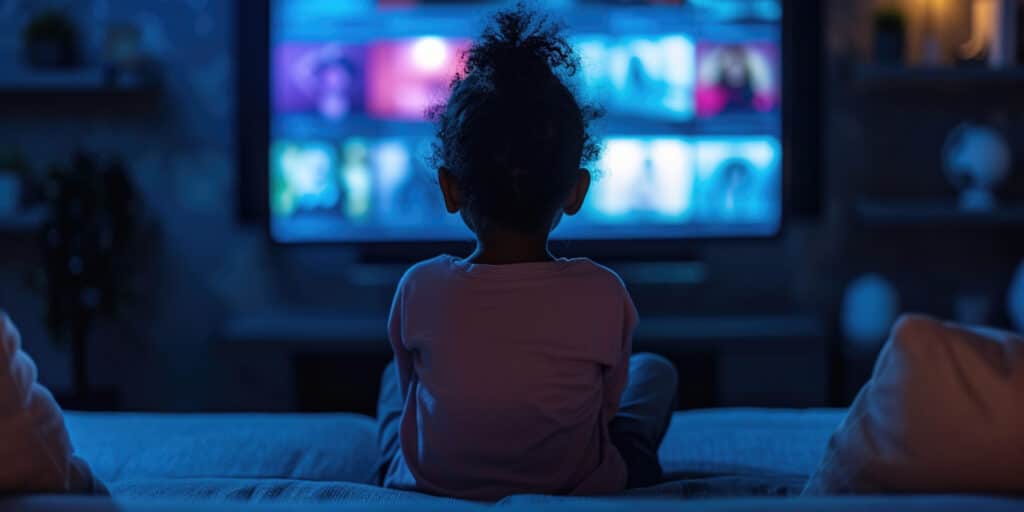
Other phenomena, such as techno-conferencing, have a much more negative impact on children. This term refers to the use of screens by adults in front of children, interfering with their interaction with them. “If, tomorrow, we take screens away from all the children in the world but not from adults, I’m not sure that many things will change,” adds Grégoire Borst, who again stresses the importance of co-viewing to counter this phenomenon.
It’s hard to talk about a negative effect on the cognitive development of young people. So, are fears about the use of screens unfounded? “No, we must continue to warn, particularly with the “no screens before the age of 3 policy,” insists the researcher. Because the real problem is the somatic risks!” Lack of sleep and a sedentary lifestyle, could these be the real dangers?
Sleep: the first victim
The issue of time and quality of sleep is at the top of the list of concerns raised by the report Children and screens: in search of lost time. Chronic sleep debt leads to a cascade of health problems (excess weight, diabetes, cardiovascular disease, mood disorders, depression, poor immune regulation, etc.). Yet “we know that children don’t get enough sleep,” points out Grégoire Borst, who points out that the rhythm naturally shifts in adolescents, despite their school timetable, which is often poorly adapted. “If we add the use of screens in the evening, we increase the risk of insomnia, anxiety and health problems in general.” The same is true of the risks associated with a sedentary lifestyle, which is itself encouraged by digital activities that take place seated and indoors.
Open communication
Another point to watch out for is young people’s exposure to inappropriate or even shocking content on the Internet. “It would never occur to anyone to give a child a very sharp knife the first time they learn to cook” explains the researcher. “It’s the same for the Internet in general.” Which brings the importance of co-viewing and supervision of these practices back to the centre of the recommendations.
Even among older young people! Because teenagers are very vulnerable to social networks, whose algorithms favour social rewards. While the limbic system, which controls anxiety, emotions and addiction mechanisms, is mature at this age, the prefrontal cortex, which is responsible for regulating this system, continues to develop until the age of 25. “Adolescents are emotional pressure cookers with neither the lid nor the means to lower the pressure,” says Grégoire Borst once again. That’s why it’s so important to provide support and open up a dialogue about these uses within the family.
In fact, this is Grégoire Borst’s final piece of advice: “It’s a good idea to think up times for disconnection within the family, for both children and adults.” It’s a way of opening up communication on these uses by setting aside times for exchanges, such as mealtimes or the time before going to bed.