Morality, a by-product of natural selection?



- Recent findings show a link between cognitive neuroscience and the field of moral philosophy.
- This research is beginning to reveal the identity of the brain circuits involved in moral judgements. We are discovering that systems for learning about reward, assessing risk and understanding the mental state of others are at work.
- This human faculty of morality would have provided an incredible adaptive advantage. Indeed, our species is living proof that to associate is to survive.
- Morality makes it possible to associate and to limit attacks on safety, health, social conflicts, and other dangerous deviant behaviour.
- These early predispositions to prosocial behaviour reflect pre-wired capacities that were adaptive to our ancestors and that enabled our species to “become master and possessor of nature”.
At first sight, morality and science are two disciplines so distinct that it would be inappropriate to confuse their respective roles. However, recent discoveries in cognitive neuroscience show the two disciplines are more interlinked than previously thought, with the possible involvement of neuroscience in the field of moral philosophy. But can we reduce man to the shapeless, greyish organ between his ears? Is he the product of his brain’s activity? For the followers of scientific rationalities, there is no doubt that the psychological, social, or moral self is carried out through operations enabled by brain circuits1. According to this point of view, there is a naturalistic interpretation of morality that I will try to explain here.
Science and Morality
Very early on, philosophy aimed to give a definition of morality, considering it as being at the centre of our actions, as if it were a reference point for correct conduct. In other words, morality and happiness are linked since, if the purpose of existence is happiness, the means to achieve it are defined by morality. It is therefore not surprising to find that in all cultures, humans are deeply concerned with morality, for example by creating institutions such as courts to ensure that social norms apply to all.
Research in cognitive neuroscience is beginning to reveal the identity of the brain circuits involved in these moral judgements. We are discovering that systems for learning about reward, assessing risk, and understanding the mental state of others are at work. However, if they seem fundamental to generate a moral judgement, their degree of participation varies according to individual differences in terms of empathy, benevolence, or greater or lesser sensitivity to injustice. In other words, each individual has his or her own threshold of sensitivity to morality. At the extreme end of this spectrum, disturbances in the social decision-making circuit generate immoral behaviour such as that of psychopaths.
Sapiens, a species in search of justice
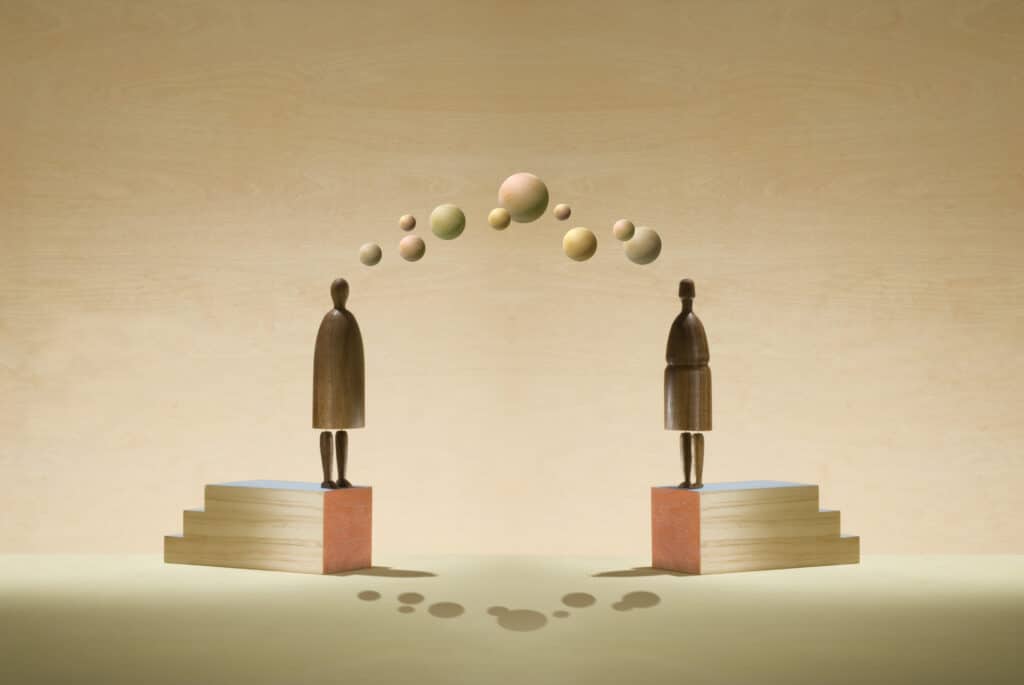
All members of human societies, however diverse they may appear, show a deep concern for issues of morality, justice and equity2. Humans are distinguished from other species by their propensity to produce cultural organisations to ensure that social norms are respected, including institutions designed to assess the acceptability of individual behaviour and to assign appropriate punishments to those who violate particular norms3. Regardless of how morality may be conceptualised, and following Darwin’s work4, researchers argue that moral judgement is a human characteristic that facilitates cooperation among large groups of unrelated individuals5. In short, humans benefit from a special relationship with others because it is totally disinterested, independent of a filial relationship such as that which governs the care of kittens by a cat.
The emergence of this mental faculty would have given Sapiens an adaptive advantage that we can measure today by the invasive nature of our species. As the musketeers used to say6, our species is living proof that living in groups improves an individual’s chances of survival. Thus, moral standards provide safeguards against safety or health hazards, and the reinforcement of moral behaviour minimises criminal behaviour and social conflict. In this way, morality makes human society a viable enterprise.
Being more moral means living longer
The example of our longevity, which is closely linked to the quality of social interaction, demonstrates this. To define the nature of the main causes of ageing, scientists analysed blood samples taken from people who were more or less social. They found that extremely social people had longer protective telomeres. When they looked at the presence of particular cells, known as senescent cells7, socially isolated people were the ones who accumulated the highest number of these cells responsible for undesirable events such as inflammation. By showing how the relationship with others remains the most important factor in effectively combating the planned obsolescence of an individual, the biology of ageing confirms the importance of social relationships for the survival of the species. In other words, by adjusting a subject’s longevity to the yardstick of his or her virtuous social relationships, our moral judgments and behaviour are the guarantors of social cohesion.
An evolutionary legacy
On an evolutionary level, morality appears to be an extreme form of cooperation that requires individuals to suppress their own interest or to assimilate it with that of others. The study of primate or child behaviour shows the conserved nature of this trait. It indicates that cooperation first arises from a personal morality centred on the individual and those close to him. Then, as a kind of extension of this personal morality, a universal morality emerges. It is from this second stage that individuals follow and apply the social norms of the group. Morality thus emerged over the course of evolution, becoming more complex, from a set of skills and motivations to cooperate with one’s relatives at first, and then with everyone.
While animals obviously do not explicitly reason about right and wrong, vice and virtue, or just and unjust, some exhibit behaviours that seem to incorporate sketches of virtuous behaviour. Many species cooperate, help their relatives and care for their offspring, and some already show an aversion to inequality. Similarly, while socialisation influences moral development and explains why moral rules may evolve over space and time, human infants enter the world already equipped with cognition and motivation that incline them to be moral and prosocial8. These early predispositions to prosocial behaviour and socio-moral evaluation reflect pre-wired capacities that were adaptive for our ancestors. This penchant for cooperation with unrelated individuals would explain how our species became masters and possessors of nature9.
In summary, the moral conscience observed in humans appears to be a consequence of several cognitive, executive and motivational capacities that are the attributes natural selection has directly favoured10. Decades of research across multiple disciplines, including behavioural economics, developmental psychology and social neuroscience, indicate that moral reasoning arises from complex social decision-making and involves both unconscious and deliberate processes that rely on several partially distinct dimensions, including understanding of intention, aversion to harm, reward and value coding, executive functioning and rule learning11. To sum up, human moral decisions are governed both by statistical expectations (based on observed frequencies), Bayesian inferences about what others will do, and by normative beliefs about what others should do.
Contributors
Pierre-Marie Lledo
Pierre-Marie Lledo’s research focuses on the adaptation and regeneration of neurons in the brain, and their interactions with the immune system. He is Research director at the CNRS, head of the Genes and Cognition laboratory, and director of the Perception and Memory unit and of Plasticity and Development of the Nervous System at the Pasteur Institute.
Other contributions
Voir toutes ses contributions