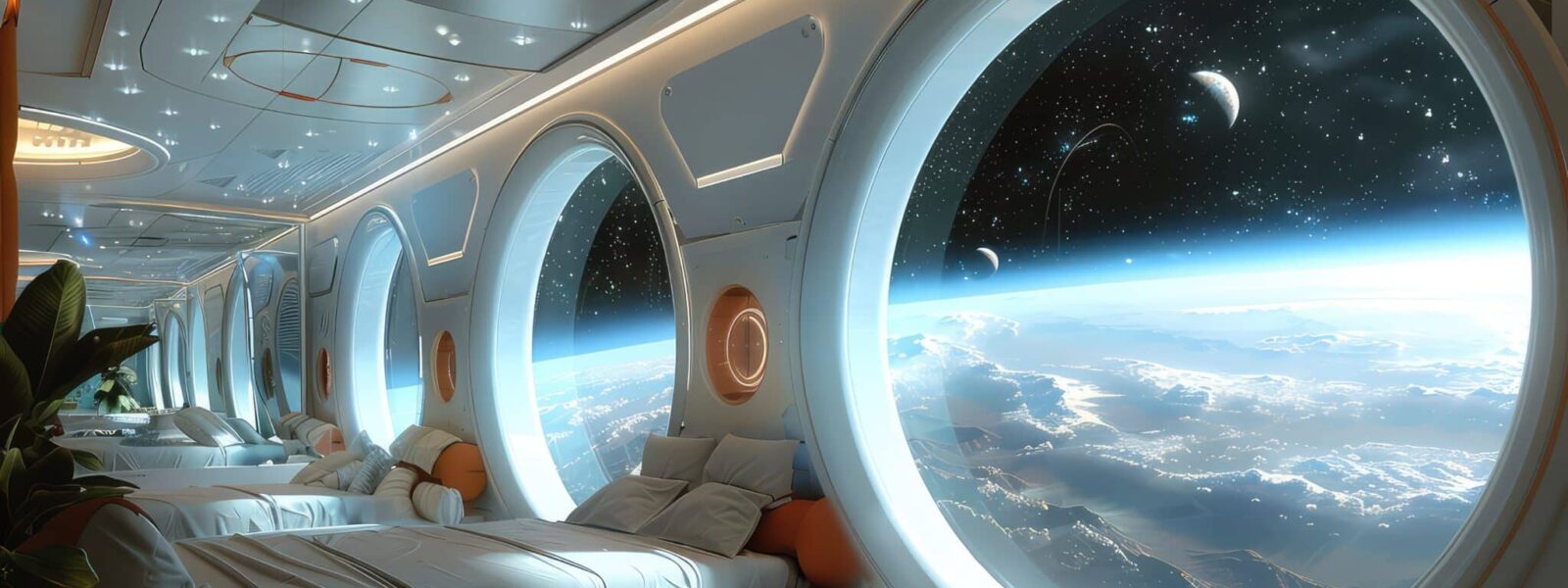
Is the future of space tourism doomed by its environmental cost?



- On 28th April 2001, the first space tourist, Dennis Tito, took off for a week-long stay in space, becoming the first space tourist.
- Yet, 25 years on, there have not been tens of thousands of space tourists, but only around 140.
- Moreover, space tourism cannot develop without addressing the elephant in the room: the environmental cost.
- In terms of energy consumption, one hour of space flight is equivalent to at least 400 hours on an aeroplane.
- And if half of humanity were to take a space flight in a single year, the level of CO₂ in the atmosphere would increase by a factor of 2.8, leading to global warming of more than 4 degrees.
Twenty-five years ago, the first space tourist, Dennis Tito, set off on a week-long trip into space, thereby becoming the first space tourist. Since then, the sector has not really taken off, and environmental concerns have made it extremely unpopular with the general public. Despite this, some still hope to make it a viable venture, including in France.
On 28th April 2001, the American businessman Dennis Tito boarded a Soyuz capsule to travel to the International Space Station (ISS) on a journey lasting around a week. What made this flight unique was that the billionaire was not an astronaut but simply a space tourist. A world first for which Tito had shelled out some 20 million dollars1, a significant financial windfall at the time for the space sector, which was seeking to turn a profit. Better still: for some, it heralded the dawn of a new era. A world in which taking a ride on a rocket and then visiting a space station in orbit would be just as commonplace as going for a hot-air balloon ride or skydiving. Dennis Tito predicted 2 that tens of thousands of people could enjoy such an experience, at a cost representing 5 or 10% of what he had had to pay.
And yet, 25 years on, there have not been tens of thousands of space tourists. Only around 140, according to the latest figures 3, whether for orbital flights alone or for stays on board the ISS. Furthermore, prices have not fallen dramatically as promised, given that Blue Origin was offering seats for $28 million in 2021. Other companies, such as Virgin Galactic, are aiming for a price of $750,000 for a trip into orbit, but the setbacks experienced by its spacecraft 4 do little to inspire confidence.
Space technology can be used to document global warming, observe the Universe, or to foster a broader perspective on the world. Tourism should be the lowest of priorities, far behind all of that.
“Space tourism has always been based on a promise,” says Olivier Berné, an astrophysicist at IRAP (Institute for Research in Astrophysics and Planetology). “It is nothing more than a pipe dream that has generated fundraising and fuelled financial speculation, which does not guarantee it a future.” In France, however, the BPI (Public Investment Bank) still has high hopes5 for this sector. Aware that the bulk of the action is taking place across the Atlantic, the organisation nevertheless insists that Europe and France can carve out a place for themselves in this sector, particularly in passenger training, parabolic flights and theoretical training.
Despite this optimism, the sector’s future remains rather bleak. Firstly, instead of the predicted fall in prices, one of the most competitive companies in the field, SpaceX, has recently increased its rates6, rising from $6,000 to $7,000 per kilogramme of payload. For its part, Blue Origin is temporarily stepping back from the sector to focus on other areas, notably lunar modules. Other US “New Space” companies, such as Axiom and Vast, are banking on their future private orbital stations, which will eventually be able to accommodate tourists. But this will not happen until, at the earliest, the 2030s, and at a price that has yet to be determined.
That being said, the development of space tourism cannot proceed without addressing the elephant in the room: the environmental cost. It is not uncommon for the space sector to be criticised for the pollution it causes, even by those who are an integral part of it. Olivier Berné, for instance, has been tasked with investigating the pollution caused by the work of astrophysicists. However, whilst the greenhouse gases emitted by researchers’ work or rocket launches can sometimes be justified by the scientific benefits they yield, the same cannot be said for this tourism sector.
This view does not prevent some in the industry from believing that reusable launch vehicles and new generations of fuel could reduce the environmental cost. But this techno-solutionist vision clashes with reality, according to Paul Peeters, a transport and environment specialist at the University of Breda in the Netherlands. “Even if rockets were to become more efficient, it’s completely illusory,” he asserts. “They would need to be 99 % more efficient and economical for space tourism to be environmentally sustainable. Perhaps this will be achieved one day, but certainly not in the short or even medium term.”
The researcher has worked on this issue on several occasions, and in a 2018 study7, he explains in detail why space tourism can never be compatible with environmental protection, unlike other, more environmentally friendly practices. “In terms of energy used, one hour of space flight is equivalent to at least 400 hours on an aeroplane. We simply do not have enough energy on Earth for space tourism to become a mass phenomenon. That is an enormous number of resources spent solely for the pleasure of a few people.”
To verify this, the researcher scrutinised several climate models to estimate the environmental impact of such activities. He also applied this data to models relating to planetary boundaries, particularly in terms of resources. Taken together, this data shows just how illusory it is to think that space tourism can be scaled up. According to this data, if half of humanity were to take a space flight within a year, the level of CO₂ in the atmosphere would increase by a factor of 2.8; this would lead to global warming of more than 4 degrees, a figure found in the IPCC’s most pessimistic scenarios.
Paul Peeters adds that these limitations are not due to any kind of environmental activism, but simply to the laws of physics: “A certain amount of energy is required to send humans into space, and we cannot reduce that. Furthermore, no real regulations have been put in place to prevent companies from entering this sector. If it doesn’t take off, it will be for technical reasons, not because of an environmental roadblock.”
Whilst taking this environmental dimension into account may contribute to making the space tourism sector unpopular, it is not necessarily what would have held it back. But behind these rather discouraging figures, companies specialising in the sector have found other opportunities. This is the case, for example, with Vast, which hasn’t ruled out selling places on its future orbital station to tourists, but which, in the meantime, is signing contracts with NASA and CNES to send European astronauts into space, notably Thomas Pesquet in the near future, followed by Arnaud Prost.
“There are scientific aspects to these missions, but they’re only there to make the pill easier to swallow,” explains Olivier Berné. “From this perspective, with the increasing privatisation of space, the main thing is to have something to sell. These are new promises that sustain a sector which benefits only a select few, without seeking the public interest. If the aim were truly to promote science, there would be many other things to do first.”
Admittedly, billionaire space tourism in the style of Dennis Tito seems set to remain a rare phenomenon reserved for a select few. But manned spaceflight in the broader sense is subject to the laws of the private sector, with missions that must, above all, be economically profitable for companies. Scientific benefits take a back seat.