Mars: how studying earthquakes changed our vision of the red planet



- Scientists are reporting on the first seismic signals measured on the planet Mars following NASA's InSight mission, launched in 2018.
- Half of the large Martian tremors detected are linked to the presence of volcanoes that erupted in the region known as Cerberus Fossae in the past.
- This discovery goes against the idea that seismic activity on Mars stems solely from the planet cooling and its crust cracking in different directions.
- Furthermore, the Martian mantle does not have the same subdivisions as Earth's lower mantle, but instead has a sort of magma ocean at its base.
- Meteorite impacts have revealed the presence of ice pockets beneath the surface of Mars, providing a better understanding of the planet for future missions.
Terrestrial seismology provides important information on the interior of our planet, including how it formed and evolved. The same applies to extraterrestrial planets with the very first seismic signals measured on the planet Mars reported by scientists following NASA’s InSight (Interior Exploration using Seismic Investigations, Geodesy and Heat Transport) mission, launched in 2018. After four years of operation on the Red Planet, researchers have detected around 1,300 seismic events, the analysis of which will revolutionise our understanding.
Mars is not the first extraterrestrial body on which scientists have detected seismic activity. Five seismometers operated on the Moon between 1969 and 1977, measuring tens of thousands of “moonquakes”. Like the Moon, Mars lacks tectonic plates and should therefore be much less active than the Earth in this respect.
Seismic activity largely due to volcanoes
“Of the 1,300 seismic events detected on Mars, a good ten were caused by meteorite impacts,” explains Philippe Lognonné, professor at Université Paris-Cité and Institut de Physique du Globe de Paris (IPGP) who heads the team that built SEIS (Seismic Experiment for Interior Structure of Mars), InSight’s main seismometer. Of all the quakes, at least 50 are relatively large, measuring more than 2.5 on the Richter scale, with the largest measured having a magnitude of 4.7. There are also almost a thousand smaller tremors, with a lower magnitude of between 1 and 2.
SEIS, a revolutionary technology?
SEIS is the main sensor on the InSight mission, which aims to deploy the first Martian geophysical station. SEIS is equipped with a Very Broadband (VBB) instrument, comparable to those used by the Global Earth Seismic Network, developed by IPGP with the Centre National d’Études Spatiales (CNES), the prime contractor for SEIS, and carried out in collaboration with Switzerland, the UK, the US and Germany. Additional payload elements include a high-precision tracking system for geodesy, a heat flux experiment, a three-axis magnetometer and a set of TWINS (Temperature and Wind for INSight) and pressure sensors, as well as a robotic arm and the cameras required to operate SEIS on the ground. Launched on 5 May 2018, InSight successfully landed on Elysium Planitia on 26 November 2018 and deployed its seismometer shortly afterwards. InSight (and SEIS) terminated operations shortly after 15 December 2022 because of dust build-up on the solar panels.
Before InSight, it was thought that this type of seismic activity was mainly linked to the cooling underway in the interior of the planet, which causes side-to-side contractions and leads to an accumulation of stress points. These are released by ruptures in the crust, generating earthquakes. InSight showed that only a small proportion of the earthquakes could be explained in this way, however. Indeed, the InSight researchers discovered that half of the large Martian tremors detected all originated in a region called Cerberus Fossae. “We know that volcanism was active between 500 000 and 1 million years ago in this region,” explains Philippe Lognonné. “Thanks to our measurements, we also know that these tremors are almost continuous: not a month goes by without a small earthquake.”
“That half of the tremors detected occur in this region implies that the volcanoes that erupted there in the past are probably not extinct, but simply dormant. This is the first major discovery we made and, to be honest, no one in our team expected this result. Until now, we thought that the seismic activity on Mars came solely from the planet cooling and its crust cracking in different directions. It’s amazing to think that Mars is a planet that still has volcanic tectonics associated with volcanoes that could very well become active again in the future.”
Other major discoveries: a molten mantle and layers of ice beneath the surface
The second major discovery made by InSight is that the Martian mantle does not have the same subdivisions as Earth’s lower mantle. “In other words, and even though the entire Martian mantle contains more or less the same types of rocks and minerals as the Earth’s upper mantle, Mars does not have a lower mantle, but rather a kind of magma ocean at its base.” Although this result is less surprising, since it is plausible, it had never been discovered in another telluric planet. This unexpected discovery shows that at the base of Mars’ mantle, the liquid is not the same as that in the core.
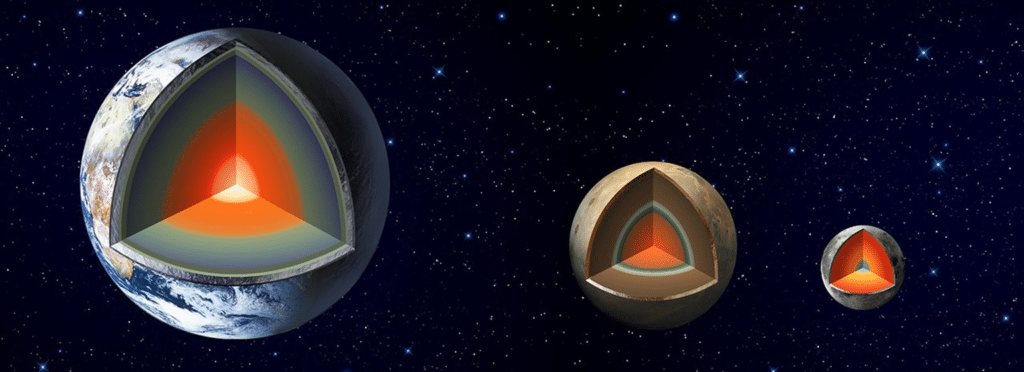
“Again, few members of the team expected this,” says Philippe Lognonné. “We now realise that the actual structure of Mars is very different to that of Earth’s. On our planet, you first have a crust, then a solid mantle divided into two parts. At the base of the solid mantle, there is a liquid core of iron and light elements, and underneath, a solid core of iron. On Mars, it’s not like that at all: we have a crust, a solid mantle, but at the base of the solid mantle, we have a molten mantle that covers a metallic core that is also molten and much richer in light elements. Finally, we’ve had some rather nice surprises in terms of meteorite impacts,” he explains. For example, a 150-m-wide crater not only generated superb seismic waves but also revealed the presence of pockets of ice beneath the surface. This discovery could have implications for future manned missions to Mars, as we now know that underground ice can be found in certain places.”
InSight’s SEIS instrument collects information about the Martian crust by detecting seismic waves from sources such as tremors and meteorite impacts that reverberate throughout the planet. As these waves travel through the interior of Mars, they change speed and direction at the boundaries between the different materials in the crust. This means that, when measured by SEIS, seismic waves from the same source can be detected at different times, depending on the paths they have taken to reach the probe.
The speed at which seismic waves travel through rocks of different densities varies according to their composition, the interstitial space and what fills that space – be it gas, water or ice. By analysing the different times that seismic waves coming from the same sources reach the probe, researchers can determine the composition of the planet’s interior.
“We use seismic waves as a kind of light to illuminate the interior of the planet,” explains Philippe Lognonné. “By analysing the data measured by the seismometers, we can then ‘image’ the interior, determine the thickness of the main parts of the planet, the crust, the mantle and the core, observe what is liquid and where and when water exists. These are the main areas of seismology in general and I think that with InSight we have made some first-rate discoveries in these fields. We can’t say that InSight has revolutionised seismology in terms of data analysis techniques, but this sensor has certainly been revolutionary in the sense that it has provided new data on a planet never before visited,” he concludes.
Interview by Isabelle Dumé
Find out more:
- Exploring Mars’ structure
https://www.coursera.org/lecture/seismology-to-earthquakes/1–10-exploring-mars-structure-VfKNY - What are Marsquakes?
https://www.coursera.org/lecture/seismology-to-earthquakes/2–8‑what-about-marsquakes-ac0pu
References:
- P. Lognonné, W.B. Banerdt, J. Clinton, R.F. Garcia, D. Giardini, B. Knapmeyer-Endrun, M. Panning, W.T. Pike, Mars Seismology,Annual Review of Earth and Planetary Sciences 2023 51:1, 643–670, https://doi.org/10.1146/annurev-earth-031621–073318
- Lognonné, P., Schimmel, M., Stutzmann, E., Davis, P., Drilleau, M., Sainton, G., et al. (2023). Detection of Mars normal modes from S1222a event and seismic hum. Geophysical Research Letters, 50, e2023GL103205. https://doi.org/10.1029/2023GL103205
- Lognonné, P., W.B. Banerdt, W.T.Pike, D.Giardini, U.Christensen, R.F.Garcia,et al., Constraints on the shallow elastic and anelastic structure of Mars from InSight seismic data, Nature Geoscience, 13, 213–220, doi: 10.1038/s41561-020‑0536‑y
- Lognonné, P., W.B.Banerdt, D.Giardini, W.T.Pike, U.Christensen, P.Laudet, et al, SEIS: Insight’s Seismic Experiment for Internal Structure of Mars, Space Sci Rev, 215, 12, doi: 10.1007/s11214-018‑0574‑6
- Samuel, H., M. Drilleau, A. Rivoldini, Z. Xu, Q. Huang, R. F. Garcia, V. Lekic, J.C.E Irving, J. Badro, P. H. Lognonné, J. A. D. Connolly, T. Kawamura, T. Gudkova and W. B. Banerdt (2023). Geophysical evidence for an enriched molten silicate layer above Mars’s core, Nature, 622, 712–717, doi: 10.1038/s41586-023–06601‑8
- Verdier, N., V. Ansan, P. Delage, K. S. Ali, E. Beucler, C. Charalambous, E. Constant, A. Spiga, M. Golombek, E. Marteau, R. Lapeyre, E. Gaudin, C. Yana, K. Hurst, P. Lognonné, and B. W. Banerdt (2023). Using wind dispersion effects during the InSight tether burial activities to better constrain the regolith grain size distribution. Journal of Geophysical Research: Planets, 128, e2022JE007707. https://doi.org/10.1029/2022JE007707
- Xu, Z., Broquet, A., Fuji, N., Kawamura, T., Lognonné, P., Montagner, J.-P., et al. (2023). Investigation of Martian regional crustal structure near the dichotomy using S1222a surface-wave group velocities. Geophysical Research Letters, 50, e2023GL103136. https://doi.org/10.1029/2023GL103136