



For the past two years, our aim at the Science and Video Games research and teaching chair has been to facilitate exchanges between three main players: researchers from all fields of science, experts from the video game industry and, finally, our students. The former has known how to use video games to popularise science since the early days of this form of entertainment. For example, the game Tennis for two – the ancestor of Pong – was developed in 1958 at Brookhaven, a research laboratory near New York. The researchers’ idea was to demonstrate the capabilities of the computer to the public at an open day.
Also, the first gamers were scientists from all over the world based in research centres; a situation that lasted for years before video games became popular in the early 1970s. This chair, which relies on a handful of gaming professionals in residence at Polytechnique, for example, pushes collective scientific projects that allow some fifty second-year students to explore the problems associated with video games.
Common points: experience and technology
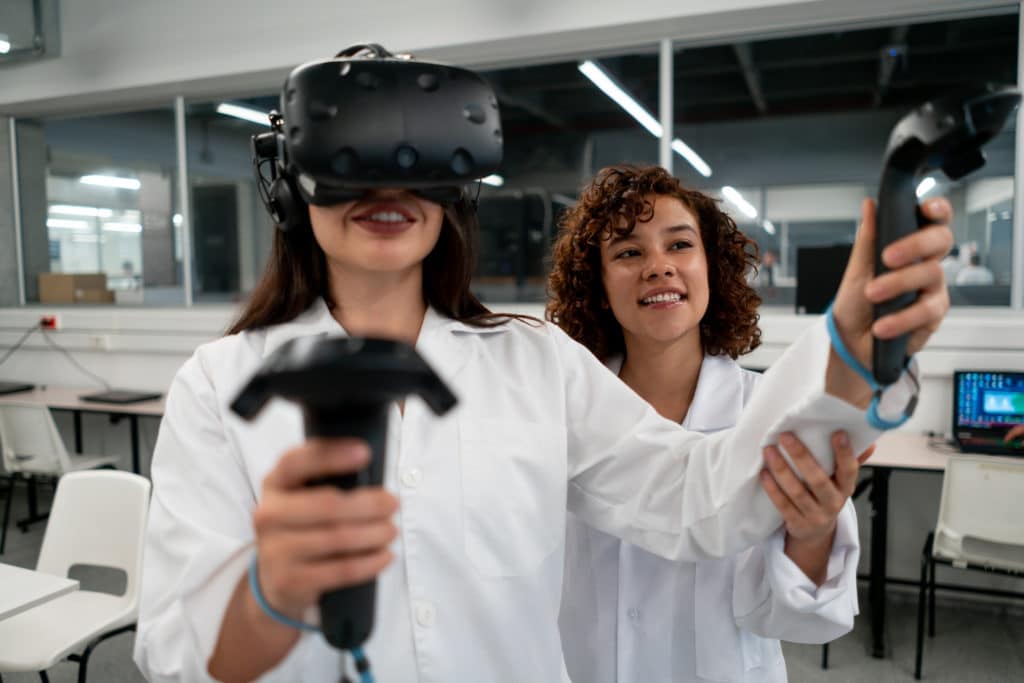
Science and video games have always had an unbreakable bond. Their common frontiers are twofold: experience and technology. Science, like video games, is all about experience; for both, the notions of trial and error are central, essential. Moreover, both science and video games make use of technologies, often innovative ones. Examples include virtual reality (VR), augmented reality (AR), network technology, artificial intelligence (AI), computer graphics, 3D modelling and more. In 2016, augmented reality was globally popularised by a game, Pokémon Go, which achieved half a billion downloads only three months after its release. New digital technologies have been used very quickly to produce or enrich games. The latter sometimes even serve as illustrators, if not popularisers, of these same technologies.
In my opinion, video games combine at least four important elements that explain this strong link. Firstly, it has an audience, the largest in terms of entertainment on the planet, with over $100bn annual revenue. In fact, almost everyone plays today, thanks to mobile phones. The second aspect is the power of representation of the moving image, which can also be found in animated films. The third important feature is game mechanics. These mechanics can be inspired by the scientific approach, allowing people to understand an environment through experience.
Finally, the fourth asset is the strength of interactivity in learning. One of the best ways to learn is to put knowledge into practice rather than to be subjected to it. For example, as a teenager, I felt that I understood something about the history of human civilisation by playing the game Civilization. It was an ideal first step towards a more serious course or content. So, games are fantastic tools for learning or at least for illustrating science.
Video games in the service of research
But can video games help research? On the face of it, this entertainment industry has driven development in technology of graphics computing, and to a lesser extent, artificial intelligence. Computer graphics because with the advent of 3D, the gaming industry has seized on every advance in this technology, often before the animation industry. A French game like Alone in the Dark, in 1992, was a pioneer in this field.
AI has seen progress thanks to video games, too. You may remember when Deep Blue, the IBM supercomputer, managed to beat Garry Kasparov at chess in 1997. Is it considered a video game or not? It’s a question of definition. Today, video games at least advance AI because they represent a new challenge. In 2019, AlphaStar, an AI system designed by DeepMind – a subsidiary of Google – ranked among the top 0.2% of players in the world on the game Starcraft 2. The best human players are able to perform about 300 actions per minute with infinite combinatorics; still a major challenge for an AI.
But in some cases, the players’ intelligence can be used to solve problems that AI cannot. This is the case of the game Foldit, which has been trying for several years to provide a collective answer to unsolved protein folding problems in biology. After solving the structure of an enzyme called M‑PMV in 3D in 2011, the platform was used in the fight against Covid-19 to make the 200,000 players on the site ‘work’ together. But just recently, DeepMind announced that they had bent this problem thanks to AI.
In fact, while I doubt that there will be much more progress of this kind for the hard sciences, there is still a lot of research to be done on the player, his brain, his social attitudes, etc. When the subject becomes humanity, there is still, in my opinion, a lot to be done using video games and what they can provide in terms of data. The cognitive, social, and economic sciences should take advantage of this in the years to come, via crowdsourcing for example.
Science at the service of video games
Finally, we can ask the opposite question. Can science inspire game experiences? This is one of the aspects I believe in the most. There have been thought experiments in games for a few years now. A player with a helmet on his head is able to play a kind of Space Invaders without a controller, just by thinking. This is an example where a science, cognitive science in this case, would help to produce a new technology, in this case the helmet, which can capture the player’s thoughts and translate them into commands. If research makes advances on this issue, it will lead to new innovative games. From these games, we will be able to collect the data produced by the players. And ask, for example, how cognitive processes and the brain itself work. Once again, science will be re-fuelled by video games.