


The Indo-Pacific is increasingly perceived as a zone of confrontation, whereas it was presented for several decades as a model of “soft trade”, with geopolitical relations calmed by commercial exchanges. Was this model an illusion?
Pierre Grosser. No, but it has a history. The term “Asia-Pacific” emerged in the late 1980s. The geo-economic climate was marked by the end of the Cold War, with a triumphant Japan taking the place of the USSR as the number one challenger against the United States. At the time, Washington perceived that there was a risk of an “Asian refocusing”. Whilst Americans saw that there was a place to be taken in what was then described as the “Pacific century”, the power of Asian economies also appeared as a challenge to them. Back then, the Pacific was an area of trade, but which increased the deficits of the United States
APEC (1989) was a way for the United States and Australia to avoid the creation of an Asian block and to develop an open regionalism that would facilitate Asia-Pacific trade. Japan agreed because its leaders feared being accused by Washington of returning to the Asia-tism of the 1930s, dominated by Tokyo.
In the 1990s, summits were held regularly, and a large free trade area developed; a reality has not disappeared. Nevertheless, with the WTO crisis in the 2000s and the growing difficulty of negotiating global trade agreements, multiple bilateral agreements were signed between countries of the region, and now broader agreements (but Trump refused the TPP negotiated by Obama).
Does China’s entry into the game disrupt this “soft trade” paradigm?
It is made possible by President Clinton’s decision in the mid-1990s to disconnect trade and human rights – a way to turn the page on Tiananmen. China’s entry into the WTO in 2001 appears at first to be a confirmation of this virtuous circle between trade, peace, and democratisation.
Compared to the 1980s, when Japan had been a real threat (at the end of 1988, it controlled 50% of the world’s semiconductor sales and there was talk of a “Pearl Harbour” of electrical components), the early 2000s seem to have been marked by a certain naivety about China. No one imagined at the time that China was moving upmarket technologically, or that it would have a destructive impact on Western industrial jobs.
At the end of the 1990s, however, several debates raised crucial questions. Between 1996 and 2000, a first discussion concerned China’s accession to the status of great power, and a book even raised the possibility of a conflict. But this strategic and military debate was soon closed. At the beginning of the Bush presidency, the Americans decided to focus on the “peer competitors”, including China. But the attacks of September 11 put the reflection on the Chinese challenge in the background. Today, the Americans are wondering whether they have made the wrong enemy by exhausting themselves in the global war against terrorism.
When did Americans start to have doubts?
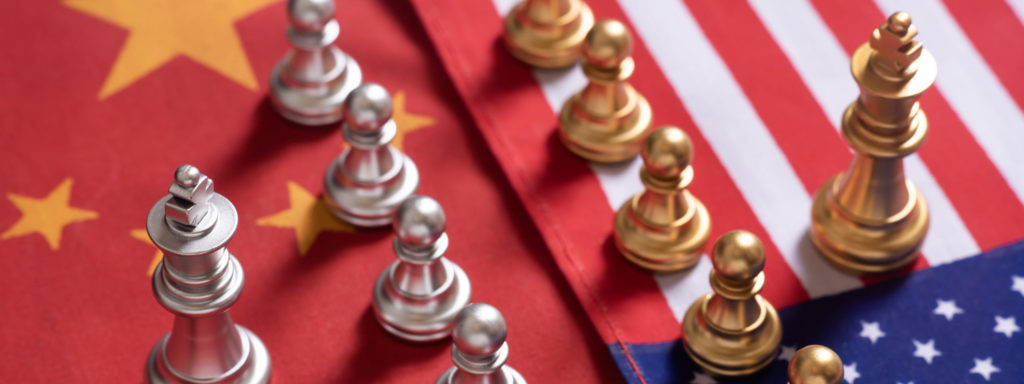
The financial crisis that began in 2008 opened a new stage: very quickly, Westerners realised that their economies were suffering while China was accelerating. Admittedly, there was a form of equilibrium: the Americans bought Chinese products cheaply, and the Chinese in return bought American public debt. This macroeconomic duo was once presented as a “G2”, at the top of global governance. But the Chinese partner is increasingly perceived as a rival.
The Chinese challenge is then formulated through new images, such as the “string of pearls”, which describes Beijing’s more “assertive” presence in the China Sea, with land reclamation that allows for the transformation of simple islets into islands, and especially Chinese activism in the Indian Ocean: Sri Lanka, Burma.
This context explains the accelerated conciliation between the United States and India. For the first time, the theme of the Indo-Pacific emerged. At the initiative of Japanese Prime Minister Shinzo Abe, the Quadrilateral Security Dialogue (Quad) was launched in 2007, an informal cooperation between the United States, Japan, Australia, and India. The pivot to Asia, which was fully affirmed by Obama in 2011–2012, had in fact begun under George W. Bush.
Does this pivot mark a major turning point?
Yes, even if it must be understood that it is not directed against China, which the Americans need on issues such as nuclear proliferation (North Korea, Iran). The pivot reflects first and foremost the ambition to focus on Asia, by reinvesting in regional organisations (ASEAN, Shangri-La Dialogue). Obama speaks of a “rebalancing”, but in terms of deployed troops the change is not very significant: with the consequences of the Arab revolutions and the emergence of Daech, the Americans are not withdrawing from the Middle East. What is perhaps more significant, then, is the Silk Roads project launched by Beijing in 2013, which marks a new stage in Chinese assertion. But this is not a breakthrough.
It is under Trump that the switch takes place, with a speech by Vice President Pence in 2018 that marks a break. Europeans are out of the game: only the British are interested in the Indo-Pacific and, starting with Hollande and then under Macron (partly in the context of strengthened ties with Australia, which then take the form of military cooperation), the French, partly to maintain their status as a world power with regards to the United States. The latter took up the (Japanese) theme of a “free and open Indo-Pacific”, which in this new context was diametrically opposed to Beijing’s ambitions in the China Sea. The question of Taiwan is resurfacing. Since the beginning of the pandemic, China seems to have been busy putting its internal affairs in order. The question of confrontation remains open, with the United States accused of looking for a new enemy and of wanting to replay the Cold War so as not to be overtaken by Chinese power, and China of wanting to place itself at the centre of the world and bend it to its interests.