

Job forecasting can be carried out in two ways. The first, methodical and somewhat short-sighted, is carried out by institutions often associated with industrial sectors or professional branches, within the framework of what is known in France as the Gestion prévisionnelle des métiers et compétences (GPEC). The aim is to anticipate needs, detect emerging issues and prevent professional deadlocks. These institutions base their reasoning on the existing situation and the trends identified by players in the sector. Their projections are continuous lines.
In contrast, other actors, particularly in the consultancy sector, work on the discontinuous: disruption, the radically new, and the unforeseen, all of which nevertheless has to be anticipated. The discourse then oscillates between alarmism, even catastrophism, and a form of enthusiasm that resorts to hyperbole. The digital revolution in its various forms offers excellent examples, which can be represented with the “Hype Cycle” model highlighted by Gartner: technological trigger, peak of exaggerated expectations, trough of disillusionment, gradual rise and productivity plateau. Ten years ago, it was uberisation that would sweep everything away. Today it is AI. There is no doubt that the metaverse trend will cause it to go into overdrive.
The trap of hyperbole
As far as jobs are concerned, you have no doubt heard the striking phrase, “60% of jobs in 2030 do not yet exist” from a 2018 study by EY. But as Cécile Jolly, a futurist at France Stratégie, reminds us, some of these new professions will be very small in terms of numbers and will therefore not structurally change the nature of the professional world. There is a lot of talk about influencers on YouTube and Instagram, but how many are there and how many will there be in the future?
Furthermore, the number of jobs created from scratch is negligible. As Isabelle Rouhan reminds us in this dossier, there are “vertical trades” that will not disappear but will be reworked, and which, by mobilising more robots or algorithms, will change the role and functions of the professionals involved in this trade.
At the same time, some professions seem to be eternal but are undergoing profound changes. In interviewing Adrien Book on the transformations of management with the web3, for this dossier, the conversation focused on the new developments that are taking place before our eyes but the power of which we do not yet fully appreciate. “The role of a concierge, for example, is one that has evolved the most in recent years: digicodes on the one hand, insertion in the last mile of deliveries on the other, have transformed this profession. Concierge services are also emerging around Airbnb, with other skills and a lot of mobility. As with the role of the concierge, the once simple job of delivery driver has been profoundly transformed with the increasing number of drop-off points and human interaction, the difficulties of accessing these drop-off points, the use of GPS, the increasing lack of fluidity of urban car traffic, and the emergence of cyclist delivery drivers for the final stretch.
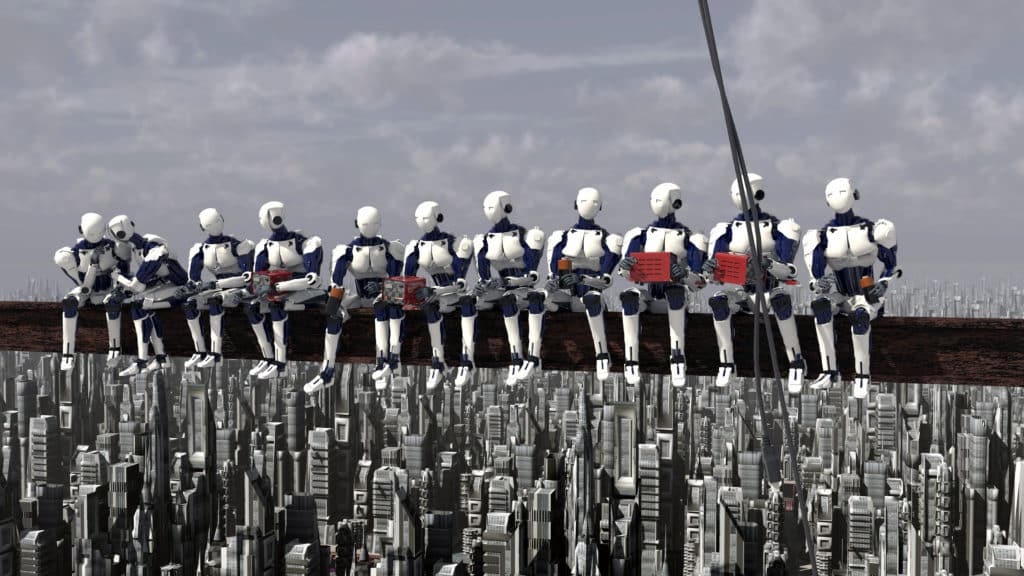
Thinking seriously about the jobs of the future means not getting carried away by hyperbolic figures, the hope of a great transformation or the fear of a “great replacement” by robots or AI. It also means that we should not overemphasise anecdotal changes, while neglecting more profound but less spectacular developments. And it means considering the weight of reality. “There is a lot of talk about artificial intelligence,” notes Adrien Book. That’s fine, we must be interested in it. But we are in 2022 and we are still talking about digitalisation and a digital transformation as we were already doing twenty years ago. The foundations have yet to be developed. The digital transformation of the world is both very fast and very slow.
What we can observe is the emergence of professions of the future. The example of data professions, an increasingly important area of activity, provides a good illustration of this: we are witnessing a gradual differentiation and the crystallisation of new professions.
Here are three areas of development, where new jobs are emerging.
First emerging field: making robots user-friendly
Automation of the world is well underway. It is proceeding along two parallel paths: software and hardware. In both cases, it raises the question of interactions with humans, and a whole range of professions are developing around these interactions.
Both applications and algorithms are designed for human users, and a clearly identified challenge is to optimise and facilitate the life of these users, both in terms of discovery or appropriation and in terms of regular use, which becomes a routine. User experience professions are developing around this demand, at the crossroads of communication, design, and ergonomics. Either it is a question of ensuring that the experience is as smooth as possible without relying on a third party (bot or human), and the issues at stake are good design (of a page, a system) or it is a question of organising this process so that it is fluid, easy and efficient. Finally, measuring the performance of these different segments is also an issue – and a range of professional specialities – in its own right.
As for robots, both in the industrial environment and in service robotics when they integrate mobility functions, human professions are emerging around robot education and ergonomics in its man-machine interface speciality.
The same educational needs are developing on the side of AIs, whose performance often depends less on the number of lines of code than on the number of hours spent processing data, a task that is not completely automatic.
Second emerging field: environmental transitions
Environmental transitions are developing in several directions, with the emergence of new professions.
Environmental concerns are increasingly integrated into agriculture, which after a century of heavy mechanisation and massive chemical use is now learning to carefully manage soil and inputs. Monitoring of soil biochemistry, hydrometry and heat (dronautics, sensors) calls for a whole range of emerging specialities, from operating drones to engineering, as well as aspects of the farming profession that can, in large farms, give rise to entire trades. The sale of inputs is increasingly integrated into service packages that include advice and training.
Management of natural areas, and in particular forests and waterways, now calls for new specialisations in monitoring, diagnosis, and intervention.
The energy transition, based on the management of CO2 and the switch to electrical power for some uses associated with hydrocarbons, is seeing the emergence of new jobs. First of all, there are all of those in consulting, from the development of applications for choosing solar panels to local support activities. Then there are those in installation and maintenance (of panels, heat pumps, storage solutions, methanisation systems, etc.). Finally, there are those of management: carbon accounting, fleet management, a field that also sees the emergence of a whole range of manual jobs.
A separate area is that of the smart city, which is seeing the emergence of professions in the field of design (of buildings and neighbourhoods), flow management (solid and liquid), and also air management. These management jobs are measurement jobs (pollution, biochemical balances), decision making jobs, which are appearing within the major service providers or public authorities.
Third emerging field: ethics, confidentiality, cybersecurity
The digitisation of the world and the switch to all-digital technology in several sectors raises new questions: data security and portability, confidentiality of exchanges, ethical quality of exchanges and data management.
Cybersecurity is already an industrial profession in its own right, with clusters of human professions involved in diagnosis, solutions, development and monitoring. But on the ethical side, some of these functions are only just emerging but will one day be professions, like compliance officers, who have become established in many companies.
Lastly, ethics is linked to environmental transitions: relations with animals, plants, certain watercourses and the environment in the broad sense are caught up in a simultaneous drive for regulation (with legal aspects and criminal risks) and preventive attention, which is leading to the emergence of new functions and jobs.
An expanding ecosystem of professions around data
In the mid-2010s, we saw the transition from “business intelligence” methods, based on pre-defined data series, to “Big Data”, which explores much more massive quantities of much less well-structured data.
A new profession has emerged henceforth: “data analyst”. What does this job involve? Visualising the extraction and processing of massive amounts of data, making queries on these databases, creating, or modifying algorithms.
What happens next is fascinating. Today, we are witnessing a multiplication of professions around this basic function. These jobs are primarily concerned with the management and development of databases and the systems used to process them. These jobs include database administrators, data engineers (who design or develop Big Data systems), data architects (who decide on the relevant technological building blocks to solve a specific problem and integrate them into the existing IT architecture), machine learning engineers, and data scientists (responsible for understanding the issues and proposing the best possible solutions to the company based on data analysis and processing). But also the data miner, in charge of exploring data, the chief data officer in charge of organising and supervising all these functions, and the whole cybersecurity galaxy on the function of data guardian.