


The question of the jobs of the future is often seen from a negative angle, that of the destruction of jobs by automation. This perspective is mistaken and ignores two fundamental developments. The first is that although the workforce is disappearing, and job descriptions are becoming obsolete, jobs are not disappearing. They are carried out differently, and human skills still play a role. The second is that the jobs of the future, those that are linked to emerging technologies such as data, draw on those of today.
Automation is not the enemy
It is true that some of the existing literature, such as McKinsey reports, emphasise the massive, imminent and inevitable nature of a transformation that will mean the disappearance of entire professions. Perspectives like this generate shock and do not help us to think about transition. 72% of European workers think that robots will steal their jobs! Admittedly, things are happening very quickly. But we can think about them and deconstruct our visions of the disappearance of work to reconstruct a reality that will be made up of transformations and transitions.
One novelty is that the automation of tasks now concerns service activities on a massive scale. Yet, if we consider industry, it is already an old story – as old, in fact, as the industrial revolution. Shouldn’t we learn from this? If we disregard France and the UK, which have undergone major deindustrialisation, and consider our European neighbours, we do not see any spectacular attrition in the number of industrial workers. The jobs are there. And the jobs, in the sense of industrial jobs, are there too. Need we remind ourselves that the most heavily automated countries in the world (Germany and Japan) are also those with the lowest unemployment rates?
This means that humans are in these industrial jobs, even if their individual jobs have disappeared from the nomenclature. It is necessary to identify the continuity that lies beneath the discontinuity: tasks are continually changing, and operators are following this movement. In the automobile industry, there are now few humans on an assembly line, but they are found elsewhere, and often very close to the line: in surveillance and quality control tasks, sometimes upstream, sometimes downstream.
Jobs are evolving
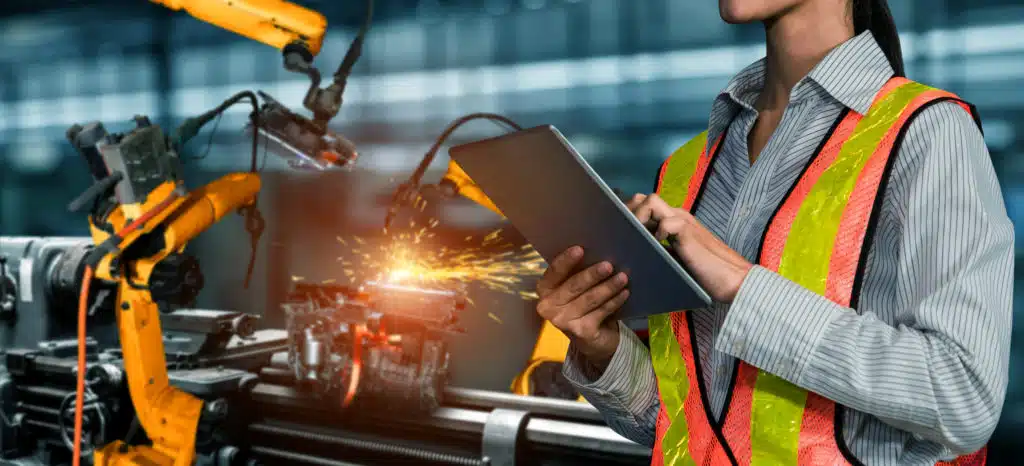
This continuity can even be understood by leaving aside the notion of an industrial trade, such as car manufacturer, and thinking in terms of a trade in its own right, such as turner-miller. The trade that the turner-millers practised is still there. Whist the operator is a machine, the skilled worker works with it, or supervises it, or supervises a number of machines, or a segment of the line. It is the position of the human being in this “job” that has changed. But the elements of the job, the intimate knowledge of the processes, tools, materials, working environment, the ability to understand a problem and to provide a rapid solution remain at the heart of their activity.
This evolution that we have seen in industry is now taking place, in fairly similar terms, in services. And we find the same permanence of ‘trades’ in activities that have been shaken up by automation and the arrival of artificial intelligence. Let’s take three examples.
We know that the paralegal professions and a good part of the accounting professions – for example, everything to do with expense reports – are already affected by this movement. But the human aspect has not disappeared, it has simply evolved towards an auditing role. In terms of employment, of course, this may have consequences: the performance of machines is such that the human workforce will probably shrink. The job description will also evolve, while remaining closely linked to the job into which the machine has been inserted. But the skill set required in the new job description remains close, both in terms of technical skills (identifying discrepancies, understanding VAT rates) and generic skills (accuracy, attention to detail).
A second example: new jobs are emerging around automated activities, such as data analyst or AI educator. The job titles may sometimes seem pompous, but the level of qualification is fairly average: around two years of higher education. These are therefore technically jobs that are accessible to former operators, to tradespeople. We are now beginning to understand that data analysis and AI education are done better when those who undertake them come from within the trade in question. There is indeed a transversal or generic part in these emerging jobs. But there is still vertical career progression. Professional experience and mastery of business elements remain an added value.
The third example is call centres. IBM has calculated that 45% of the requests handled in its call centres could be processed by a bot. But this still leaves room for humans: around a core activity which, in the case of IBM, carried out by software. Around which the complex and sensitive world of relationships with users can develop and offer humans spaces in which to deploy their skills. And that being far from lines of script and mind-numbing work which still make some call centres into service factories.
The results are already visible
In 2019, I published a book with Clara-Doïna Schmelk entitled Les Métiers du futur, published by First. I completed this prospective approach with a second book, entitled Emploi 4.0, published in 2021 by Editions Atlande. We based our work on a long-term forecast. Barely three years later, some of the changes we imagined in the medium term have already occurred. But these are not so much ruptures, social breakdowns and human tragedies, as they are transitions. The jobs of the future have appeared, and for the most part they are not radical innovations. What has happened is that professionals, with specific skill sets, have seen their jobs transformed, and have followed this transformation. Others, relying on their transversal skills but also on a “trade” qualification, have invested in the new activities offered to people in trades that have not disappeared, but where the machine now holds a central place. Anyone can change jobs, provided they are given the right support!
It is true that some generic jobs, such as those of middle management, are deeply disoriented – especially with the growth of remote work.
It is true that some generic jobs, such as those of middle management, are deeply disoriented – especially with the growth of remote work. However, the role of a manager, between organisation and supervision, is at the centre of the activities that are emerging and being offered to people around their former profession. Supervising robots and software, controlling their work, extending it, guiding it, taking the best part of it: this is already the core of the jobs of the future, and these jobs are already ours.
The jobs of the future are already here. For the most part, if we look at the core professions – caring for people, making bread, defending a defendant, erecting a building – these professions are here to stay. But we must distinguish between the job and the role that we, as human beings, play in it. And this role is bound to change, sometimes profoundly, sometimes at the margin. If you take care professions, for example, we could certainly imagine a redistribution of tasks to the robots: physical tasks such as lifting patients, psychological care, accompanying, listening and caring for humans. But it is likely that these care robots will not be deployed for some time in France, in the way they are already used in Japan. On the other hand, a part of the monitoring is already automated, which does not make the nursing profession disappear, nor the jobs of nurses, but contributes to transforming this activity. The evolution is more spectacular in other sectors: a good part of the accounting and paralegal professions are obviously being absorbed by automation, and in these professions people’s time is being spent on control and coordination. In terms of employment volume, each industrial revolution has always created more jobs than it has destroyed. Moreover, Eurostat estimates that AI and digital technology will create 15 million jobs in Europe, while the number of jobs which will be lost is 6 million. The balance is therefore largely positive!