




Around twenty individuals are training today in a rather unusual gym, on bicycles and stationary rowing machines. These people are special in that they are all living with a disability. Their legs and arms shouldn’t be able to move, but thanks to electrostimulation, their muscles can now respond again.
Vance Bergeron, director of research at the Physics Laboratory of the ENS in Lyon, himself tetraplegic following a cycling accident, is at the origin of the S.P.O.R.T (Stimulating People and Organizing Recreational Therapies) room, created in 2018 by the association ANTS (Advanced Neuro-rehabilitation Therapies & Sports).
“The idea of electrically stimulating muscles is not new,” explains Vance Bergeron. “In fact, it was a Frenchman, Dr Duchenne de Boulogne, who studied the physiology of movement using electrical experiments in a book published in 1867 that has remained a reference ever since! The development of exoskeletons came later, starting in the 1950s, but research in the field stagnated until the semiconductor and electronics boom of the 1990s.”
Efforts around the world
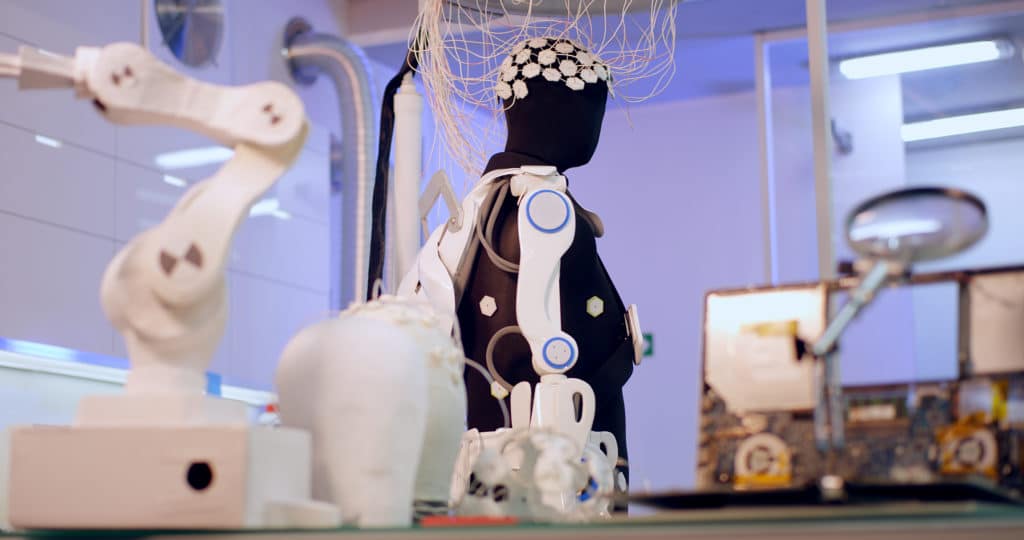
Japan is leading the way in this area, with exoskeletons seen as a good way to support an ageing population. The United States, on the other hand, is focusing on military applications. What remains is to combine the two technologies; exoskeleton and electrical stimulation. This is what the company Clinatec, founded in 2006 by Professor Alim-Louis Benabid, a neurosurgeon in Grenoble, is doing. By designing an implantable device that collects the brain signals emitted when a person intends to make a movement, the Clinatec researchers hope to give tetraplegics the possibility of mentally controlling an exoskeleton robot to walk and manipulate objects.
Grégoire Courtine, a neuroscientist at the Ecole Polytechnique Fédérale de Lausanne (EPFL), is also working towards this goal and has just tested the possibility of allowing tetraplegics to walk again using an abdomen-implanted cardiac neurostimulator and spinal-cord-implanted electrodes (see box). These devices are very invasive, however, and results still uncertain. Maintaining physical activity in the disabled brings immediate benefits though and is safe. “Stimulating injured limbs effectively combats the risk of secondary complications that can arise following an injury to the spinal cord,” explains Vance Bergeron, “whether it is caused by an accident or a stroke.”
Following his accident, Vance Bergeron reoriented his laboratory’s activity to develop an electrostimulation bicycle. It works as follows: the pedalling movement is recreated via non-invasive surface electrodes, simply placed on the legs of the paralysed person. An electric current stimulates the motor nerves to trigger muscle contractions in a sequence that allows them to pedal again. “We thus prevent various physical risks, such as bedsores, bone demineralisation and blood circulation disorders,” continues Vance Bergeron. “Electrostimulation also has a psychological impact: maintaining muscle volume gives the person a better body image and makes daily movements easier, especially transfers from the wheelchair, which require considerable physical effort.”
Benefits for well-being
Finally, being in a place such as a gym makes social reintegration easier, reduces isolation and therefore the risk of depression. Two bicycles and a rowing machine are now available in the S.P.O.R.T room, which is still the only one of its kind in France. There is problem with these electrostimulation devices, however, in that they cause significant muscle fatigue. “When a marathon runner trains, he uses different muscles from those used by a sprinter,” explains Vance Bergeron. “In the laboratory we are trying to see how we can target certain muscles, and not stimulate them all at the same time.”
The laboratory is also working on improving the equipment, with a Bluetooth system that would make it possible to get rid of the wires by integrating the electrodes into clothing. Finally, the aim is to offer financially competitive equipment. “The first bike designed for electrostimulation that I imported from the US and adapted it so that it could be used in France cost €30,000! Now I’m working with a German company1 on a model that is accessible to the public, at around €2,000.”
What equipment will be used by disabled people in the future? Exoskeletons certainly allow people to stand up, but even in their non-invasive version, they are very heavy, and their operating-time is limited by battery life. In comparison, electrostimulation is very simple: a few watts are enough to make the device work…
Making tetraplegics walk again?
In 2020, a team led by researcher Grégoire Courtine, a neuroscientist and professor at the École Polytechnique Fédérale de Lausanne, Jocelyne Bloch, a neurosurgeon at the Centre Hospitalier Universitaire Vaudois (Switzerland), and Guillaume Charvet; project leader at CEA-Leti Clinatec (Grenoble), used abdomen-implanted cardiac neurostimulators in three paralysed men and spinal-cord-implanted electrodes to target activation regions in the trunk and leg muscles. The patients were able to take their first steps almost immediately, even though walking on a laboratory treadmill is not exactly the same as normal walking.
In concrete terms, the technology requires at least six centimetres of healthy spinal cord under the lesion, where the electrodes are implanted. The patient has a walker with two buttons attached. He has to press the right button if he intends to lift his left leg; and the left button if he wants to lift his right leg.
These buttons are connected to a tablet, which contains the control software that transmits signals to the neurostimulator. The neurostimulator in turn relays these signals to the spinal implants, which then activate the specific neurons that control leg lifting.
After five months of rehabilitation, one of the patients, for example, was able to walk almost a kilometre without stopping. As soon as it is switched off, however, the electrical stimulation has no effect. It cannot be maintained permanently though because doing so would exhaust patients.
This technology will be the subject of extensive clinical trials, led by the Dutch start-up Onward.